[caption id="attachment_83949" align="aligncenter" width="500"]
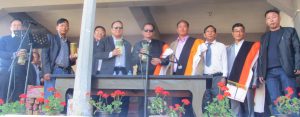 Kuzholuzo Nienu and Kevisa Kense seen here during the Fish festival at Porba village in Phek district on Tuesday.
 [/caption]
Phek, November 16: Villagers of Porba, a village under Phek district, on Tuesday celebrated their traditional Khiliinyie (fish festival). The director of the Fisheries department, Kevisa Kense, was the chief guest of the celebrations.
Speaking during the occasion, Kense announced that the department will be adopting Porba to boost large scale production of fish in the village. He said that the department would be supporting fishery pond project to.
The director called upon the villagers to take advantage of the offer and take up fishery as an income-generation activity.
Kevisa Kense also released a documentary, a booklet, on the Porba Khiliinyie.
Member of the Nagaland Legislative Assembly Kuzholuzo Nienu also attended the celebrations.
Khiliinyie is celebrated to mark the New Year right after cultivated crops had been harvested, according to a press release issued to the newspapers on Tuesday.
The festival is celebrated with invocation to God to bless the people with good and productive summer and judicious use of the harvested crops. The festival has seven days rituals that are observed during the feast.
The first day of the festival, which falls on the 21st day of the Lunar month taking seven days, is called Khikro. It is a preparation for the festival. The term Khikro means dropping of paddy grains into barns; the grains are collected by hand from leftover grains from the paddy fields as a ritual to be performed.
On this day, all the people go to the fields to catch the fish for themselves. They are not allowed to take the caught fish to the village. The fish are kept on the outskirts of the village near the village gates. These are then collected the next day.
The second day is called Khilii Liide. The name means the first observation by eating new paddy with fish collected in the morning.
The third day called Uva Kiitiih which means a ritual preparation for oneself to consume the yearly produce judiciously.
Meve, is an act of making reconciliation with wildfire. On this day, no one is allowed to smoke; it is to protect property from destruction.
Utheva is an act of reconciliation with the most furious wild tiger (Uthe) “which means our great grandfather which we generally believe them (tiger) to be our great grandfather, in the course of our history,” the press release stated.
The last day, the seventh day of the festival, is called Gwaphiih Chieswiih by the locals. Traditionally the festival is assumed to be a festival of new beginnings and the New Year too.


