


Naga People’s Front leader Achumbemo Kikon warns population-based delimitation could reduce Nagaland’s voice and disadvantage smaller states in Parliament.
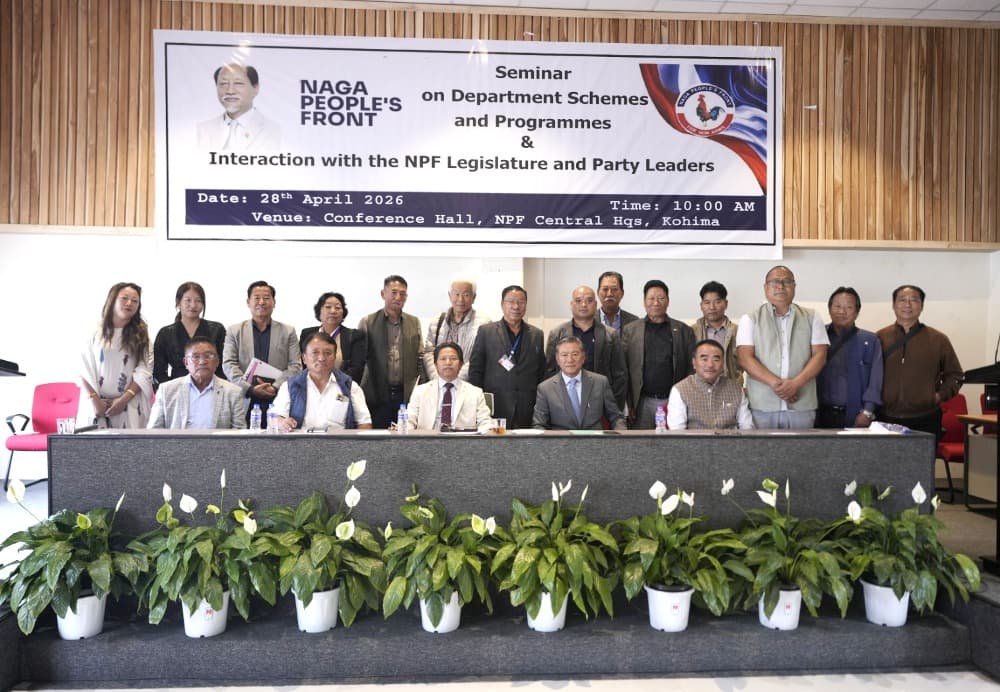
DIMAPUR — Naga People’s Front (NPF) Secretary General Achumbemo Kikon on Tuesday raised concerns over the proposed delimitation exercise based solely on population, warning that such an approach could disadvantage smaller states like Nagaland and reduce their voice in national decision-making.
Addressing a seminar at the party’s central headquarters in Kohima on Tuesday, Kikon said Nagaland has remained with only one Member of Parliament for nearly six decades and argued that a population-based redistribution fails to account for the state’s historical, political and tribal realities.
He maintained that Nagaland, being a special state formed under unique political circumstances, deserves enhanced parliamentary representation and called for a broader consensus by engaging tribal leaders to evolve a common stand on the issue. Kikon cautioned that an expanded Lok Sabha based purely on population could marginalise smaller states.
According to an update, the seminar, attended by party legislators and leaders, focused on governance issues including implementation of government schemes, agriculture reforms, digitisation of the Public Distribution System (PDS), land resource development, and the importance of accurate census and electoral processes.
In his keynote address, Kikon stressed the need for stronger coordination across all levels of the party, stating that grassroots outreach remains central to electoral success. He said recent tours had tested organisational strength and loyalty, and called for improved coordination at the central, divisional and constituency levels in view of upcoming elections.
“Any political party is to wrestle power, to command the people, to take over the government. But our party goes beyond that. We formed this party to protect the interests of our people, to look after the welfare of our people, and furthermore, to defend our land, our rights, including our family. That is the core philosophy of this party,” he said.
Highlighting fiscal constraints, Kikon noted that a significant portion of the state budget is consumed by salaries and fixed expenditures, leaving limited scope for development activities. He also reiterated the party’s support for women’s reservation and emphasised the need for unity and awareness among party members on key policy issues.
Earlier, MLA and Advisor for Agriculture Mhathung Yanthan said a comprehensive agriculture policy recently approved by the Cabinet and passed in the Assembly aims to transform Nagaland’s farming from subsistence to a market-oriented and climate-resilient system. Noting that nearly 70 per cent of the population depends on agriculture, he emphasised mechanisation, scientific farming and youth participation, and announced the introduction of seven new high-yielding, climate-resilient rice varieties.
MLA and Advisor for Food & Civil Supplies and Legal Metrology KT Sukhalu said the state has transitioned to a Smart Public Distribution System since May 2025, enabling full digitisation and real-time monitoring. He said Aadhaar-based authentication through ePOS devices has been made mandatory, manual distribution discontinued, and households earning above INR 2.5 lakh annually excluded from free ration categories.
MLA and Advisor for Land Resources G Ikuto Zhimomi outlined initiatives in watershed development, spring rejuvenation and plantation expansion, projecting economic potential in scaling up coffee cultivation to 50,000 hectares and rubber to 30,000 hectares. He stressed the need for non-politicised beneficiary selection and coordination with district authorities.
Minister for Rural Development and SIRD Metsubo Jamir called for full participation in the national census and accurate electoral roll verification, describing them as key responsibilities of party workers. He also emphasised the role of self-help groups in welfare delivery and flagged weak grassroots participation as a concern.
The seminar also included an interaction session on implementation challenges and strategies.