


Achumbemo Kikon identifies poor customer relations and high prices as key reasons for failure of Naga entrepreneurs
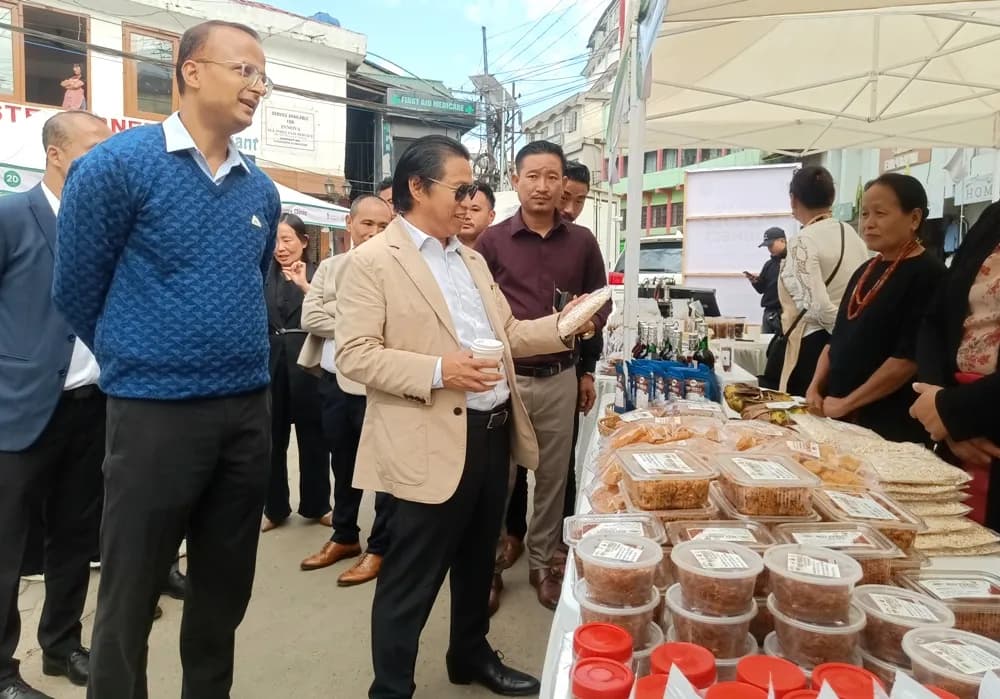
KOHIMA — Advisor for SCERT and Food Processing, Achumbemo Kikon, on Tuesday identified poor customer relations and excessively high prices as major reasons behind the failure of many Naga entrepreneurs, stressing that patience, reasonable pricing and a positive attitude are essential for business growth.
He was speaking at the fourth edition of Nagaland Food Connect, organised by the Department of Food Processing under the Pradhan Mantri Formalisation of Micro Food Processing Enterprises (PMFME) Scheme, on the theme “Promoting Foodpreneurs” at Old NST, Kohima.
Kikon said Nagas have the potential to become successful businesspeople but often expect to make substantial profits within a week of starting a business instead of building it gradually.
He urged local entrepreneurs to learn from non-local business owners who have sustained and expanded their businesses over the years through patience and consistency.
Questioning whether Nagas were unwilling or unable to learn, he said entrepreneurs must understand the basic principles of buying and selling to succeed in business.
Also read: Nagaland DGP flags buck-passing culture, calls for accountability in governance
The Advisor said that although he often encouraged people to purchase from Naga-owned shops, the feedback he received was that many shopkeepers had poor attitudes towards customers and charged unreasonably high prices.
He stressed that prices should be reasonable and standardised, adding that entrepreneurs must be patient and allow their businesses to grow step by step.
Emphasising the importance of customer relations, Kikon said shopkeepers should welcome customers warmly, regardless of whether they make a purchase.
He observed that a pleasant personality and good customer service could generate word-of-mouth publicity, helping businesses attract more customers without spending heavily on advertisements.
WATCH MORE:
He also advised shopkeepers to be willing to negotiate prices rather than maintain a rigid “fixed price” attitude. The mindset of not caring whether a customer buys anything, he said, was one of the reasons local businesses struggled to grow.
On the potential of food processing in Nagaland, Kikon stressed the need to maintain hygiene, quality and attractive packaging to draw customers and investors. He highlighted the importance of what he termed the “6 P’s and 1 B” approach — production, processing, preservation, packaging, pricing, patenting and branding.
He said farmers must be encouraged to increase production, while proper preservation methods should be adopted to ensure products remain suitable for marketing and consumption and are not wasted.
He also emphasised that packaging, along with the quality and quantity of production, must be given due attention by aspiring entrepreneurs.
Kikon pointed out that Nagaland often lacked adequate production volumes despite having products of good quality.
He urged the department to explore ways to preserve organic products without compromising their natural taste, enabling producers to effectively communicate their health and environmental benefits to consumers.
He further informed that the department was attempting to establish its own food testing laboratory meeting national standards, noting that products must undergo proper testing to qualify for export to international markets.
Encouraging educated youth to venture into entrepreneurship, Kikon said the government could not provide jobs to everyone.
He urged young people to acquire business knowledge, explore different forms of entrepreneurship and strive for independent livelihoods rather than depending solely on government employment.
Secretary of Industries and Commerce and Food Processing, Ramnikant Kumar, said Nagaland's products had considerable potential but continued to face several challenges, particularly post-harvest losses caused by gaps in market linkages.
He said the PMFME Scheme aimed to address these challenges through credit-linked subsidies, technology upgrade, training and incubation support at the district level.
He urged participants to use the platform to establish business-to-business linkages, gain insights into packaging and branding, and familiarise themselves with FSSAI requirements and market compliances.
Food technologist Mhasiphizo Khezhie said the programme was organised to provide food processing entrepreneurs with a platform to sell their products while promoting locally made goods and supporting local businesses.
He identified market linkages as a major challenge despite the growing number of food processing entrepreneurs in the state.
The two-day event features an exhibition-cum-sale of locally processed food products, a technology clinic, on-the-spot registration for interested scheme applicants and awareness dissemination on the PMFME Scheme.
A total of 20 stalls representing various Self-Help Groups (SHGs) have been set up for the event.