Students meet police in interface of accountability
[caption id="attachment_46652" align="aligncenter" width="400"]
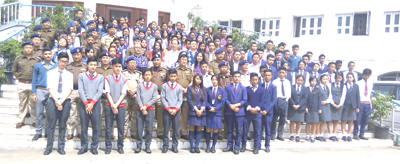
Police officers and students pose for a group photograph after the launch of Project-SLATE at the police headquarters in Kohima town on Monday.[/caption]
Our Correspondent
KOHIMA OCTOBER 5
With the ever increasing number of vehicles and no corresponding expansion of roads, and with the absence of civic sense among the general public, traffic management has become very important in today’s time. True traffic management is the responsibility of traffic police, however civic sense and everybody’s contribution towards traffic problem is also very important.
And aiming at educating the students on the basic traffic awareness and also the general laws, the PHQ Kohima today launched ‘Project–SLATE’ which stands for ‘Students Law and Traffic Education’ at its conference hall. The project is being initiated by the DGP Nagaland, LL Doungel, IPS.
LL Doungel, IPS, DGP as the chief guest in his address said traffic management in our state is in a grave state which need immediate attention, and for which he said, students are the best medium for conveying things which are relevant in our society.‘Unless you are aware of the basics of law, you cannot be a responsible citizen, and you’ll not be aware of your rights’ he advised the students, and said through this project it endeavors to bring some awareness and arouse the people’s mind with matters relating to traffic and the difficulties that it faces.
‘Here in Nagaland, it’s not so much about the width or size of the road per se’, he said and maintained that traffic congestion can be greatly eased and a lot of s can be brought about, if the public can make use of the road judiciously.
Reposing great hope on the students, he said by inculcating in them a little bit of the road sense and civic sense, and exposing them to difficulties faced both by the police and the public on road management, the students will be able to pass it on to their circle, so that there will be more awareness and the public will be more sensible in the use of the road.
He also said traffic management should not be left to the police alone, but the police and the masses can tie up and work as a team so that ‘with the growing awareness we will be able to create an atmosphere where we feel and realize these are shared common properties which should be utilizes according to everybody’s convenience and keeping in mind everybody else’s convenience’.
‘I hope you will be able to help us in your ways so that the police will be able to serve you better’ stated the DGP.
Addressing the students, Sr. SP, Kohima, Joseph Hesso said the students have been specifically targeted because they are the ‘Future’, and it aims to let them grow up to love and respect the law. Under this project basic knowledge on traffic signs, traffic signals and traffic laws including basic general laws like law of arrest and search, how and what to report to the Police, what to see and observe and most importantly cyber crime will be imparted to the high school and higher secondary students.
He also informed that at a later stage, college and university students will also be targeted for implementation, and the second phase will be ‘Safe-Street’ covering both the topics, but said it will be in a different form.
‘Traffic congestion cannot be wiped out altogether however, a little bit of awareness and judicious use of road will ease the traffic problems to a great extend’ he said and maintained that though there has been quantum increase on road, most users or drivers are self taught drivers.
Hesso also noted that though some driving schools have come up, there are no regulations, and trained authorized instructs are very few. Moreover, no driving tests are conducted for one to acquire a driving license. The result, he said is what we see today on our roads- haphazard parking and improper use of signal lights.
Also informing on its upcoming programme which is based on law, he said in this it plan to awareness by imparting a few basic duties of a responsible citizen, wherein he pointed out that age is not a factor to be a responsible citizen.
‘We, the police as custodians of the law are empowered to search and arrest if necessary, but we are also bound by the law with certain rules and restrictions’. He also shares his concerned on the use of mobile wherein most people frequently surf the net, and cautioned it must be purposefully used since one can be booked under the law if anyone is misusing it.
IGP (Range), Nagaland, Wapang Jamir, IPS said traffic enforcement can be seen as a metaphor for sharing common space, which brings about its own problems. Therefore, he maintained that it is a utilitarian and rational question of ‘how do we ensure the greatest good for all of us?’ This, he said can be done only by bringing some norms. “Any rules and regulations which are made by human beings, unless it is infused in spirit are ‘dead’”, and stressed that we all should look into our moral and ethical philosophy to draw inspiration.
While stating his concerned on the random use of mobile phones while driving, he said traffic enforcement stands on twin pillars of rationality and correct philosophy. Mobile phones, he said have reached the fourth generation, which is still grappling on issues on how to actually involve the right etiquettes to use mobile, so that we poses the least inconveniences and facilitate the greatest goods for all of us.
‘It is only through the process of socialization that this cultural lack between technology and behavior is breached, and it is in conducting such camps that we hope to further the process of socialization’ he added.
Explain the importance of traffic awareness and its management, he said traffic enforcement is a great exercise in character building, and to which he said ‘the earlier it begins, the better’. It teaches children to respect the law, and also inculcates a sense of empathy, putting oneself in others shoes and putting the welfare of others before one’s own. ‘And the realization that in the welfare and safety of others lie our own. Traffic awareness also teaches us to be very punctual and to be discipline’.
He also stated that this kind of public awareness translates to greater goods not only for the students who attended the programme, but for the family as a whole, adding that children are the best vehicles to transmit these values to the future generation.
He also expressed hope that this programme will resonate not only to the members present, but even outside the precinct of the police headquarters. He also thanked the DGP and Senior SP Kohima for having conceived this idea, which they have been nurturing for long.
Later the electronic display board was launched by the DGP. It may be mentioned that the public utility electronic display board, which the Kohima Police intend to use it as a medium of communication with the general public. Through this board, it would display important messages, tips and slogans such as traffic safety tips, common tips for women safety, cyber crime tips, road safety slogans, salient points of CrPc 1973, basic laws and rights, explosive hazards and precautions, general safety tips, Kohima Police helpline and traffic offences penalties. As per the requirement it will be loading messages and information, as a means of communication and educate the public.
It hopes it will benefit the public and serve its purpose to some extent.
The programme was attended by students from Baptist Higher Secondary School, Mezhur Higher Secondary School, G Rio Higher Secondary School, Vineyard School, Razhükhrie Govt Higher Secondary School and Little Flower Higher Secondary School participated in today’s programme.
An essay competition was also held for both the high school students and higher secondary students on the topic ‘Traffic awareness’ and ‘cyber crime’ respectively. The winners were awarded with cash and certificates.
Meanwhile SDPO and PRO DEF Kohima has also informed that any schools or colleges under Kohima district requiring the services of Kohima Police for imparting awareness on cyber laws, general laws and traffic laws in their schools and colleges many contact the SP through email spkma-ngl@nic.in or call at 9436012686 and fax at 0370-2240034.



 Police officers and students pose for a group photograph after the launch of Project-SLATE at the police headquarters in Kohima town on Monday.[/caption]
Our Correspondent
KOHIMA OCTOBER 5
With the ever increasing number of vehicles and no corresponding expansion of roads, and with the absence of civic sense among the general public, traffic management has become very important in today’s time. True traffic management is the responsibility of traffic police, however civic sense and everybody’s contribution towards traffic problem is also very important.
And aiming at educating the students on the basic traffic awareness and also the general laws, the PHQ Kohima today launched ‘Project–SLATE’ which stands for ‘Students Law and Traffic Education’ at its conference hall. The project is being initiated by the DGP Nagaland, LL Doungel, IPS.
LL Doungel, IPS, DGP as the chief guest in his address said traffic management in our state is in a grave state which need immediate attention, and for which he said, students are the best medium for conveying things which are relevant in our society.‘Unless you are aware of the basics of law, you cannot be a responsible citizen, and you’ll not be aware of your rights’ he advised the students, and said through this project it endeavors to bring some awareness and arouse the people’s mind with matters relating to traffic and the difficulties that it faces.
‘Here in Nagaland, it’s not so much about the width or size of the road per se’, he said and maintained that traffic congestion can be greatly eased and a lot of s can be brought about, if the public can make use of the road judiciously.
Reposing great hope on the students, he said by inculcating in them a little bit of the road sense and civic sense, and exposing them to difficulties faced both by the police and the public on road management, the students will be able to pass it on to their circle, so that there will be more awareness and the public will be more sensible in the use of the road.
He also said traffic management should not be left to the police alone, but the police and the masses can tie up and work as a team so that ‘with the growing awareness we will be able to create an atmosphere where we feel and realize these are shared common properties which should be utilizes according to everybody’s convenience and keeping in mind everybody else’s convenience’.
‘I hope you will be able to help us in your ways so that the police will be able to serve you better’ stated the DGP.
Addressing the students, Sr. SP, Kohima, Joseph Hesso said the students have been specifically targeted because they are the ‘Future’, and it aims to let them grow up to love and respect the law. Under this project basic knowledge on traffic signs, traffic signals and traffic laws including basic general laws like law of arrest and search, how and what to report to the Police, what to see and observe and most importantly cyber crime will be imparted to the high school and higher secondary students.
He also informed that at a later stage, college and university students will also be targeted for implementation, and the second phase will be ‘Safe-Street’ covering both the topics, but said it will be in a different form.
‘Traffic congestion cannot be wiped out altogether however, a little bit of awareness and judicious use of road will ease the traffic problems to a great extend’ he said and maintained that though there has been quantum increase on road, most users or drivers are self taught drivers.
Hesso also noted that though some driving schools have come up, there are no regulations, and trained authorized instructs are very few. Moreover, no driving tests are conducted for one to acquire a driving license. The result, he said is what we see today on our roads- haphazard parking and improper use of signal lights.
Also informing on its upcoming programme which is based on law, he said in this it plan to awareness by imparting a few basic duties of a responsible citizen, wherein he pointed out that age is not a factor to be a responsible citizen.
‘We, the police as custodians of the law are empowered to search and arrest if necessary, but we are also bound by the law with certain rules and restrictions’. He also shares his concerned on the use of mobile wherein most people frequently surf the net, and cautioned it must be purposefully used since one can be booked under the law if anyone is misusing it.
IGP (Range), Nagaland, Wapang Jamir, IPS said traffic enforcement can be seen as a metaphor for sharing common space, which brings about its own problems. Therefore, he maintained that it is a utilitarian and rational question of ‘how do we ensure the greatest good for all of us?’ This, he said can be done only by bringing some norms. “Any rules and regulations which are made by human beings, unless it is infused in spirit are ‘dead’”, and stressed that we all should look into our moral and ethical philosophy to draw inspiration.
While stating his concerned on the random use of mobile phones while driving, he said traffic enforcement stands on twin pillars of rationality and correct philosophy. Mobile phones, he said have reached the fourth generation, which is still grappling on issues on how to actually involve the right etiquettes to use mobile, so that we poses the least inconveniences and facilitate the greatest goods for all of us.
‘It is only through the process of socialization that this cultural lack between technology and behavior is breached, and it is in conducting such camps that we hope to further the process of socialization’ he added.
Explain the importance of traffic awareness and its management, he said traffic enforcement is a great exercise in character building, and to which he said ‘the earlier it begins, the better’. It teaches children to respect the law, and also inculcates a sense of empathy, putting oneself in others shoes and putting the welfare of others before one’s own. ‘And the realization that in the welfare and safety of others lie our own. Traffic awareness also teaches us to be very punctual and to be discipline’.
He also stated that this kind of public awareness translates to greater goods not only for the students who attended the programme, but for the family as a whole, adding that children are the best vehicles to transmit these values to the future generation.
He also expressed hope that this programme will resonate not only to the members present, but even outside the precinct of the police headquarters. He also thanked the DGP and Senior SP Kohima for having conceived this idea, which they have been nurturing for long.
Later the electronic display board was launched by the DGP. It may be mentioned that the public utility electronic display board, which the Kohima Police intend to use it as a medium of communication with the general public. Through this board, it would display important messages, tips and slogans such as traffic safety tips, common tips for women safety, cyber crime tips, road safety slogans, salient points of CrPc 1973, basic laws and rights, explosive hazards and precautions, general safety tips, Kohima Police helpline and traffic offences penalties. As per the requirement it will be loading messages and information, as a means of communication and educate the public.
It hopes it will benefit the public and serve its purpose to some extent.
The programme was attended by students from Baptist Higher Secondary School, Mezhur Higher Secondary School, G Rio Higher Secondary School, Vineyard School, Razhükhrie Govt Higher Secondary School and Little Flower Higher Secondary School participated in today’s programme.
An essay competition was also held for both the high school students and higher secondary students on the topic ‘Traffic awareness’ and ‘cyber crime’ respectively. The winners were awarded with cash and certificates.
Meanwhile SDPO and PRO DEF Kohima has also informed that any schools or colleges under Kohima district requiring the services of Kohima Police for imparting awareness on cyber laws, general laws and traffic laws in their schools and colleges many contact the SP through email spkma-ngl@nic.in or call at 9436012686 and fax at 0370-2240034.
Police officers and students pose for a group photograph after the launch of Project-SLATE at the police headquarters in Kohima town on Monday.[/caption]
Our Correspondent
KOHIMA OCTOBER 5
With the ever increasing number of vehicles and no corresponding expansion of roads, and with the absence of civic sense among the general public, traffic management has become very important in today’s time. True traffic management is the responsibility of traffic police, however civic sense and everybody’s contribution towards traffic problem is also very important.
And aiming at educating the students on the basic traffic awareness and also the general laws, the PHQ Kohima today launched ‘Project–SLATE’ which stands for ‘Students Law and Traffic Education’ at its conference hall. The project is being initiated by the DGP Nagaland, LL Doungel, IPS.
LL Doungel, IPS, DGP as the chief guest in his address said traffic management in our state is in a grave state which need immediate attention, and for which he said, students are the best medium for conveying things which are relevant in our society.‘Unless you are aware of the basics of law, you cannot be a responsible citizen, and you’ll not be aware of your rights’ he advised the students, and said through this project it endeavors to bring some awareness and arouse the people’s mind with matters relating to traffic and the difficulties that it faces.
‘Here in Nagaland, it’s not so much about the width or size of the road per se’, he said and maintained that traffic congestion can be greatly eased and a lot of s can be brought about, if the public can make use of the road judiciously.
Reposing great hope on the students, he said by inculcating in them a little bit of the road sense and civic sense, and exposing them to difficulties faced both by the police and the public on road management, the students will be able to pass it on to their circle, so that there will be more awareness and the public will be more sensible in the use of the road.
He also said traffic management should not be left to the police alone, but the police and the masses can tie up and work as a team so that ‘with the growing awareness we will be able to create an atmosphere where we feel and realize these are shared common properties which should be utilizes according to everybody’s convenience and keeping in mind everybody else’s convenience’.
‘I hope you will be able to help us in your ways so that the police will be able to serve you better’ stated the DGP.
Addressing the students, Sr. SP, Kohima, Joseph Hesso said the students have been specifically targeted because they are the ‘Future’, and it aims to let them grow up to love and respect the law. Under this project basic knowledge on traffic signs, traffic signals and traffic laws including basic general laws like law of arrest and search, how and what to report to the Police, what to see and observe and most importantly cyber crime will be imparted to the high school and higher secondary students.
He also informed that at a later stage, college and university students will also be targeted for implementation, and the second phase will be ‘Safe-Street’ covering both the topics, but said it will be in a different form.
‘Traffic congestion cannot be wiped out altogether however, a little bit of awareness and judicious use of road will ease the traffic problems to a great extend’ he said and maintained that though there has been quantum increase on road, most users or drivers are self taught drivers.
Hesso also noted that though some driving schools have come up, there are no regulations, and trained authorized instructs are very few. Moreover, no driving tests are conducted for one to acquire a driving license. The result, he said is what we see today on our roads- haphazard parking and improper use of signal lights.
Also informing on its upcoming programme which is based on law, he said in this it plan to awareness by imparting a few basic duties of a responsible citizen, wherein he pointed out that age is not a factor to be a responsible citizen.
‘We, the police as custodians of the law are empowered to search and arrest if necessary, but we are also bound by the law with certain rules and restrictions’. He also shares his concerned on the use of mobile wherein most people frequently surf the net, and cautioned it must be purposefully used since one can be booked under the law if anyone is misusing it.
IGP (Range), Nagaland, Wapang Jamir, IPS said traffic enforcement can be seen as a metaphor for sharing common space, which brings about its own problems. Therefore, he maintained that it is a utilitarian and rational question of ‘how do we ensure the greatest good for all of us?’ This, he said can be done only by bringing some norms. “Any rules and regulations which are made by human beings, unless it is infused in spirit are ‘dead’”, and stressed that we all should look into our moral and ethical philosophy to draw inspiration.
While stating his concerned on the random use of mobile phones while driving, he said traffic enforcement stands on twin pillars of rationality and correct philosophy. Mobile phones, he said have reached the fourth generation, which is still grappling on issues on how to actually involve the right etiquettes to use mobile, so that we poses the least inconveniences and facilitate the greatest goods for all of us.
‘It is only through the process of socialization that this cultural lack between technology and behavior is breached, and it is in conducting such camps that we hope to further the process of socialization’ he added.
Explain the importance of traffic awareness and its management, he said traffic enforcement is a great exercise in character building, and to which he said ‘the earlier it begins, the better’. It teaches children to respect the law, and also inculcates a sense of empathy, putting oneself in others shoes and putting the welfare of others before one’s own. ‘And the realization that in the welfare and safety of others lie our own. Traffic awareness also teaches us to be very punctual and to be discipline’.
He also stated that this kind of public awareness translates to greater goods not only for the students who attended the programme, but for the family as a whole, adding that children are the best vehicles to transmit these values to the future generation.
He also expressed hope that this programme will resonate not only to the members present, but even outside the precinct of the police headquarters. He also thanked the DGP and Senior SP Kohima for having conceived this idea, which they have been nurturing for long.
Later the electronic display board was launched by the DGP. It may be mentioned that the public utility electronic display board, which the Kohima Police intend to use it as a medium of communication with the general public. Through this board, it would display important messages, tips and slogans such as traffic safety tips, common tips for women safety, cyber crime tips, road safety slogans, salient points of CrPc 1973, basic laws and rights, explosive hazards and precautions, general safety tips, Kohima Police helpline and traffic offences penalties. As per the requirement it will be loading messages and information, as a means of communication and educate the public.
It hopes it will benefit the public and serve its purpose to some extent.
The programme was attended by students from Baptist Higher Secondary School, Mezhur Higher Secondary School, G Rio Higher Secondary School, Vineyard School, Razhükhrie Govt Higher Secondary School and Little Flower Higher Secondary School participated in today’s programme.
An essay competition was also held for both the high school students and higher secondary students on the topic ‘Traffic awareness’ and ‘cyber crime’ respectively. The winners were awarded with cash and certificates.
Meanwhile SDPO and PRO DEF Kohima has also informed that any schools or colleges under Kohima district requiring the services of Kohima Police for imparting awareness on cyber laws, general laws and traffic laws in their schools and colleges many contact the SP through email spkma-ngl@nic.in or call at 9436012686 and fax at 0370-2240034.