 Our Correspondent
Kohima, May 31 (EMN):
Our Correspondent
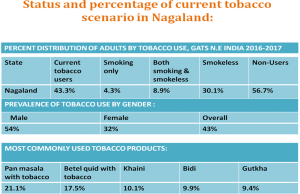
Kohima, May 31 (EMN): Nagaland’s status as the second-highest consumer of tobacco (56.8%) in the country has significantly improved and moved down to eighth position in the country and seventh in the Northeast, according to a study conducted by Global Adult Tobacco Survey during 2016-2017.
There is a significant decline in smoking – from 31.5% to 13.2% – and use of smokeless tobacco, from 45.3% to 39%. Showing some positive changes, the study shows that 34% adults who smoke cigarettes, 46% who smoke ‘bidi,’ which is unprocessed tobacco rolled in leaves and smoked, and 28% who uses smokeless tobacco have thought of quitting tobacco use because of the warning label on tobacco packages.
Statistically, while there has been significant decrease in overall tobacco use, the study indicated Nagaland has the highest consumers of 'pan masala' — spiced tobacco products — standing at 21%. Presenting the current status and percentage of tobacco-use scenario in the state, the study shows that 'pan masala' with tobacco has the highest form of use with 21.1% followed by betel quid or 'paan' with tobacco at 17.5%; ‘khaini’ (tobacco kneaded and chewed) at 10.1%; ‘bidi’ at 9.9% and 'gutkha,' which is a mixture of tobacco and betel nuts, with 9.4% of users.
The statistics were presented by Dr. Arenla Thong, the district nodal officer of the National Tobacco Control Programme (NTCP) at Kohima during the observation of World No Tobacco Day at the Naga Hospital in the capital town on Thursday. She said that the District Tobacco Control Cell (DTCC) has reached out to 211 schools, nine colleges and four teaching institutes conducting publicity programmes.
Besides conducting competitions on essay writing, painting and slogan writing in various schools, she said training programmes have been conducted for teachers, health workers, enforcement officers, shopkeepers, hotel managers, and GBs and heads of educational institutes.
It was informed that a tobacco cessation centre has been set up at the Naga Hospital where patients are given counselling, Nicotine Replacement Therapy and 'Smokerlyzers' to test the contents of carbon monoxide among smokers.
Dr. Thong said patients are referred by doctors from different OPDs in the hospital, while some patients voluntarily seek help from the counselling centre. In Kohima district 74 schools (21 government and 53 private schools), seven colleges, two teaching institutes and three villages namely Gariphema, Jotsoma and Khonoma have been declared tobacco-free. 24 dental clinics have also been declared tobacco-free.
Medical Specialist at Naga Hospital Dr. Vanlalruati Nyuthe said that 40% of smokers will die prematurely due to smoking unless they quit. She explained in detail the risk factors of cardiovascular diseases associated with tobacco.
Highlighting the benefits of quitting smoking, Dr Nyuthe said smoking cessation reduces the risk of a second coronary event after 6-12 months of cessation while rates of first Myocardial Infarction and death from coronary diseases declines within the first few years of cessation. After 15 years of abstinence, the risk of new Myocardial Infarction or death from coronary events in former smokers is similar to that for those who have never smoked.
In commemoration of the day, the Kohima administration issued a notification banning the sale of tobacco products in Kohima on Thursday.
Six enforcement teams from the north and south block went for checking enforced by guidelines laid down by the Cigarettes and Other Tobacco Products Act, 2003 or COTPA 2003. A walkathon was organised with District Legal Services Authority in the morning while an anti-tobacco slogan-writing competition was organised in three schools namely Little Flower Higher Secondary School, Holy Family Higher Secondary School, and Dainty Buds School.