


Community Piggery Project beneficiaries in Asetkong receive piggery management training across multiple clusters.
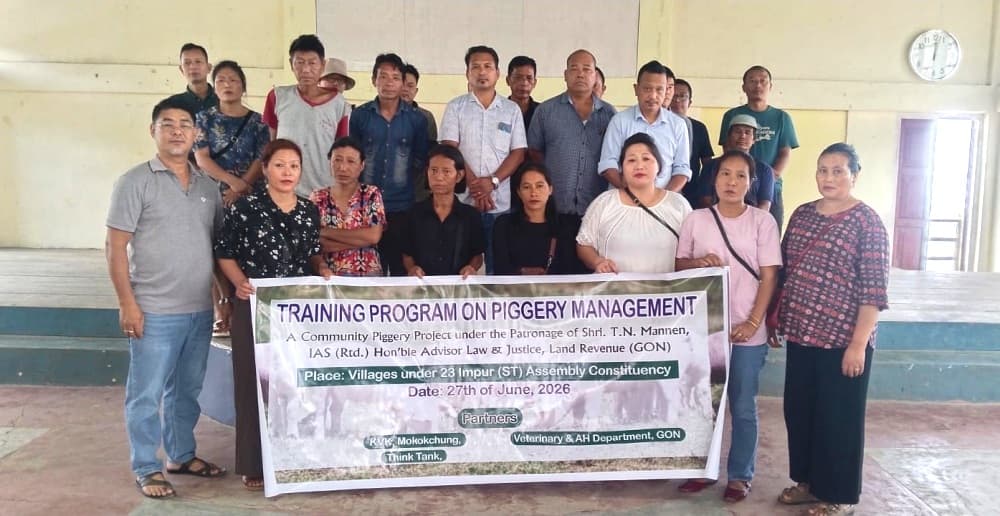
MOKOKCHUNG — A training programme on piggery management was conducted cluster-wise across the Asetkong range, Mokokchung, on Saturday as part of the Community Piggery Project initiated under the District Plan by Advisor for Law and Justice and Land Revenue, TN Manen.
Under this project, 169 high-quality piglets were distributed in April this year to more than 100 selected beneficiaries identified by village councils across the constituency. The training was organised as a follow-up initiative in partnership with Krishi Vigyan Kendra (KVK), Mokokchung, the Department of Animal Husbandry and Veterinary Services (AH&VS), and Think Tank Asetkong.
The training sessions were held at multiple venues to ensure wider participation. Beneficiaries from the Longjang, Khanimu, Longpa, and Chami clusters attended the programme at the Community Hall in Longjang. The Sungratsu, Yisemyong, and Yimchalu clusters attended the programme at Senden Salang in Sungratsu, while beneficiaries from the Mopungchuket and Molungkong clusters gathered at the Council Hall in Mopungchuket.
Resource persons Dr. Sarendi Walling, ACTO (Animal Science) from KVK Mokokchung, and Dr. Simon, Retired Joint Director of AH&VS, led the sessions.
Also read: Naga Students' Federation holds prelude to 150 years of education
Dr. Walling spoke on breeding management in gilts and sows, proper management of breeding boars, the risks associated with inbreeding, and the importance of systematic record-keeping. Dr. Simon focused on biosecurity measures under local conditions and effective feeding management practices.
The resource persons said the training aimed to equip beneficiaries with essential knowledge to tackle prevalent diseases in the district. They highlighted the importance of adopting biosecurity protocols suited to local conditions to safeguard livestock, minimise losses, and ensure a strong return on investment.
Participants were also sensitised to scientific breeding programmes for both male and female pigs, the need to maintain proper records, and the detrimental effects of inbreeding on swine productivity and overall herd health. Special attention was given to optimal feeding practices that promote faster growth, better performance, and enhanced profitability for piggery farms.