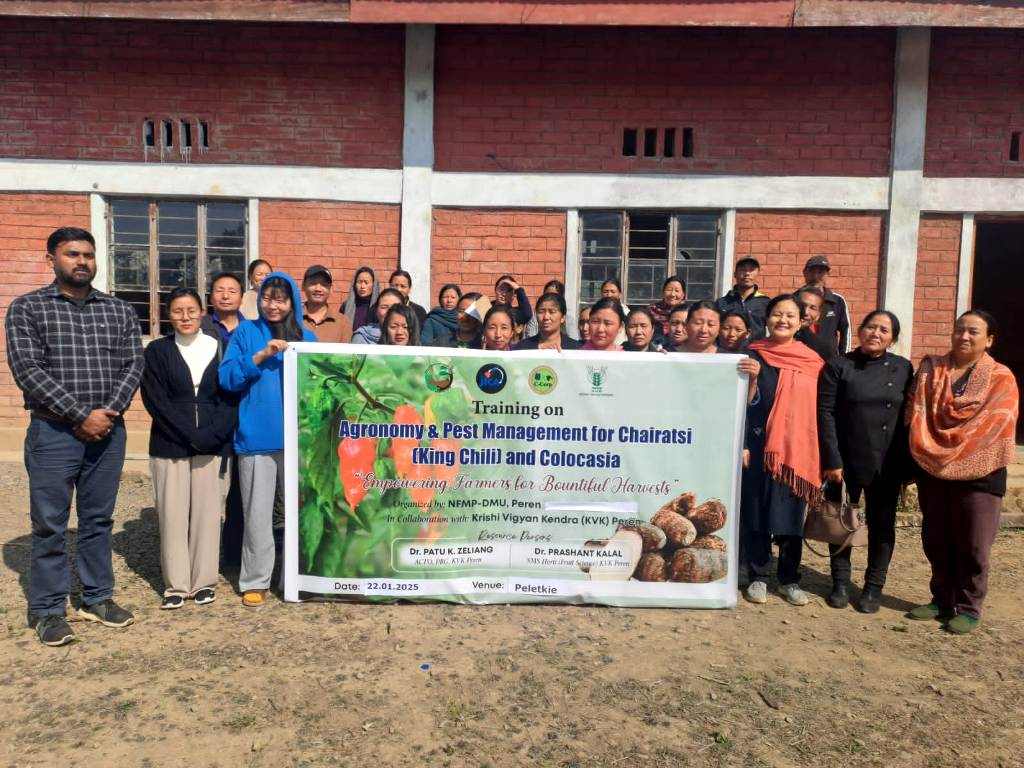
Resource persons and farmers following the skill training on
agronomy and pest management of King chili and colocasia at the Peletkie
village council hall on Wednesday.
DIMAPUR — A skill training on agronomy and
pest management of King chili and colocasia was conducted on Wednesday by
Nagaland Forest Management Project (NFMP)-Divisional Management Unit (DMU)
Peren in collaboration with Krishi Vigyan Kendra (KVK) Peren for farmers of
Peletkie village.
According to an update, the training was held at the village
council hall in Peletkie village. The resource persons were Dr. Pattu,
assistant chief technical officer (PBG), KVK Peren, and Dr. Prashant Kalal,
subject matter specialist (Horti, Fruit Science), KVK Peren.
Liangsi Niumai, director and team leader of C-CERP FNGO, in
her keynote address, emphasised the importance of rural agriculture and stated
that chemical pesticides should be used only when all other means have failed.
The release mentioned that King chili and colocasia are
age-old traditional crops in rural Peren District. However, given the impact of
climate change and the depletion of soil fertility, pests and disease
infestations are said to be on the rise, leading to a decline in the yield of
these two major crops.
The contents of the training included seed selection,
nursery seed bed preparation, planting in the main field, cultural practices
and plant care, harvest and post-harvest management of both crops, as well as
the common pests and diseases of King chili and colocasia, which were explained
in depth. The farmers were taught how to identify pest and disease infestations
and take preventive measures.
It was strongly advised that farmers opt for cultural and
biological methods of pest and disease control. The farmers were given samples
of yellow sticky traps and neem oil to control adult pests and disease vectors,
and were directed to use chemical pesticides only as a last resort to control
pests and diseases on crops.
The resource persons also taught the farmers to incorporate
climate-resilient practices into their native traditional skills, so that the
severity of pest and disease infestations could be reduced and their produce
increased.