


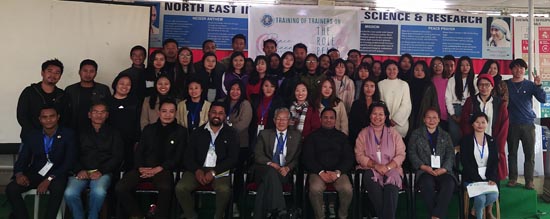
Dimapur, Feb. 2 (EMN): Local resource group Peace Channel has concluded its four-day training programme for trainers on the role of peace builders. The programme was conducted from January 22 to the 25th in Dimapur, updates stated.
The group issued a press release informing about the various activities that were conducted during the programme.
On January 24, Dr Ellen Konyak, an associate professor, spoke about mental health and wholeness. She said psychological wellbeing is a key to achieving peace in one’s life and spreading peace within the society. When a person is mentally healthy, one can have fulfilling relationships with individuals and with oneself.
Konyak trained the participants in how to detect signs of depression, stress and anxiety, how everyone can be a victim of depression at one point or the other, and how people should be able to seek help and not be ashamed of the stigma from the society. She added that it is a curable disease and that one should be aware of its consequences if not treated on time.
In the second session, Dr Akum Longchari, former editor of English newspaper The Morung Express, spoke about reconciliation.
Reconciliation is a small point in conflict transformation which plays the most important role, the gathering was told. He began with an exercise where he asked the participants to reflect on where the Peace Channel stands today and also after five years. The resource person urged the participants to identify their core values that will drive them to meet the organizational mission in making Nagaland a peaceful state in the country.
Further, he enlightened the participants about the concepts of reconciliation in peace-building which apply to different contexts such as individuals and society working to establish trust, and dialogue between groups and so on. One of the most frightening consequences of the conflict in Nagaland has been psychological trauma, an internalisation of fear that has occurred in our society, the updates stated.
Kallol Dey, a journalist and writer trained the participants on how to write efficient reports. He mentioned one should never be biased but to write with clarity when submitting press releases and reports.
One should keep in mind the importance of keeping the theme of the program while documenting reports, which would help in keeping reports short and efficient, the gathering was told.
Another resource person, Vitono Haralu, a project coordinator, emphasised on the various guiding principles of Peace Channel such as spirituality, acceptance, dialogue, respect, equality, empathy and non-violence as a way of culture and lifestyle for peace builders.
The resource person urged the participants to inculcate the habit of learning. As peace-builders, it is important for every individual to experience personal change stories to give hope and sustain positive change through spiritual awakening in changed behaviours and healing, the gathering was told.
Dr Fr C P Anto, director of Peace Channel, spoke about the fundamentals of peace building. He spoke about the difference between peace education and education for peace and how education builds character, increases strength of mind, expands intellect and equips a person to stand on his own feet, the updates reported,
‘The mission of Peace Channel as peace builders and initiators is an effort to educate and advocate for peace through psychological and sociological approach and methods to achieve vision 2030 for the people of Nagaland state and her neighbours to see us as an example model in days to come.’
Niketu Iralu, a peace activist from Nagaland who follows the philosophy of non-violence, addressed the trainers of Peace Channel and Master of Social Work students from the North East Institute of Social Sciences and Research (NEISSR) on the fourth day of the training event, on January 25, at the NEISSR’s conference hall.
Addressing the gathering, he said ‘we are expected to build a society as it is in heaven.’
“We are all expected to do things that are right and refuse to do the wrong. We undergo numerous challenges in life so we need to ponder upon, in order to know if we are making heaven or hell on earth. Relating to the teachings from the Bible he adds that every inch and second of life is being counted by God and countered by the devil.”
He quoted Richard Rohr: “Hurts not transformed are always transferred” which was the theme of the closing ceremony.
Reflecting on the quote, Iralu spoke about the philosophy and life testimony of well-known personalities such as CH Lewis, Mao Zedong, Mahatma Gandhi, Joseph Stalin, and Abraham Lincoln, who lived exemplary lives over decades and had a great impact on the lives of people.
“Among these personalities he gave away the reflection on the life of Saddam Hussein, narrating about the parameters of Hussein’s early childhood humiliation that led to him becoming as a person that later reflected in his leadership when he grew up,” the press release stated.
According to Iralu the autobiography of Mahatma Gandhi had a big impact and changed his philosophy of life.
The press release stated: “We need to learn from our hurts and humiliation or else it may create a hell for others life on earth. The unhappy individual has the power to influence on the other person and as peace builders we must listen to the still small voice that guides and navigates our thoughts and decisions in life. To bring peace in the world, we all have a role to play as a responsible human being. If we fail to do what we are supposed to do, we end up in chaos.”
Quoting Gandhi, the resource person stated, “Be the change that you want to see in the world.” He said that if one wants to be part of the change that the world and the state desperately needs, ‘take it upon yourself, have integrity and ponder on becoming a model for being a person with a morally responsible character.’
A total of 75 participants attended the event. Certificates were given away by the keynote speaker Niketu Iralu, and Dr. Fr. CP Anto, to 15 trainers of Peace Channel, the updates stated.