[caption id="attachment_259344" align="aligncenter" width="600"]
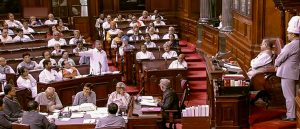 Union Law and Justice Minister Ravi Shankar Prasad speaks in the Rajya Sabha during the Budget Session of Parliament, in New Delhi on Monday. (PTI)
[/caption]
New Delhi, July 8 (PTI): Parliament on Monday passed an amendment bill which allows voluntary use of Aadhaar as proof of identity for users to open bank accounts and get mobile phone connections.
The Aadhaar and Other Laws (Amendment) Bill, 2019 was passed in Rajya Sabha by a voice vote, although many parties including the Trinamool Congress and DMK opposed it citing various reasons, including apprehensions data theft.
The amendment bill, which also provides for a stiff Rs one crore penalty and a jail term for private entities for violating provisions on Aadhaar data, was earlier passed by Lok Sabha on July 4. It was introduced on June 24 to replace an ordinance issued in March 2019.
The amendments provide for use of Aadhaar number for KYC authentication on voluntary basis under the Telegraph Act, 1885, and the Prevention of Money Laundering Act, 2002.
Put simply, this means it will allow voluntary use of Aadhaar number for authentication and identity proof in opening bank accounts and procuring mobile phone connections.
It also gives option to children to exit from the biometric ID programme on attaining 18 years of age, while stipulating stiff penalties for violation of norms set for the use of Aadhaar and violation of privacy.
Replying to a debate on the matter, Information Technology Minister Ravi Shankar Prasad said Aadhaar was a foolproof system and over 123 crore people were currently using it in the country.
Allaying fears of Opposition on data leakages, he said the Aadhaar system had enough safeguards to ensure privacy of the card holder.
Displaying his personal Aadhaar card in the House, the Minister said it only discloses his name, father's name, date of birth, residential address and does not give out any information on medical records or details of caste, religion and community.
Aadhaar data can only be shared when there is a threat to national security or there is court order, he added.
"For banks, it needs 256-bit inscription and for Aadhaar data it is 2,048 bit encryption, which is safe and secure and would not be breached," Prasad noted.
He added that the government has saved INR 1.41 lakh crore due to Aadhaar and removed 4.23 crore and 2.98 crore bogus LPG connection and ration cards respectively.
The government has cancelled licences of around 50,000 Aadhaar centre operators out of the total strength of six lakh for various violations, Prasad said.
Replying to Opposition charges that the bill was brought to circumvent an SC order on the Aadhaar issue, Prasad said Parliament has the full right to formulate a new law.
"This house and that house (Rajya Sabha and Lok Sabha) has powers to undo a judgement by removing the basis of the judgement," he added.
Opposing the bill, TKS Elangovan (DMK) alleged it has been "brought just to supersede the Supreme Court judgement. It is out of anger that the government has brought the bill."
V Vijaysai Reddy (YSRCP) pointed out various "loopholes" in the bill but said his party is supporting the bill "out of compulsion".
Singhvi said Aadhaar collected the most sensitive data and the government failed to come up with a legislation to protect the data and instead wanted to just amend the Aadhaar.
Singhvi said: "Aadhaar is not one country one identity, Aadhaar is not exlusive card, it is not a certificate of truth, it is not a tool of exclusion, it is not a data collection tool and not a tool of controlled surveillance or snooping."
"The government is avoiding data protection Act," he alleged and said even the European Union has taken up protection of their data seriously.
Despite the Srikrishna Committee recommendations, which match the provisions of the EU, the government has not taken them up, he said.
He said there are several rights under the Data Protection Act that include the person sharing the data must know where his data is being used. The person must also have right to data portability, right to object and right to erase, he said.
Singhvi said without these rights, Aadhaar is vulnerable.
Rajeev Chandrashekhar (BJP), who was one of the petitioners in the Supreme Court on data protection, said it was a larger issue and must not be seen through the narrow prism of Aadhaar.
Opposing the bill, Sukendu Sekhar Ray (AITC) expressed concern that it has been brought without scrutiny by any Parliamentary panel and said it "circumvents" the Supreme Court order of September 2018.
Jairam Ramesh (Cong) said his party filed a petition in the Supreme Court not to oppose the Aadhaar bill but for bringing it as a money bill in 2016. He alleged that while the apex court had struck down section 57 of the original Aadhaar bill, the government has tried to bring it in the form of Section 24-25, which circumvents the apex court's order.
Supporting the bill, Prasantha Nanda (BJD) said Aadhaar has helped lakhs of people get the benefit of welfare schemes like KALIA scheme in Odisha. He suggested that the government bring a robust data protection bill in near future.
A Bill to do away with mandatory representation for practising dentists not holding qualification in the Dentist Councils at different levels was passed by Rajya Sabha on Monday.
The Bill was passed by the Lok Sabha last week.
Union Minister for Health Harsh Vardhan introduced the Dentists (Amendment) Bill, 2019 that seeks to further amend the Dentists Act, 1948 in Rajya Sabha.
"This is a very simple legislation. It will certainly give proper proportion in Dental Council of India to qualified dental surgeons and they will be able to exercise their duties in a far better manner and it will be reflected in better quality of dental education through the control of the Dental Council of India in the country," the minister said.
The Dentists Act 1948 provided for representation of dentists registered under Part B, which include persons not holding such qualifications but are engaged in practice of dentistry as principal means of livelihood for a period not less than five years prior to the date appointed under section 32 of the Act, in the Councils.
However, no person was registered under Part B after 1972, said the Statement of Objects and Reasons of the Bill.
It said that there are approximately 950 dentists registered in Part B and 2.7 lakh dentists in Part A, (consisting of dentists possessing recognised dental qualifications.
The Bill, which was passed by a voice vote, got support from all sections of the House cutting across party lines.


