NEW DELHI — The Paris Agreement is in grave danger and the world must mark 2025
as the year of decisive climate action to reduce greenhouse gases and speed up
the transition to renewable energy, World Meteorological Organization (WMO)
Secretary-General Celeste Saulo said on Tuesday.
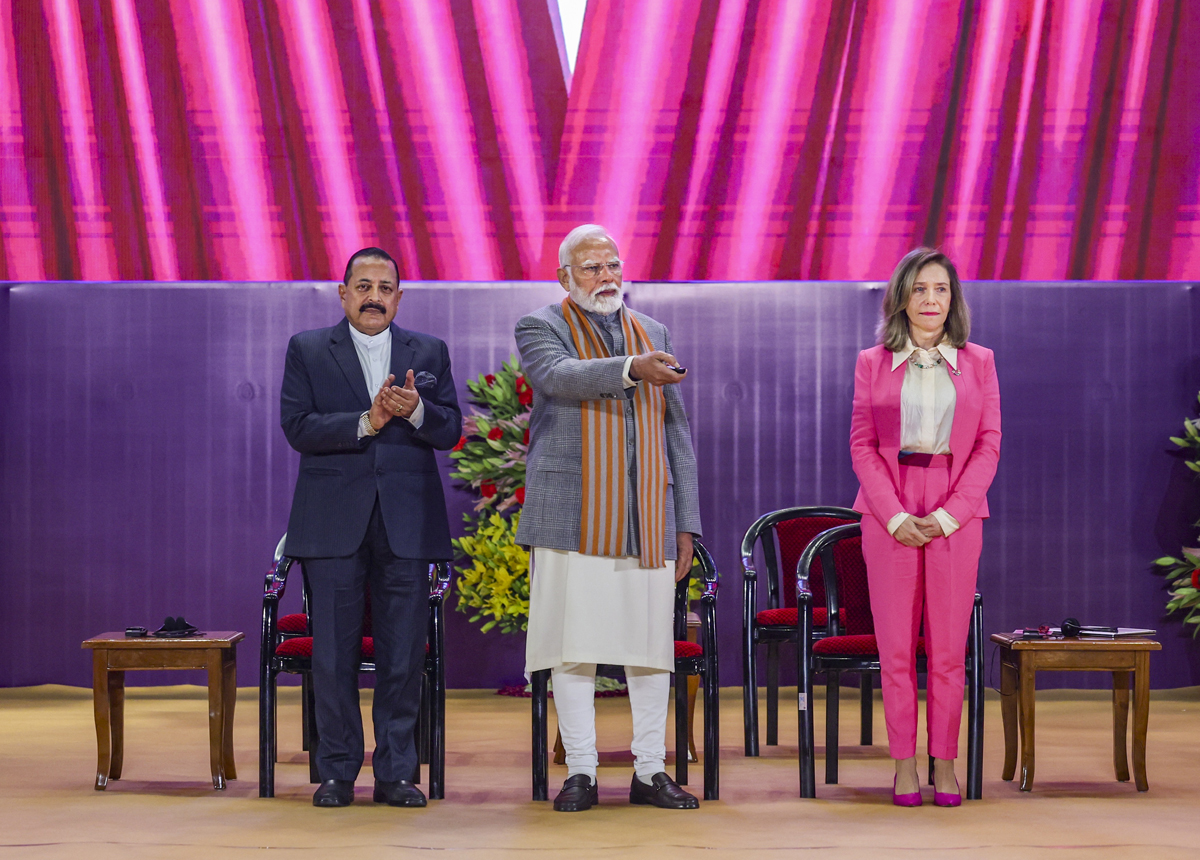
In this image released by PMO on Jan. 14, 2025, Prime
Minister Narendra Modi with Union MoS for Science and Technology (Independent
Charge) Jitendra Singh and World Meteorological Organization (WMO)
Secretary-General Celeste Saulo during the 150th foundation day celebrations of
India Meteorological Department (IMD), in New Delhi. (PMO via PTI Photo)
Saulo, who attended events to mark the India
Meteorological Department's (IMD) 150th anniversary here, said the celebration
comes at a crucial moment for the planet.
She pointed out that 2024 was the hottest year on record
in India and globally too.
In 2024, India suffered prolonged extreme heat, which
greatly impacted human health, agriculture, water supply and energy supplies,
she recalled.
"Heavy monsoon rains caused disruption and death, as
we saw with tragic landslides in Kerala in July. More recently, air pollution
hit alarming and dangerous levels in many parts of the country," Saulo
said.
The WMO chief said 2024 also became the first calendar
year with an average temperature of 1.5 degrees Celsius above the
pre-industrial average but this does not mean that the Paris Agreement is dead.
"But as we all know, it is in very grave danger....
We must mark 2025 as a year of decisive climate action to reduce greenhouse
gases and speed up the transition to renewable energy," she said at an
event attended by Prime Minister Narendra Modi and Union Minister of Earth
Sciences Jitendra Singh.
The global average surface temperature was 1.55 degrees Celsius
above the 1850-1900 average, according to the WMO's consolidated analysis of
the six datasets.
This means the planet has just experienced the first
calendar year with a global mean temperature of more than 1.5 degrees Celsius
above the 1850-1900 baseline, the period before human activities, such as
burning fossil fuels, began significantly impacting the climate, the UN weather
agency said last week.
However, a permanent breach of the 1.5-degree Celsius
limit specified in the Paris Agreement refers to long-term warming over a 20-
or 30-year period.
Saulo said national meteorological and hydrological
services have a vital role in providing tailored weather and climate services
to power the shift to renewables and support adaptation and mitigation strategies.
She emphasised that the climate crisis is closely
interlinked with the inequality crisis.
"In the long term, the cost of climate action will
be much less than the cost of climate inaction. We have a responsibility to
future generations and to the planet," the WMO secretary-general said.
She said the IMD stands as a testament to India's
pioneering spirit in meteorological science and has served as a cornerstone of
weather observation, forecasting and research across the Indian subcontinent
for 150 years.
"This legacy of dedication and innovation has
enhanced India's resilience and contributed greatly to the global good,"
Saulo said.
She mentioned that India, a founding member of the WMO
since 1950, has been an invaluable partner in its programmes.
An Indian representative has been on the WMO executive
board for more than 60 years, longer than any other country in the Asia-Pacific
region.