[caption id="attachment_278348" align="aligncenter" width="600"]
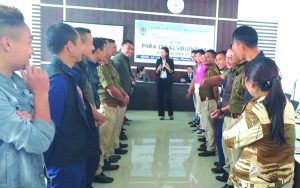 Participants and organisers at the Kohima District Legal Services Authority-organised training programme for paralegal volunteers in procedures and transparency practices.
[/caption]
Dimapur, Oct. 20 (EMN): The Kohima District Legal Services Authority (KDLSA) conducted an orientation and training programme for paralegal volunteers about utilisation of legal services clinics in Nagaland besides transparency practices and report maintenance.
A press release issued by the KDLSA on Sunday informed that the training involved a briefing about the extra measures that need to be taken in situations involving juveniles, besides guiding officers and police personnel in their work. The event was also aimed at teaching the paralegal volunteers to create awareness among the public, even during the course of accomplishing their duties, the updates stated.
The training programme consisted of topical discourses concerning the purpose and role of paralegal volunteers, do's and don'ts, and record keeping and reporting, the press release stated.
Rana, a retainer lawyer, said that the paralegal volunteers’ scheme aimed at imparting legal training to volunteers. They were ‘selected from different walks of life so as to ensure that legal aid is reached to all the section of people through the process of paralegal volunteers.’
Puchole Zaphu, project assistant at KDLSA, spoke about how to file First Information Reports (FIR) and affidavits besides applications to the departments etc.
‘It is a common understanding that ‘complaint’ and “FIR’ is same. However, in statutory interpretation, there is a difference between complaint and FIR. The term ‘complaint’ is defined in CrPC (Code of Criminal Procedure) as any allegation made orally or in writing to a magistrate that some person known or unknown has committed an offence with a view to taking action under this code,’ she clarified.
Zaphu added that a "report made to the magistrate U/S 2 of CrPC for commission of cognizable or non-cognizable offence is treated as ‘complaint.’
The update stated that the FIR can be made only of cognizable offence to the police. ‘FIR is a pre-requisite for the police to begin investigation of a cognizable offence. FIR is a paramount document in any criminal trial not only because it initiates criminal proceedings when an offence is committed but also because it is considered as a spontaneous information without any consultations or deliberations as regards what complaint should be filed, whom should be implicated or who should be the witnesses.’
Apila Sangtam, a panel lawyer, gave a presentation about various welfare schemes such as old age pension schemes, widow schemes, and disability schemes etc.
Further, Nagali Shohe, also a panel lawyer, spoke about alternative dispute redress (ADR) systems such as the Lok Adalat. She said that the "Indian Judiciary is one of the oldest judicial system."
"It has become insufficient to deal with pending cases as the courts are clogged with long unsettled cases. The scenario is that even after setting up more than a thousand fast track courts that already settled thousands of cases, the problem still lies far from being solved as pending cases are still piling up," she said.
Altogether 22 paralegal volunteers attended the training programme, the press release informed.


