


CNCCI clarifies pan masala is not banned in Nagaland and alleges syndicates are exploiting market confusion.
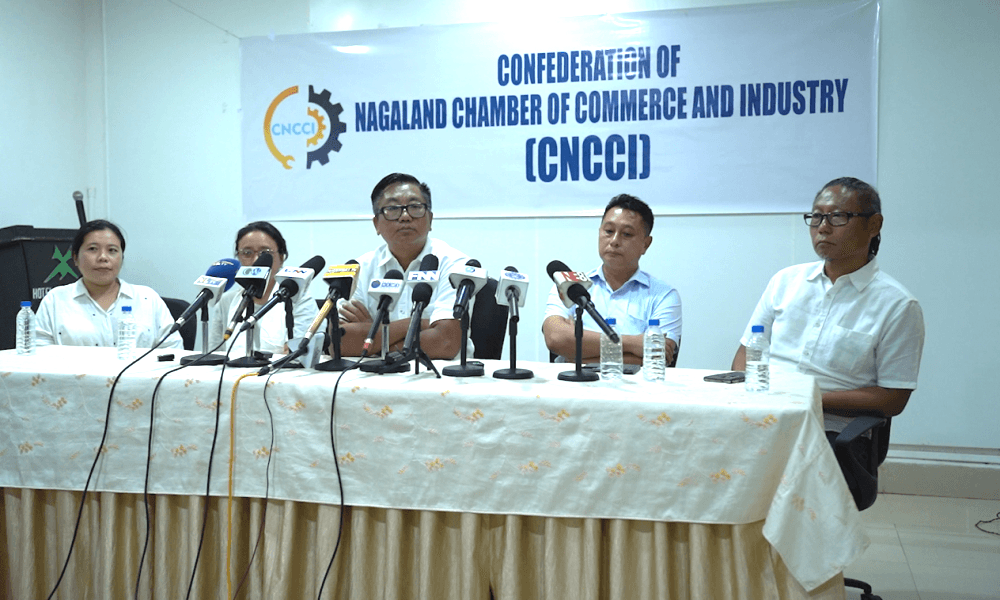
DIMAPUR — Amid widespread confusion over Nagaland's recent notification on tobacco-containing food products, the Confederation of Nagaland Chamber of Commerce and Industry (CNCCI) on Monday clarified that the order does not ban pan masala as a product category.
It also urged civil society groups not to take enforcement into their own hands, and alleged that syndicates and monopolies are exploiting the situation to create artificial shortages and inflate prices.
Addressing a press conference at Hotel Saramati, CNCCI chairman Dr. Khekugha Muru said that the organisation found it necessary to explain the government's notification after confusion over its interpretation led to raids, seizures and destruction of stocks by various groups across the state.
He informed that the CNCCI had met officials of the State Food Safety Authority and other senior government authorities, seeking an official clarification, which the department has assured will be issued within the next one or two days.
Also read: Nagaland Tobacco ban: Dimapur urban body joins call for policy overhaul
Explaining the legal position, Muru said that the Food Safety and Standards Act, administered by the Food Safety and Standards Authority of India (FSSAI), and the Cigarettes and Other Tobacco Products Act (COTPA) are separate legislations with different regulatory frameworks.
According to him, the confusion stemmed from the clause stating that "any food product containing nicotine and tobacco is banned", leading many to incorrectly assume that all pan masala products had been prohibited.
He clarified that pan masala is regulated under the Food Safety and Standards Act and licensed by the FSSAI.
Referring to Supreme Court directions issued following litigation involving the FSSAI in 2016, he said that manufacturers discontinued tobacco-containing gutka and shifted to producing tobacco-free and nicotine-free pan masala from 2016-17 onwards.
WATCH MORE:
He claimed that popular brands sold in Nagaland, including Siggnature, Rajnigandha and Shikhar, are manufactured without tobacco or nicotine and possess valid FSSAI licences.
"The present notification bans only food products containing tobacco or nicotine, not pan masala as a product category," he clarified.
Muru further explained that nicotine is classified as a medicinal substance while tobacco is regulated separately under COTPA. He said that tobacco products in their pure form remain legal for sale, provided vendors possess licences issued by urban local bodies in accordance with a state government notification issued in 2024.
He added that traders holding valid licences and complying with COTPA provisions, including restrictions on sales near educational institutions and to minors, are legally permitted to sell tobacco products.
"There is no blanket ban on tobacco products. Therefore, there is no question of seeking extensions or grace periods for traders," he said.
Appealing to civil society organisations, student bodies and NGOs, Muru urged them not to take the law into their own hands while appreciating their efforts to create public awareness.
"If anyone observes violations, they should report the matter to the competent authorities rather than confiscating or destroying goods themselves," he said.
He also expressed concern that multiple government departments were conducting parallel inspections due to confusion surrounding the notification, resulting in harassment of traders.
Also, Muru alleged that the trade in pan masala and tobacco products in Nagaland is controlled by syndicates and monopolies that have created artificial shortages and inflated prices.
"It is embarrassing that people in Nagaland have to stand in long queues, sometimes regulated by bouncers or even police personnel, simply to purchase pan masala. This situation is entirely unacceptable," he said.
He further alleged that only a handful of distributors control dealerships for major brands, preventing other local entrepreneurs from entering the business, and claimed that certain manufacturing companies were colluding with local distributors to maintain exclusive dealership arrangements.
CNCCI treasurer Kevin Yepthomi said that the confusion could have been avoided had the government issued clearer and more comprehensive guidelines. He added that fake government notifications circulated on social media platforms, including WhatsApp, had further fuelled panic among traders and consumers.
On reports that syndicates operate with the backing of underground groups, Muru said that syndicates and monopolies are illegal and that the CNCCI would pursue every available legal avenue to challenge such practices.