


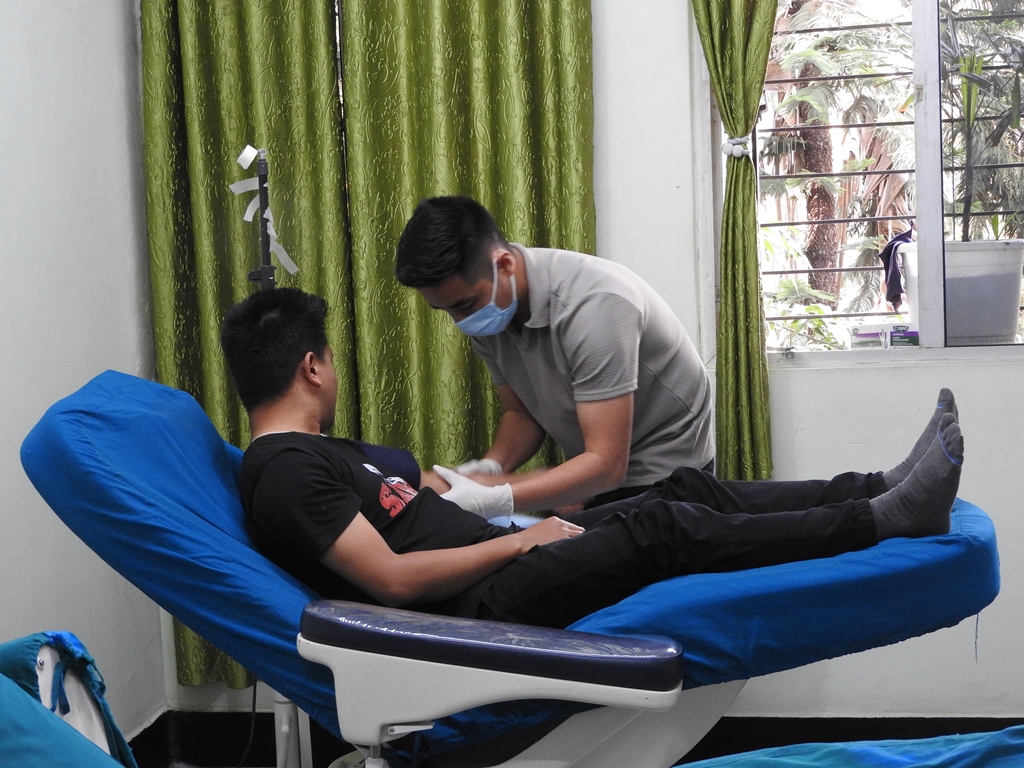
DIMAPUR — More than 100 individuals from various background came forward to donate blood during the blood camp organised by Young Blood Nagaland (YBN) on Friday at Christian Institute of Health Sciences and Research (CIHSR). The blood donation camp began at 10 am and concluded at 2 pm.
Speaking at the blood donation camp, Dr. Imlimenba Walling, mentioned that the event was organised with an aim to benefit individuals requiring blood in emergency situations. He explained that patients admitted to CIHRS, especially those from remote areas or other states, encountered challenges in finding suitable blood donors during emergencies.
He stated that the decision to organise the blood donation camp was driven by the need to ensure timely access to blood for patients particularly those admitted from distant areas. He added that the youth were able to donate and safe lives through their timely intervention.
While speaking to the technical supervisor of blood centre at CIHSR, Dr. KG Gaikhonlungpou informed that the hospital does not impose charges for the blood. He mentioned that the expiration date of blood depended on the type of anticoagulants used with a maximum storage period of up to 42 days for bagged RBC.
He specifically mentioned that red blood cells (RBC) could last between 35 to 42 days. He added that Plasma (FPP) has a storage life of one year, while platelets, after separation, are stored in a platelet incubator and last only for 5 days.
He clarified that a single blood bag unit could be divided into various components. He added that it was particularly valuable in cases where patients need platelets in case of dengue.
Dr. Walling further mentioned that fresh frozen plasma is typically administered for bleeding disorders. He shared that there are four different types of blood collection bags which included single bag, double, triple bag and quadruple blood bag.
While explaining the process of separating blood into distinct components, Gaikhonlungpou said that a centrifuge machine is employed for the separation of blood components including red blood cells, platelets and plasma.
According to him, the blood bag is placed inside the centrifuge and set in motion, causing the heavier red cells to settle at the bottom, while the lighter platelets and plasma move upward.
“Following the separation of plasma, the remaining blood bag components including RBC, WBC and platelets are hung for approximately one hour in a process known as platelet yield. Subsequently, the blood bag undergoes another round of centrifugation in a low spin. It is then transferred to an automated component separator machine for the extraction of platelets,” said Gaikhonlungpou.
He stated that in India there are mandatory 5 transfusions transmissible infections test that has to be done before the blood transfusion which includes human immunodeficiency virus (HIV) test, hepatitis B virus (HBV) test, hepatitis C virus (HCV) test, syphilis test, and malaria parasites test.