Our dealings with Pakistan will be strictly bilateral; any d
Our dealings with Pakistan will be strictly bilateral; any dialogue limited to terrorism: EAM S Jaishankar
External Affairs Minister S Jaishankar on Thursday said India's relations and dealings with Pakistan will be "strictly bilateral" and New Delhi is "prepared to discuss" with Islamabad
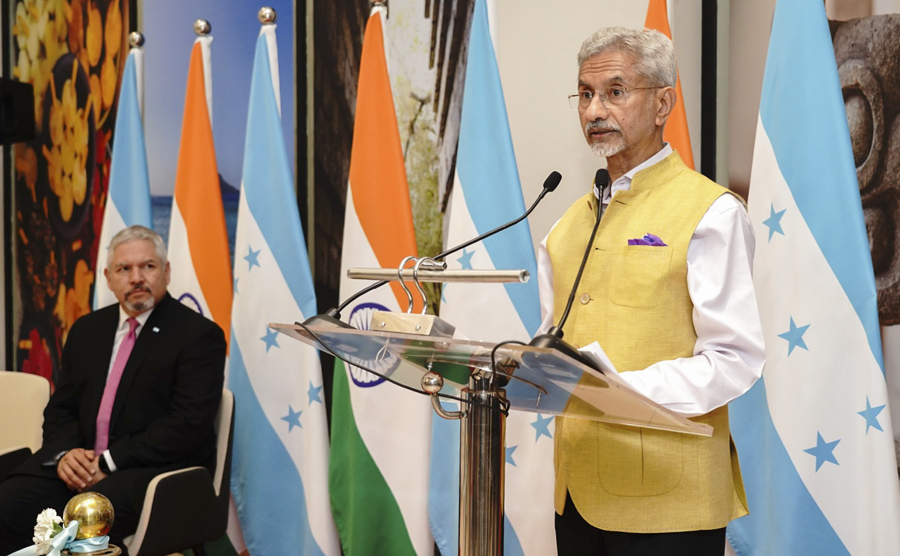
External Affairs Minister S. Jaishankar addresses the
media at the inauguration of the Honduras Embassy in New Delhi, Thursday, May 15,
2025. (PTI Photo)
NEW DELHI — India's relations and dealings with Pakistan will be "strictly
bilateral", which is a national consensus for many years and there is
"absolutely no change" in that consensus, External Affairs Minister S
Jaishankar said on Thursday.
Interacting with reporters on the sidelines of an event
here, he also said that the Indus Waters Treaty will continue to be held in
abeyance until Pakistan "credibly and irrevocably" stops its support
for cross-border terrorism.
Jaishankar said the UN Security Council had underlined
the need to hold the perpetrators of the Pahalgam attack accountable, and on
May 7 morning, "we held them accountable through the Operation
Sindoor".
India carried out precision strikes on terror
infrastructure early on May 7 following which Pakistan attempted to attack
Indian military bases on May 8, 9 and 10. The Pakistani actions were strongly
responded to by the Indian side.
The hostilities ended with an understanding on stopping
the military actions following talks between the Directors General of Military
Operations (DGMOs) of both sides on May 10.
"To me things are fairly clear. So, let me take this
opportunity to spell out our position. One, where Pakistan is concerned, our
relations, our dealings with them will be bilateral, and strictly bilateral.
"That is a national consensus for many years, and
there is absolutely no change in that consensus that dealings with Pakistan
will be bilateral," Jaishankar said.
He said Prime Minister Narendra Modi has made it
"very clear" that any talks with Pakistan will be only on terrorism.
"...Pakistan has a list of terrorists, who need to
be handed over. They have to shut down terrorist infrastructure, they know what
to do," the external affairs minister said.
Jaishankar said New Delhi is "prepared to
discuss" with Islamabad what is to be done on terrorism, adding those are
the talks that are "feasible".
The external affairs minister was talking to reporters
after the opening of an embassy of Honduras here. He was also asked about the
Indus Waters Treaty, and the understanding reached on May 10 on stopping the
military actions.
"Water issues have been raised. I re-emphasise, the
Cabinet Committee on Security was very clear that the Indus Waters Treaty is
held in abeyance and will continue to be held in abeyance" until Pakistan
"credibly and irrevocably" stops its support for cross-border terrorism,
he said.
"So, sometimes, the Kashmir issue has been brought
up. Again, the only thing that remains to be discussed on Kashmir, is vacation
of illegally occupied Indian territory in Pakistan-Occupied Kashmir, we are
open to discuss it with Pakistan. I want to spell out our position very
clearly...the government's position is very, very clear," he said.
The Indus Waters Treaty (IWT), brokered by the World
Bank, has governed the distribution and use of the water of the Indus river and
its tributaries between India and Pakistan since 1960.
A day after the April 22 Pahalgam attack, India announced
a raft of punitive measures against Pakistan including suspension of the IWT.
External Affairs Ministry spokesperson Randhir Jaiswal on
Tuesday said that India will keep the IWT in abeyance until until Pakistan
abjures its support for cross-border terrorism.
Sources indicated that Pakistan has signalled its
willingness to discuss New Delhi's long-standing concerns about the treaty.
Jaishankar also responded to a query on understanding
reached between India and Pakistan on May 10 on stopping the military actions.
Shortly before Foreign Secretary Vikram Misri had made
the announcement on May 10 that the DGMOs of India and Pakistan have agreed to
stop all firings and military action on land, air and sea with effect from 5 pm
on that day, US President Donald Trump said India and Pakistan have agreed to a
"full and immediate" ceasefire, and claimed that it was a result of
the US-mediated talks.
Jaishankar on Thursday told reporters, "What you
call ceasefire, we call cessation of firing and military action. We achieved
the goals which we set out to do by destroying the terrorist infrastructure in
Bahawalpur and Muridke, Muzaffarabad and other places."
"After that...since the key goals were achieved, I
think we reasonably took the position, because even at the start of the
operation, we had sent a message to Pakistan, saying we are striking at
terrorist infrastructure, we are not striking at the military, so the military
has an option of standing out and not interfering in this process. They chose
not to take that good advice," he said.
Once they got "hit as badly as they did" on the
morning of May 10, and all of you have seen today the satellite pictures which
actually bring out the "very graphically how much damage we did", the
external affairs minister said, adding, "by the way, the satellite
pictures also bring out how little damage they did".
"So, these pictures will tell you what a hit they
took, and the same people who were not wiling to stand down on May 7, were
willing to talk and stand down on May 10. It is very clear who wanted the
cessation of firing," he said.
On the opening of the new embassy, Jaishankar said for
India, it is very good that there is a new embassy here of a county in the
CELAC (Community of Latin American and Caribbean States) group.
"Honduras is a country where business is growing,
they are politically supportive of us. They were one of the countries which
expressed strong solidarity when it came to the Pahalgam attack, so I
appreciated it very much," he said.