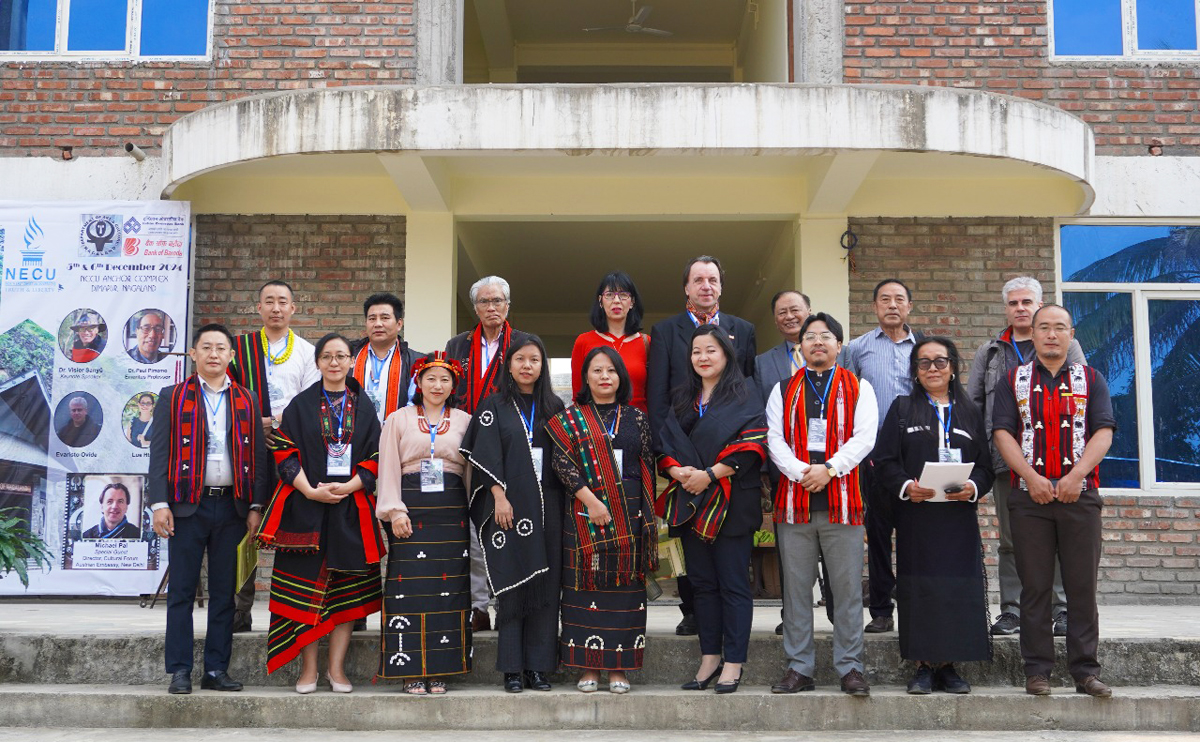
DIMAPUR — The intersection of tradition and
modernity in Naga culture took centre stage at the 6th International Naga
Culture Symposium held at North East Christian University, Dimapur, on
Thursday.
Delivering the keynote address, historian Dr. Visier Sanyü
reflected on the impact of colonialism, the evolving nature of culture, and the
importance of preserving Naga identity amidst rapid changes.
Dr. Sanyü underscored the significance of oral tradition as
the cornerstone of Naga identity and continuity. Quoting Belgian historian and
anthropologist Jan Vansina, whom he described as the ‘father of oral history,’
he said: “Whether the memory changes or not, culture is reproduced by
remembrance, put into words and deeds. The mindful memories carry culture from
generation to generation.”
Stating that oral tradition should be central to the
students of ideology, society, psychology, art, and finally history, he
emphasised the importance of passing down knowledge through stories, actions,
and practices, which form the cultural backbone of the Naga people.
The colonial impact
Dr. Sanyü reflected on the cultural disruption brought by
colonialism and missionary activities and outlined how the British reshaped
Naga society through narratives that dehumanised the people and justified their
conquest.
“In order to justify conquering a land, you must create a
story. The British created a story and said Nagas are pretty primitive and they
are savage, and therefore the justification was to civilise them and take the
land,” he said. However, he argued their true interest lay in exploiting
resources like tea and oil.
Similarly, missionaries imposed their cultural beliefs,
suppressing festivals and traditional songs for nearly a century. He stated
that this loss of language and culture creates “a spiritual disarticulation”
which leads to social issues, citing widespread alcohol and drug abuse among
Naga communities as a potential consequence. He compared this phenomenon to the
struggles faced by indigenous communities worldwide, such as the First Nations
in America, the Maoris, and the Aboriginals in Australia.
Culture as a living practice
Turning to modern interpretations of Naga culture, Dr. Sanyü
discussed the Hornbill Festival’s role in promoting tourism and creating
economic opportunities. While he acknowledged its importance, he cautioned
against mistaking it for a comprehensive representation of Naga heritage.
“That is not our culture. That is point 0.001% of our
culture. Our culture is much deeper. It has spirituality in it,” he maintained.
The Hornbill Festival is a valuable revenue generator, but
it often prioritises spectacle over substance. “Sometimes, the less you wear,
the more foreigners like it. That’s one way of making money,” he quipped.
Despite this, he expressed optimism about the festival’s
potential to reclaim narratives and showcase elements of Naga culture to a
global audience.
He also cautioned against reducing culture to occasional
displays of traditional attire or performances, emphasising that culture is a
living, evolving practice rooted in daily life and community.
Sharing an example, he recounted an annual “Cultural Sunday”
in a local church where people wore traditional shawls and mekhalas. “What they
did not realise is that culture is a living thing. Culture comes from
agriculture, which means to cultivate, to grow. It’s not something you do once
a year,” Dr. Sanyü explained.
He pointed out that even regular practices, such as
attending church and praying loudly every Sunday, have now become part of the
evolving Naga culture.
Naga social values
Further, Dr. Sanyü highlighted two aspects of Naga society
that he believes are unique and should be preserved.
He described how Nagas rely on their clans and families for
support, ensuring no one becomes homeless or destitute. Sharing examples from
his personal relationships, he recounted how a family facing an INR 11-lakh
hospital bill received full financial support from relatives, with additional
contributions to support the widow and her children.
Stating that this does not exist in America, Japan, or
China, he urged the Naga people to preserve this culture of social security.
He also introduced the Greek word “philoxenia,” meaning love
for strangers and hospitality, which he equated to the generosity of Naga
people. He noted how foreigners visiting Naga villages are often welcomed with
food, shelter, and gifts, such as traditional shawls.
Juxtaposing this with the growing xenophobia in the world,
he urged Nagas to embrace their heritage while remaining open to others.
“Let us not become xenophobic, but let us be philoxenic and
show our hospitality to our friends who have come from abroad and elsewhere,”
he added.
Tourism and cultural exchange opportunities
Reflecting on his visit to the Hornbill Festival and the
region, Michael Pal, Director of the Cultural Forum at the Austrian Embassy in
New Delhi, noted the vibrant cultural displays but stressed the need for deeper
engagement with Naga heritage.
“To go deeper into the matter, I think you should visit the
museum,” he said, suggesting the introduction of a shuttle service between the
festival venue and the state museum of Naga culture. He proposed that tourism
boards or corporate sponsors could help bridge this gap, enhancing visitors’
understanding of Naga traditions.
Drawing from Austria’s experience, Pal shared how tourism
had been pivotal in rebuilding the nation’s economy after World War II.
“Tourism brings fresh money to the society and the community…This is how we
recovered in Austria after the Second World War,” he said, adding that
Austria’s GDP is now 80% reliant on tourism.
Pal encouraged Nagaland to leverage its rich cultural
heritage through homestays, collaborations with international travel agencies,
and targeted efforts to attract more global tourists.
Highlighting Austria’s open educational policies, he invited
collaboration between Austrian and Naga institutions, including opportunities
for Nagaland students to study in Austria without needing to know German. He
also proposed introducing ÖSD (Österreichisches Sprachdiplom), a German
language certification programme, to support such exchanges.
Pal emphasised the importance of partnerships between
European cultural institutions and universities like NECU. As president of
European Union National Institutes of Culture (EUNIC) in Delhi, he expressed
willingness to foster cultural and academic exchanges.
“We could together develop something to bring culture here
but also learn more about you,” he said, inviting NECU to play a pivotal role
in future collaborations.
The two-day symposium, which includes paper presentations
from several academics, students, and cultural practitioners, will conclude on
December 6.