NEW DELHI — A robust exchange of contesting views on Wednesday marked the first
meeting of a parliamentary panel scrutinising two bills on conducting
simultaneous polls, with opposition members criticising the concept as an
attack on the basic fabric of the Constitution and federalism, and BJP MPs
hailing it as reflective of popular opinion.
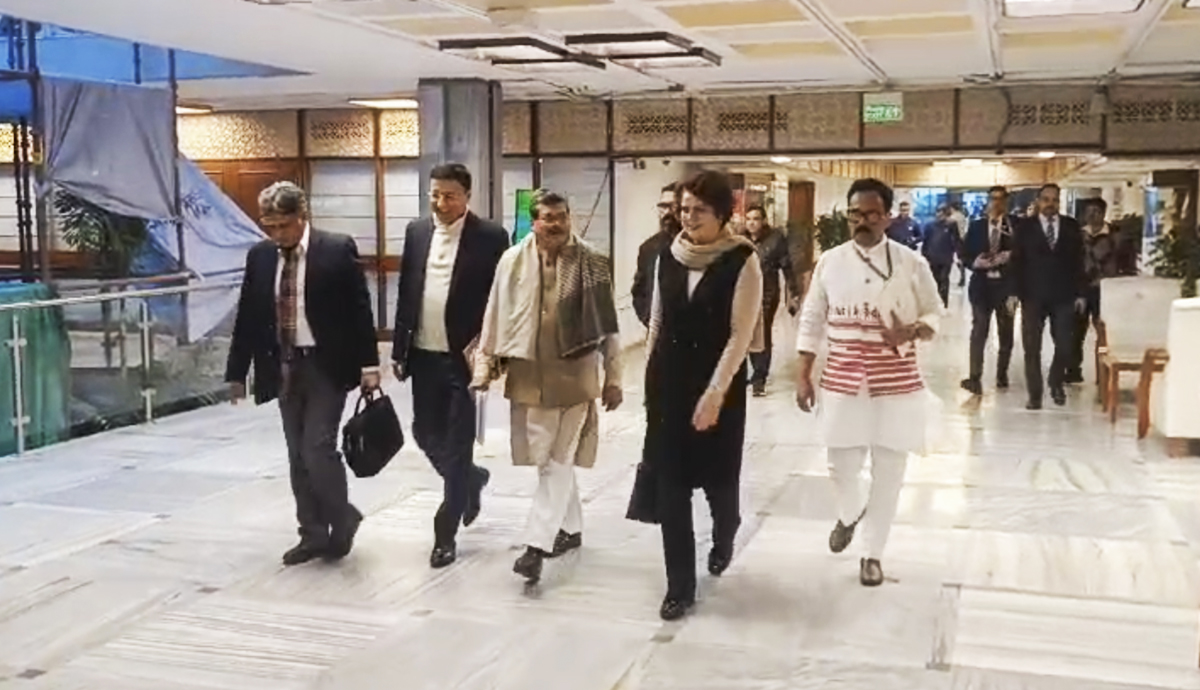
Members of the Joint Parliamentary Committee, constituted to
scrutinise the two bills on simultaneous elections, arrive to attend a meeting,
in New Delhi, Wednesday, Jan. 8, 2025. (PTI Photo)
The MPs attending the meeting of the 39-member Joint
Parliamentary Committee expressed their views and asked questions following a
presentation by the Ministry of Law and Justice on the provisions of the bills
and the rationale guiding them.
A number of opposition MPs, including Congress' Priyanka
Gandhi Vadra, questioned the claim that simultaneous polls will reduce
expenditure. They asked if any estimate was made following the 2004 Lok Sabha
elections when EVMs were used for the first time in all 543 seats and are
believed to have brought down the cost incurred.
BJP MPs, the sources added, countered the charge that the
'one nation one election' proposal flouted constitutional values by requiring
an early dissolution of several state assemblies and locking their term with
the Lok Sabha's.
Noting that seven state assemblies were dissolved early
in 1957 to ensure all state elections are held alongside the national
elections, Sanjay Jaiswal asked if the likes of then president Rajendra Prasad,
who was also the chairman of Constituent Assembly, and other eminent lawmakers,
including those in the Nehru government, acted in violation of the
Constitution.
Another BJP MP, V D Sharma, said the idea of simultaneous
elections was reflective of the popular will. He also noted that the high-level
committee headed by former president Ram Nath Kovind had consulted over 25,000
members of the public, with an overwhelming majority supporting the idea.
The BJP MPs reiterated that a continuous cycle of
elections hampers development, the country's growth and is a drain on the
exchequer. One nation one election will be a boost to growth and development,
they added.
Shiv Sena, which was represented by Shrikant Shinde,
cited the case of Maharashtra where Lok Sabha, assembly, and local body polls
are held back to back within few months, stressing that this derails
development work as the entire state machinery is busy in the conduct of
elections.
Several opposition MPs, including those from the
Congress, DMK and the Trinamool Congress, echoed their parties' stated views
that the proposed laws run contrary to the Constitution and are attack on its
basic fabric as well as federalism.
A TMC MP said upholding people's democratic rights is
more important than saving money.
Some opposition MPs demanded that the Joint Committee of
Parliament, headed by former Union minister P P Chaudhary, scrutinising the two
bills should be given a tenure of at least on year due to the enormity of the
exercise.
V Vijayasai Reddy of the YSR Congress, which had earlier
supported the concept in its submission to the Kovind committee, raised a
number of questions over the bills, and demanded that ballot papers must
replace Electronic Voting Machines which are is "vulnerable to manipulation".
Reddy claimed that simultaneous elections will
marginalise regional parties, dilute diversity of representations and local
issues, undermine the need for elected representatives to engage regularly with
voters and turn polls into a contest between two or three national parties.
JD(U) MP Sanjay Jha, sources said, spoke of the incidents
of booth capturing in Bihar during the use of ballot papers to refute the
suggestion to bring them back.
The BJP ally, however, also raised a few questions,
including whether a government elected for a short tenure will have the
required governance focus that a incumbent with five-year term will have.
The bills propose that if a mid-term Lok Sabha or
assembly election is held due to the fall of a government and the absence of
any alternative, the tenure of the new legislature will be for the remainder of
outgoing House.
All MPs were given a trolley carrying over 18,000 pages,
including one volume of the Kovind committee report each in Hindi and English,
and 21 volumes of annexure, besides a soft copy as well.
The Constitution (129th Amendment) Bill and the Union
Territories Laws (Amendment) Bill were introduced in the Lok Sabha during the
recent Winter Session and referred to the committee.
The government decided to increase the committee's
strength from 31 to 39, as more political parties expressed their desire to be
part of the exercise to examine the two draft legislations on simultaneous
elections.
Former Union ministers Anurag Thakur, Parshottam Rupala
and Manish Tewari, along with several other lawmakers, including Bhartruhari
Mahtab, Anil Baluni, Bansuri Swaraj and Sambit Patra, are also members of the
committee.
The panel has 27 members from the Lok Sabha, and 12 from
the Rajya Sabha.