


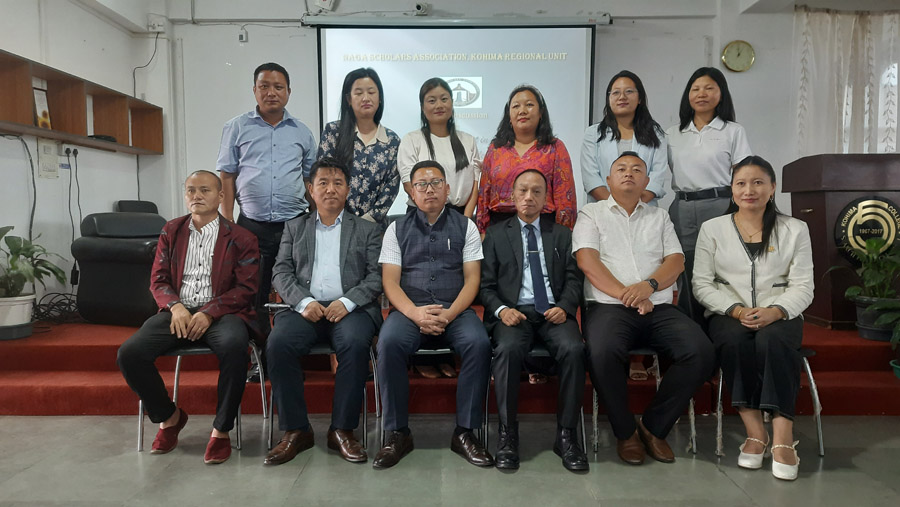
Participating in the panel discussion on ‘Opposition-less government in a democracy: Trends and challenges’ organised by Naga Scholars’ Association (NSA), Kohima regional unit at Kohima College on Saturday, Dr. Khriezo Yhome, senior fellow Asian Confluence, Shillong, said the rise of powerful politicians has diminished the role of the opposition, giving rise to majoritarian politics which marginalises the minorities.
[bsa_pro_ad_space id=1]‘There is a lack of ideological politics in terms of social welfare. What society has today in the name of democracy is plutocracy, a state ruled by the rich and wealthy. The existence that is driven by the money power, and unless we have some structural system it will be difficult to bring a change,’ he said.
He added that the quality of democracy is declining across the world and it is not a recent phenomenon.
He also opined that Nagaland government could have opted for better words like “all party” or “coalition” instead of the current nomenclature “opposition-less”.
Dr. Tovika Swu, HoD of Political Science, Don Bosco College, Kohima, also said that opposition-less government, which is witnessed around the world, is a big challenge to democracy.
‘People elect their leaders to be their spokespersons but when they become part of the government, democracy is in threat. This is happening because the political ideology is dying all over the world,’ he said.
Read: PM Modi constantly monitoring Manipur situation, says Amit Shah at all-party meet
Claiming that political ideology has “died” in Nagaland, he called upon the intellectuals, researchers, scholars and teachers to educate the people on the definition of political ideology.
Dr. David Sachü, Assistant Professor, department of Political Science, Sazolie College, Kohima, said that any healthy democracy can never thrive in the face of opposition-less government; it will be just autocratic or dictatorship.
Dwelling on the nature and dynamics of politics in Nagaland, he said a paradigm shift was witnessed in 2003 while eroding of party system started in 2013 where the NPF sided with the ruling government. In Nagaland people don't fight on political ideology but fight on village, he added.
Meanwhile, advisor of NSA, Kohima regional unit, Dr, Zavise Rume, who is also the president of Nagaland Education Association, said that system of government without opposition has been there in the Naga society since time immemorial and it was a way of life. But came the modern politics and things have changed, he added.
Suggesting that people should become critic to their own government in the face of opposition-less government, he said, that way everyone can participate in the functioning of the government. To ensure accountability in the opposition-less government, he suggested holding regular healthy interaction to explore resources and ensure development.
Whether good or bad, now that we are in the given situation, people should explore ways and nurture good ideas, he added.
Joint secretary of NSA, Kohima regional unit, Dr Aosunep moderated the panel discussion.