[caption id="attachment_182479" align="alignnone" width="550"]
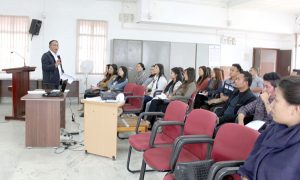 A file picture of the state's education department 'inducting' new secondary-level teacher recruits in April this year.
[/caption]
Our Correspondent
Kohima, May 11 (EMN): Professionally qualified teachers in the state comprise of only 37.81% as per the Unified District Information System for Education (UDISE) 2016-17 report. Among the 19, 618 teachers employed in government-run schools, only 7418 are professionally qualified while the 12,200 are professionally ‘unqualified’.
This information was shared by T Alemla Longkumer from the State College of Teacher Education, Kohima while speaking on the ‘Needs & Challenges of Teacher Education in Nagaland’ during the first All Nagaland Teacher Educators conference held at Kohima on May 10.
Prior to that, an educationist had also pointed out that it the state government was grappling with a high percentage of untrained teachers and its negative bearings on the quality of education for several years; and on the other hand the system of teacher education in the state was said to be badly fragmented, defined by a ‘complete absence of coordination’.
According to the report, Nagaland has a good number of training colleges and institutions with ‘one College of Teacher Education (CTEs), one government and seven B.Ed. Colleges, nine District Institute of Education and Training (DIETS) and two private Elementary Teacher Education Institutions (ETEIs)’.
However, it was also learnt that there is a shortage in faculty in all the State Teacher Education Institutions (STEIs) ‘with minimum of 13 faculties in DIETs’.
Highlighting the concerns and issues of teachers education in the state, Longkumer was doubtful if the teachers ‘are sufficiently oriented, academically well-equipped both in depth and width, prepared to develop new understandings, ready to take upon new responsibilities and initiatives, able to translate theory into practice and able to reverse student-teachers (STs) perspectives of the teaching-learning (T-L) process’.
Towards this end, she asserted on the need of an urgent need to shift in understanding of the teaching and learning process, multi-disciplinary understanding and insights, reflective practitioners and in-depth understanding of pedagogic aspects encompassing content, context and learner.
She also emphasised on the need for new approaches to assessing and evaluating learning viz. ‘process versus product evaluation and knowledge-based versus application based’.
Also sharing on the systematic issues and concerns, which as a whole is affecting the education system in the state, she observed that the curriculum was framed without expert knowledge and guidance, while the late introduction of M.Ed. programme has rendered those with T Ed. degrees under-qualified.
Another major problem, according to her was although there is a shortage of faculty in STEIs, there is no creation of posts whereby the new appointments made were of contractual in nature.
Besides, Longkumer said, the indifference to requirements and poor salary packages by the private institutions and the lack of facilities and opportunities to attend programmes outside the state is hindering towards achieving the desired goals in the education sector.
Therefore, she asserted that there is an urgent need of teacher educators in Nagaland through strategic planning in terms of stage-specific teacher requirements (UEE & USE), research-based development, rationalising establishment of TEIs with specific intake capacities as per needs of districts and regions, establishment of more government-run STEIs in districts as per requirements and checking the establishment of more private STEIs in Dimapur and Kohima.
She also insisted on the need to put more thrust on In-Service TE by engaging appropriate agencies (level-wise), RMSA & SSA to establish better links with district level agencies for need-based ISTE programmes in continuum (level/ subject/ teacher-category/district specific); and that agencies involved in ISTE must establish coordination to avoid overlaps and wastage.
Longkumer highlighted on the need to review school curriculum, evaluation and examination systems at all levels, community awareness about new developments in T-L, orient professionally qualified teachers in schools on the new approach and development of resource materials.
While emphasising on establishment of co-ordination and collaboration between different departments and agencies concerned with education, she also pointed on the need to review appointment of school teachers in line with level of professional qualification, faculty selection criteria of teacher educators should be reviewed and state policy of disallowing deputation of personnel from non-gazetted to gazetted posts, in respect of schools and TEIs.


