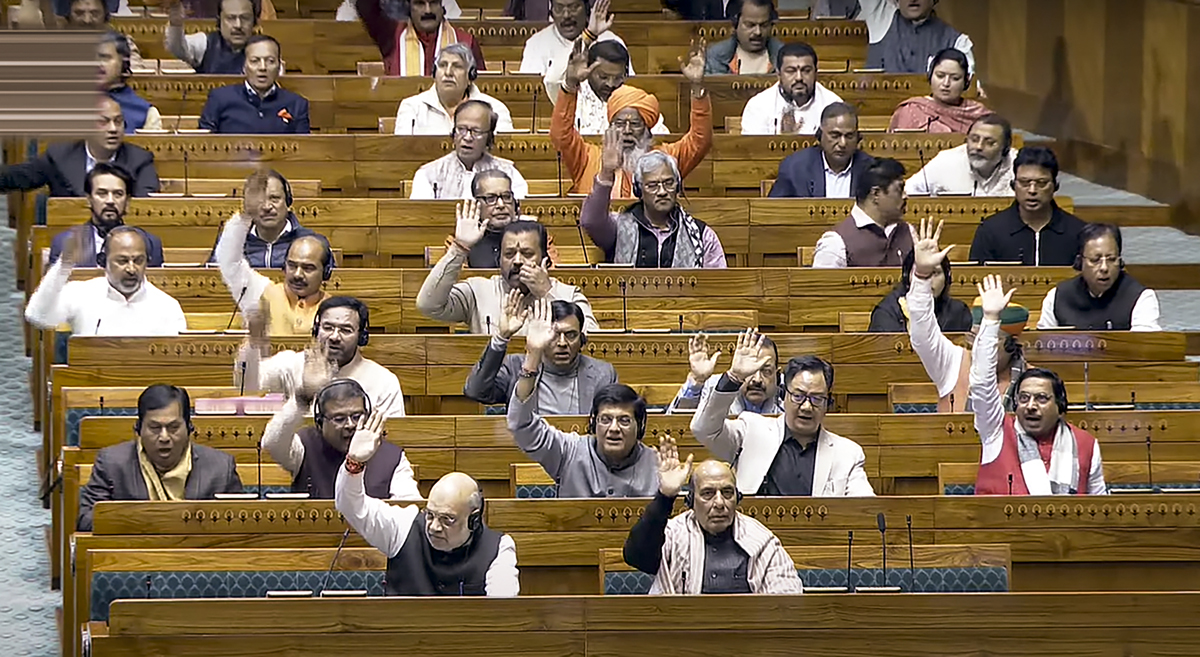
New Delhi: Minister of State Arjun Ram Meghwal speaks in the Lok Sabha during the Winter session of Parliament, in New Delhi, Tuesday, Dec. 17, 2024. (PTI Photo)
NEW DELHI — Two bills that lay down the mechanism to hold simultaneous
elections were introduced in the Lok Sabha after a fiery debate on Tuesday,
with the opposition terming the move "dictatorial" and Law Minister
Arjun Ram Meghwal asserting that the legislation would not tamper with the
powers enjoyed by states.
The Constitution (129th Amendment) Bill was introduced in
the Lok Sabha by Meghwal after a nearly 90-minute debate, followed by a
division of votes. As many as 269 members voted in favour of the Bill and 198
against it.
Meghwal also introduced The Union Territories Amendment
Bill, which seeks to align elections in the Union territories of Puducherry,
Delhi, and Jammu and Kashmir with the Lok Sabha polls.
He said the proposed bills did not attack the "basic
structure doctrine, as claimed by the opposition".
Principles such as judicial review, federal character of the
Constitution, separation of powers, secular character, supremacy of the
Constitution had not changed, Meghwal said, adding that the objections to the
Bill were political in nature.
Congress member Manish Tewari opposed the introduction of
the bills and termed the move an assault on the basic structure doctrine that
stipulates certain features of the Constitution are beyond the amending power
of Parliament.
"One of the essential features is federalism and the
structure of our democracy. The bills assault the basic structure of the
Constitution and exceed the legislative competence of this House," Tewari,
a former Union minister, said.
Samajwadi Party member Dharmendra Yadav said the measure to
introduce "one nation, one election" by the BJP was an attempt to
bring dictatorship in the country.
Union Home Minister Amit Shah said Prime Minister Narendra
Modi had favoured referring the bills to a joint committee of Parliament for
wider deliberations at every level.
"Detailed discussions can take place in the JPC. The
report of the JPC will be approved by the Cabinet. Then again, there will be a
discussion on this (bills) in the House," Shah said.
Meghwal said he would move a resolution referring the Bills
to a joint committee of Parliament.
Earlier,Trinamool Congress member Kalyan Banerjee said the
bills linked the tenure of state assemblies to that of the Lok Sabha, thus
undermining the mandate of the people.
"The state government is not subordinate to the central
government or Parliament. The bills take away the autonomy of the state
assembly. It is not an election reform but just the fulfilment of one
gentleman's desire and dream," he said.
DMK member TR Baalu said, "The electors have the right
to elect the government for five years and this right cannot be curtailed with
simultaneous elections."
The opposition members also objected to Speaker Om Birla's
move to call the treasury benches to speak on the bills, leading to a heated
debate.
Parliamentary Affairs Minister Kiren Rijiju said the speaker
had given a ruling to allow floor leaders of all parties to speak on the
introduction of the bills.
"You alone do not represent Parliament, every political
party has a representation here," Rijiju said.
BJP allies the Telugu Desam Party (TDP) and the Shiv Sena
extended "unwavering support" to the election reform measure.
TDP member and Union minister Chandra Shekhar Pemmasani said
"one nation, one election" would reduce expenditure on polls and
enhance logistical efficiency.
Shiv Sena member Shrikant Shinde hit out at the opposition,
saying they were allergic to reforms.
The DMK's Baalu and NCP (Sharadchandra Pawar) member Supriya
Sule favoured referring the bills to a parliamentary committee, if they could
not be withdrawn.
"This Bill is aimed at maximising political gain and
convenience. This Bill will finish off regional parties," All India
Majlis-e-Ittehadul Muslimeen (AIMIM) leader Asaduddin Owaisi said.