[caption id="attachment_126229" align="alignnone" width="584"]
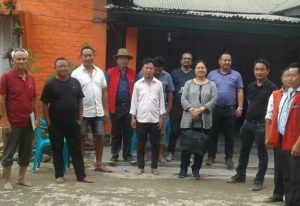
Government officials along with the Yeveto village authority during the joint spot verification on July 11.[/caption]
Dimapur, July 13 (EMN): Following reports of massive flooding in Yeveto and other surrounding villages under Niuland Sub-Division, government officials visited Yeveto village on July 11 for a joint spot verification.
Joint spot verification was led by the ADC Niuland V Lovitoly Sema; EAC Niuland Kelevituo Nisa; EE Irrigation and Flood Control Er. Sobou Angami; SDO Irrigation and Flood Control Er. Hotoi; JE (Power) Er. InakaAssumi alongwith Dobashis. The officials later interacted with the village authorities and the villagers.
It observed that the village comprising of 142 households of which 90% of the houses are thatch houses were found to have been affected. Besides, it was observed that paddy fields and plantations have been destroyed, while livestock were swept away and many rendered homeless. However, there was no report of human casualty. The people have been requested to temporarily relocate to a safer area.
Emergency protection works are being taken up at Yeveto village on Zubza river by providing a coffer dam and 3 numbers of bed bars with boulders in wire nets on the personal initiative of the Parliamentary Secretary of Irrigation and Flood Control, Jacob Zhimomi, under the supervision of EE, Irrigation and Flood Control to control the flood along the river bed.
The district administration has provided monetary assistance and food materials as immediate relief. Further, the villagers have requested the government/ department concerned to take up the matter on top priority basis and to strongly pursue for the early approval of the project so as to permanently mitigate the flood hazards that affect the village every year.
I&FC department on flood in Yeveto village
Department of Irrigation & Flood Control today said the department has been implementing anti-erosion and flood mitigation works under the “Flood Management Programme” within the scope and guidelines and funding of the Ministry of Water Resources, RD&GR, Government of India. Department of Irrigation & Flood Control today said the department has been implementing anti-erosion and flood mitigation works under the “Flood Management Programme” within the scope and guidelines and funding of the Ministry of Water Resources, RD&GR, Government of India. It said the department had undertaken protection of Rengmapani, K Hetoi and Hozukhe village areas from erosion of Dzuza River during 2014-15 with construction of bed bars, spurs and river bank revetment works for protection of erosion affected areas as well as mitigate erosion prone areas for the stretch of Dzuza River from Niuland Bridge upto Rengmapani as well as in other areas. Chief Engineer of Irrigation and Flood Control, Er. S Kughaho Sema, said the protection works have been completed successfully and had served the purpose. However, he said unregulated exploitation of river bed materials in all the major rivers in the foothill plains of Dimapur and adjoining areas has caused severe erosion of river banks damaging agricultural lands, habitations, roads and communication and infrastructures. “Large boulders in the river beds dissipate the energy of the swift river flow and the water literally tumbles/rolls with its speed reduced. The entire stretch of Dzuza as well as Chathe, Langlong and Khova rivers in the plain sector are now devoid of the any boulders and rendered plain with gravel and pebbles only,” he said. He said that under such conditions with nothing to impede the fast flow of the river, hectares upon hectares of arable lands have been swallowed leaving large tracts of barren flood banks. He added that more disaster awaits the urban areas where public tend to encroach right upto the river’s edge and even beyond and restricting the natural drains/rivers. Stating that cycles of heavy rains causing flood conditions have been observed to occur every 10-15 years in the State, he said where the river channel has been constricted due to encroachment, the river overflows its banks and causes damages in its wake. “No amount of finger pointing or blame game will undo the damaged done,” the release said.Stating that the department had initiated emergency erosion mitigation measures to protect the river banks at Yeveto village area during 2016 as well as 2017, it, however, said inundation of the river bank area due to natural calamity of flood condition is not within the scope of the department. It added that the department had also submitted proposal to the government for consideration of NEC funding for protection works at Yeveto village area.“Land is privately owned in Nagaland and the restrictions on river bed exploitation, sand extraction or any other regulations on landed property by the State, more than often, goes unheeded. The onus therefore should be taken up by the village councils and NGOs in their own jurisdiction for pre-emptive measures to avert man-made disasters and circumvent the impending hazards,” the release said.
Measures to mitigate flood1. Rivers and natural drainage systems should left in their pristine state as far as possible.2. Restriction should be imposed in exploitation of river bed materials such as, boulders, gravels, shingles, sand etc.3. Wherever quarrying or sand harvesting is necessitated, it should be regulated with the advice of experts4. Restriction of activities of the general public in the flood plains (flood plains includes channel and that area of nearby low land susceptible to flood inundation)5. Co-ordination with the district administration and line departments for administrative and technical guidance and taking up remedial measures as per government programmes.


