


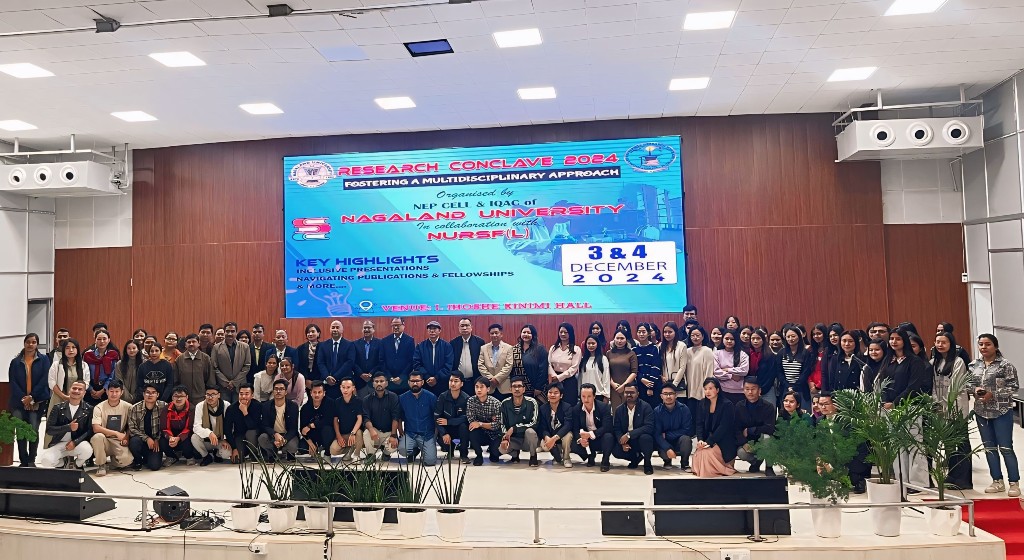
DIMAPUR — The first research conclave of Nagaland University (NU) was held at I Ihoshe Kinimi Hall, NU Lumami campus in Zunheboto district on Tuesday. The conclave is a collaborative effort between the University’s NEP Cell, IQAC and the Nagaland University Research Scholars Forum (Lumami).
An update from the university stated that the event marked a significant milestone in promoting multidisciplinary approaches among 140 scholars and faculty from diverse academic disciplines, emphasising collaboration, innovation and skill development.
The inaugural programme was chaired by Dr. Viheno Iralu, assistant professor at the Centre of Biodiversity, wherein she welcomed the delegates and also outlined the event's objectives, while Dr. Latonglila Jamir, assistant director of IQAC and the organising secretary, delivered the welcome address and highlighted the conclave’s role in fostering scholarly growth.
Prof. Dipak Sinha, NEP nodal officer, elaborated on the foundational vision behind the conclave, emphasising the necessity of multidisciplinary collaboration without compromising the uniqueness of individual disciplines. He also addressed the practical aspects of the conclave, including mentorship opportunities, guidance on publications and scholarships and fostering self-sufficiency among scholars by encouraging them to organize such events independently.
In his keynote address, Prof. Temjensosang, director of Research Development Cell, connected the NEP’s guiding principles with ancient Indian education systems like the Gurukul, emphasising holistic and skill-based learning. He stressed the importance of adopting multidisciplinary approaches to achieve a well-rounded understanding of India’s educational landscape.
Dr. Abemo, registrar of Nagaland University, shared his excitement about such initiatives and reminisced about his PhD journey. He encouraged scholars to actively engage in the sessions, making the most of the platform to share, learn, and collaborate.
Prof. Jagadish K Patnaik, vice chancellor of Nagaland University, differentiated between multidisciplinary, interdisciplinary and transdisciplinary approaches.
Sharing his own research experiences, he highlighted the importance of flexibility, open-mindedness and the pursuit of meaningful contributions to knowledge.
Prof. Patnaik reassured scholars of institutional support including access to research materials and equipment and urged them to dedicate themselves to academic rigor.
The event showcased Nagaland University’s commitment to advancing research and education through innovative approaches and collaborative platforms. Scholars were encouraged to build networks, engage in mentorship and utilise the conclave as a foundation for future academic endeavours.
The research conclave concluded with a collective resolve to continue fostering multidisciplinary learning by ensuring that scholars from Nagaland University emerge as leaders in their respective fields while contributing meaningfully to society.