


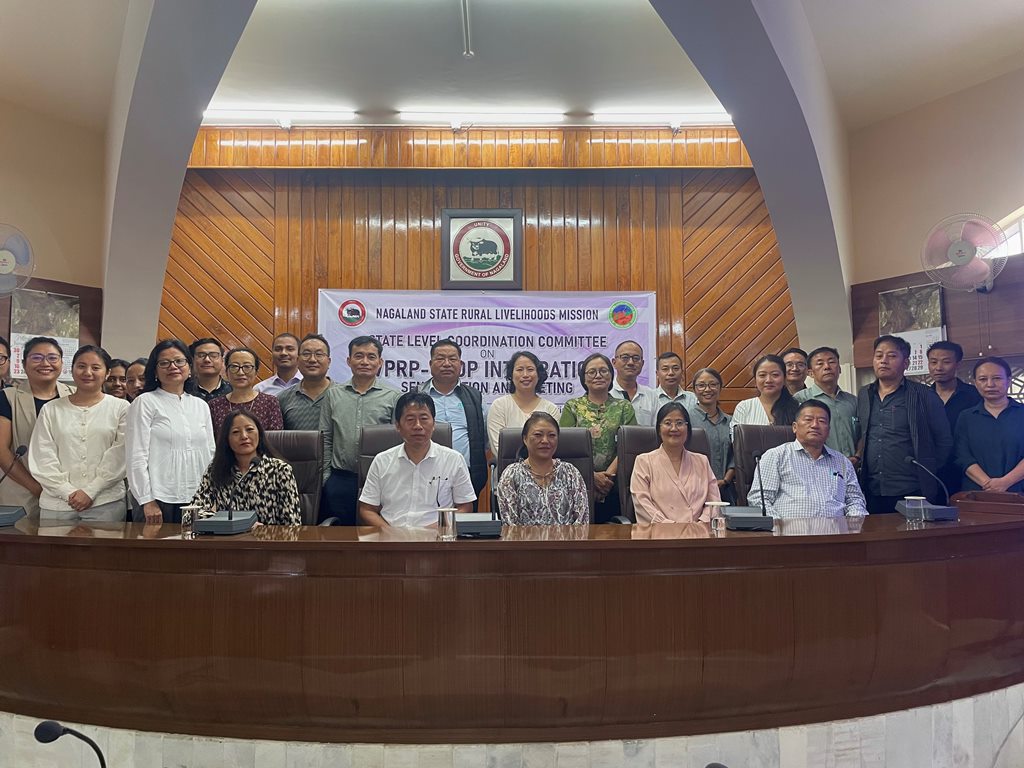
DIMAPUR — Nagaland State Rural Livelihood Mission (NSRLM) organised the first state level joint coordination committee (SLCC) on village prosperity resilience plan (VPRP) and gram panchayat development plan (GPDP) integration at the Secretariat conference hall in Kohima on July 16.
An update from NSRLM stated that the meeting was chaired by Imtimenla, joint secretary and NSRLM state mission director, while the joint secretary of Rural Development, Johnny Humtsoe, delivered the opening remarks.
It added that powerpoint presentation on VPRP-GPDP integration and analysis of 2023-2024 VPRP exercises were made by Qheboka Sumi, state project coordinator; Kudumbashree, NRO; and Khriezovonuo Lhoungu Doulo, NSRLM state programme manager.
It mentioned that SLCC on VPRP-GPDP integration was constituted under the chairpersonship of the commissioner and secretary of Rural Development in order to ensure better coordination among various departments in addressing the demands of the community through self help groups (SHP) and their plans. The objective of the committee was to facilitate convergence for fostering access to entitlements and to integrate plans prepared by SHG through a process called the village prosperity resilience plan (VPRP).
VPRP comprises of 4 plan components namely entitlements; social development plan; public goods, services and resources development (PGSRD) plan and livelihoods plan. It stated that planning is done by SHG and SHG federations at the village and block levels.
Facilitated by a resource pool of trained staff and cadres, it stated that the SHG under NSRLM prepare plans listing their demands based on requirements under the 4 components and the consolidated plans are presented at the gram sabha conducted in the village.
The objective was to integrate the plans into the overall gram panchayat development plan (GPDP) and uploaded in portals, so that the genuine community demands are included in the annual planning of the related departments.
It further mentioned that SLCC comprised of 15 key departments namely Rural Development (nodal), SIRD, Home, Health and Family Welfare, School Education, Agriculture (and allied), Animal Husbandry, Sericulture, Industries and Commerce, Power, Tribal Affairs, Social Welfare, Fisheries and PHED.