


NSLSA concludes 40-hour mediation training in Kohima with 26 advocates certified as mediators under Supreme Court guidelines.
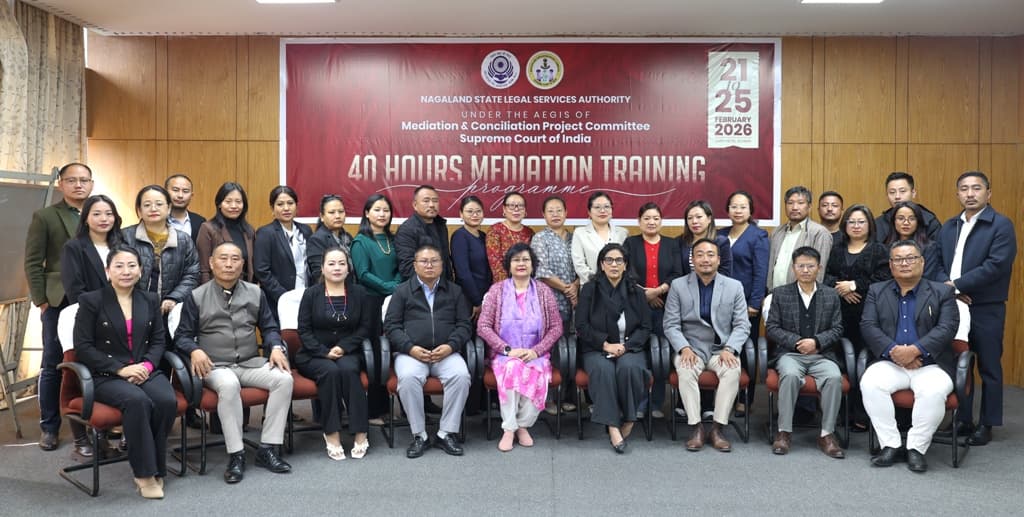
DIMAPUR — The 40-hour mediation training programme organised by the Nagaland State Legal Services Authority (NSLSA) under the aegis of the Mediation and Conciliation Project Committee (MCPC), Supreme Court of India, culminated at Hotel Japfü, Kohima, on Wednesday.
According to a press release, the training began on February 21.
During a certificate handing-over ceremony, Member Secretary, NSLSA, Neiko Akami, delivered the closing note. He commended the senior trainers under MCPC, Supreme Court of India, Reema Bhandari and Rita Das Mozumdar, for rendering highly experienced mediation expertise through structured mediation programmes and practical techniques.
Speaking about various positive aspects of mediation, Akami stated that mediators are professionally trained persons and attempt to make people in conflict come to an agreement to settle differences. He added that a mediator stands as a "neutral" force and "facilitates" between conflicting parties to resolve cases.
Also read: Zunheboto DWSM reviews Jal Jeevan Mission progress
Apart from being trained, he enunciated that the role of a mediator comes with honesty and integrity. He said cases resolved through mediation are permanently settled, and agreements reached are binding, enforceable in courts and final.
Stating that the current training has made an attempt and opportunity to train at least two counsels for mediation from each district of Nagaland, he expressed optimism that cases referred to mediation by a court of law or eligible to be undertaken through mediation can be duly carried out.
During the 40-hour intensive training, the senior trainers dwelled on the ground rules of mediation, conflict management and resolution, types and processes of Alternate Dispute Resolution, the role of lawyers, communication roles, techniques such as negotiating, bargaining, understanding, management, stages of impasse and mediators' reflection, professional ethics, and ethical principles for judicial mediators and advocate mediators, among other topics.
As per the Mediation Act, 2023, the court or tribunal may, at any stage of proceedings, refer the parties to undertake mediation.
Mediation training has been given to advocates who usually have at least 10 years of standing at the Bar. To become a certified mediator, the candidates must complete a 40-hour Intensive Mediation Training Programme accredited by the MCPC, Supreme Court of India.
Twenty-six mediators spread across 11 districts received completion certificates.