


NSEDM organised Enterprise Readiness Support Workshop 2.0 in Longleng to support entrepreneurs and micro businesses.
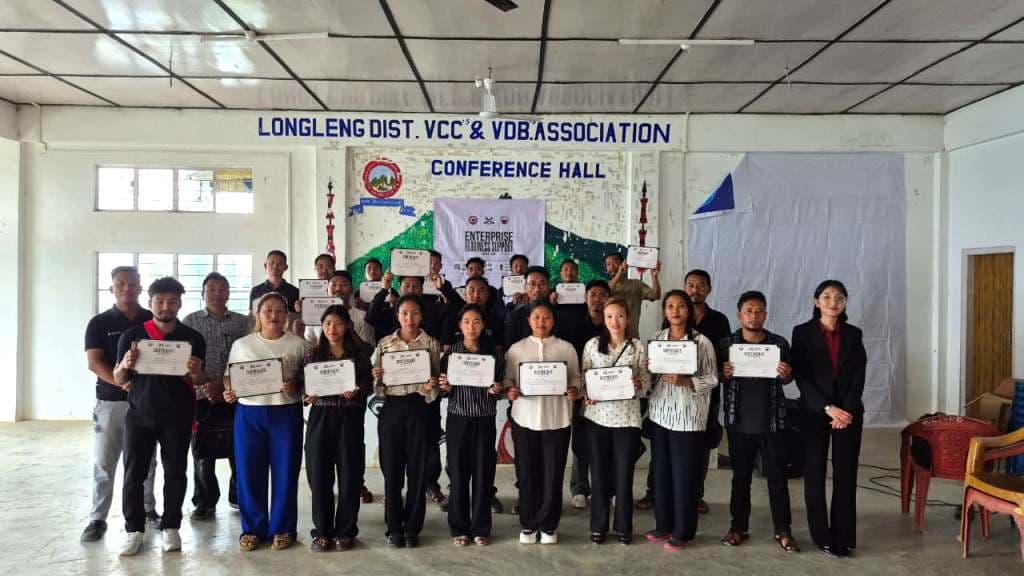
DIMAPUR — The Nagaland Skill & Entrepreneurship Development Mission (NSEDM) under Investment & Development Authority of Nagaland (IDAN) conducted ‘Enterprise readiness support workshop 2.0,’ a two-day programme on May 8 and the 9th at the VCC & VDB Association Complex, Longleng.
According to an update, the workshop was organised to strengthen enterprise capabilities among micro business owners and aspiring entrepreneurs in the district.
Delivering the opening remarks, Imkongnukla Ao, EAC Longleng, emphasised the importance of entrepreneurship as a pathway for economic growth and encouraged participants to build confidence in pursuing enterprise opportunities.
The EAC also emphasised the importance of changing one’s mindset and being more open-minded.
Also read: Workshop in Kohima focuses on AI innovation, digital tools
Additionally, Imkongnukla urged the candidates to take initiative themselves by stepping up, seeking opportunities, and becoming more aware and proactive in improving their own future.
The workshop covered a structured set of themes designed to build both foundational understanding and practical skills in enterprise development.
Sessions on ‘Enterprise readiness and compliances’ focused on ownership of business, entrepreneurial mindset, and understanding the distinction between success and failure, along with addressing common myths around entrepreneurship.
Participants were also introduced to key compliance requirements, including business registrations, licensing, taxation, basic GST calculation, banking practices, employee-related aspects, and pitch deck preparation.
A session on ‘Understanding enterprise structure’ provided insights into organising and structuring businesses effectively.
The session on ‘Going digital’ emphasised the importance of leveraging digital tools and platforms for business growth, including the use of social media, online payment systems, and digital communication channels.
It highlighted the role of mobile technology in marketing, the importance of consistency in digital presence, and the need to build trust and effective communication with customers.
The session on ‘Credit linkages’ focused on the Chief Minister’s Micro Finance Initiative (CMMFI), covering eligibility criteria, documentation requirements, business planning, detailed project reports (DPR), subsidy structure, and loan repayment mechanisms.
Participants were also guided on different types of loans and the importance of accurate documentation and planning.
On the second day, sessions on ‘Business operations and risk management,’ and ‘Understanding cost and financial awareness’ covered key aspects such as unit economics, identification of fixed and variable costs, preparation of invoice templates, use of accounting tools, and best practices in banking.
Further sessions addressed loan processes and banking norms, including eligibility, documentation procedures, verification mechanisms, and available financing options for enterprises.
The session on ‘Growth strategy’ focused on developing structured and practical approaches to scaling enterprises through roadmap-based planning.
The workshop concluded with participants presenting their business ideas through pitch decks and presentations, followed by a certification ceremony for participants who completed the programme.
“The programme provided participants with a comprehensive understanding of enterprise development, equipping them with practical knowledge and tools to start, manage, and grow their businesses in a structured and sustainable manner,” the update stated.