[caption id="attachment_110537" align="aligncenter" width="565"]
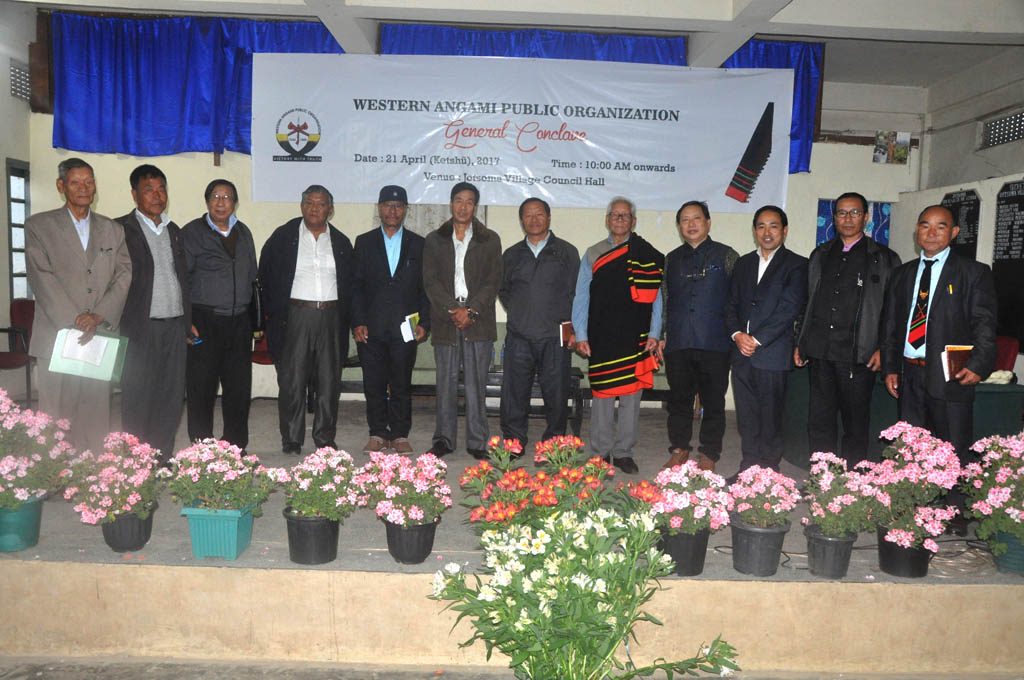 Leaders of the WAPO and resource persons pose for a photograph at the WAPO conclave in Jotsoma village on April 21. (EM Images)
[/caption]
Jotsoma, April 21 (EMN): A “kilonser” of the Federal Government of Nagaland, Kaka Iralu, on Friday said that the NSCN (IM) was an ‘illegitimate government’ as it was not formed with the consensus of the Naga people.
Speaking at a conclave of the Western Angami Public Organisation (WAPO) at Jotsoma village council hall on the topic “the Naga national movement–the journey ahead”, Kilonser Iralu slammed the NSCN (IM) for being an ‘illegitimate government which never had the support of majority of the Nagas at any point of time.’
He went on to say that India was a legitimate government, but had ‘stooped so low and undermined its position as a great nation for holding talks with an illegitimate government in the form of NSCN (IM).’
On the idea of the NSCN (IM) about ‘shared sovereignty,’ Iralu wondered what ‘shared sovereignty meant.’ He maintained that “sovereignty is a single entity and cannot be shared by two groups.”
“By shared sovereignty, do they mean that the constitution will favour Nagas with 50 percent and the rest to India? I wonder what the Naga national flag is going to be like by shared sovereignty,” he pondered.
On the decades-long Naga political issue, Kaka reminded India not to consider it as an internal affair, but to take it seriously as an international affair.
Addressing a host of Naga national workers and public leaders of Western Angami region, Kaka said “Nagas cannot defeat India by waging war against them, but through our legal rights.”
“Talking about Naga independence, we have done 80% out of 100%. So let us come together as a people to press for our rights so that justice is delivered to us sooner or later,” he added.
General Secretary of Naga National Council (NNC), Vizosielhou Nagi also slammed the NSCN (IM) for not been a party to unite the Nagas.
“Almost all the Naga political factions are in a position to unite; however, it is regrettable that the NSCN (IM) is not opening its doors towards this end,” Nagi said maintaining that the Nagas should firstly unite, if not “the settlement of Naga political issue will remain a distant dream.”
“The August 3 framework agreement is only between the Government of India and NSCN (IM). I don’t see the settlement being fruitful without the support of other political factions,” he said adding that “it will just be wastage of time if the ongoing talk is only confined to the decision of one party.”
“The NSCN (IM) cannot ignore the NNC which has the support of the Naga people at the grassroots. Those political factions/groups which have come together are for Naga unity,” he said wondering if it could be the difference in ideology that is hindering the NSCN (IM) to be together.
“The NNC stand for democracy, while the NSCN (IM) is for socialism,” he added.
Executive member of NNC, Zapuvisie Lhousa stated that NNC is the highest political institution of the Nagas, and therefore, said that “it is wrong on the part of GoI to open up talks with just one party.”
“Any kind of sovereignty within the Indian union and within the Indian constitution won’t be accepted by the people,” he said adding that this was stated clearly by NNC President AZ Phizo on July 31, 1960. It may be recalled that the NNC have agreed in principle to accept Naga sovereignty if any political group brings solution at the international level.
Stating that all Nagas, young and old, men and women, are members of the NNC, he urged every section of the Naga society to unite and continue pressing for our rights.
Executive member of Steering Committee of NSCN (IM), Colonel (Retd) Vitsolhu Peseyie recalled that it was the Shillong Accord, signed in 1975, which then had split the national workers, both underground and over ground.
“It is true the NNC leaders were the torch bearers for Naga nationalism, but those leaders who signed the Shillong Accord have betrayed the Nagas and surrendered our sovereignty to the Indians. That was the reason why new political groups emerged to fight for Naga rights,” Col (Retd) Peseyie said and questioned as to “why AZ Phizo remained silence if he has nothing to do with the Shilong Accord.”
“Gone were the days. We have lost enough lives and had shed enough blood. Now it’s time for us to reconcile and seek forgiveness from one another,” Peseyie said.
He told the gathering that the August 3 framework agreement between the GoI and NSCN (IM) won’t fall short of what the Nagas desire.
“There is nothing to lie or fool the people about the framework agreement. It will be out for the public to see before it is settled,” he said maintaining that “the Nagas can be confident that the said agreement will not be the final settlement, but with time, the Nagas also can move for referendum even in the near future.
Earlier, delivering the keynote address, Mhiesizokho Zinyü, convenor of the WAPO Elder’s Consultative Board and former president of APO, urged the Nagas to bury the past and work extensively to bring unity amongst the people.
“In politics, we will have divided opinions. If there had been any differences in the past, let us forgive and forget as we surge ahead to achieve what we are seeking for,” he said and told the Naga political groups to not isolate themselves, but to be united and march a one political entity.
“We must discern the time. If we isolate ourselves within our own cocoon, we will be the loser. Let us exercise ‘Open Door Policy’ in our approach to the future,” Zinyü urged.
For the second session on the topic “Public organisation – Then and now”, the speakers were Pfükhrielie Peseyie, vice president, Angami Public Organisation, Dr Kepelhousie Terhüja, general council member, Nagaland Tribal Council and Rüüngutuo Sechü, finance secretary, Naga Hoho. The keynote address on this topic was delivered by Krurovi Peseyie, advisory member, APO and NTC.


