[caption id="attachment_183862" align="aligncenter" width="565"]
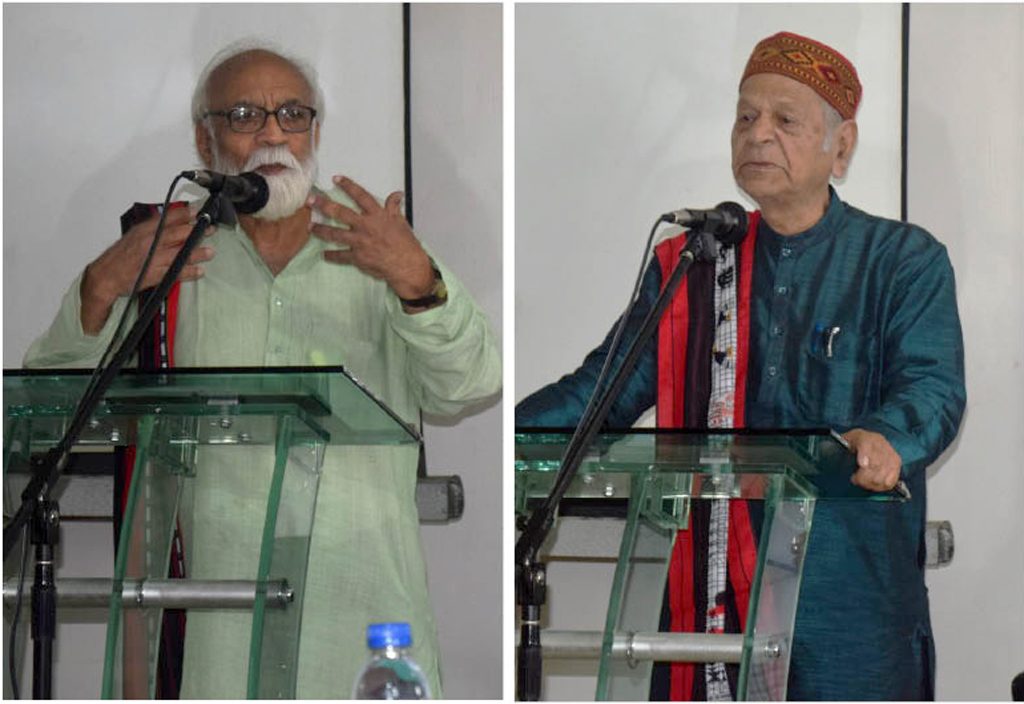 Prof. Anil Sadgopal and Prof. Wasi Ahmed speaking at the two-day National seminar at Nagaland University, Meriema on May 18. (EM Images)
[/caption]
Kohima, May 18 (EMN): One of the universally accepted thesis of learning is that ‘the mother tongue in a multi lingual context is the best and most efficient way of acquiring knowledge of any kind.’ However, an academician is not convinced about the statement and its applicability in a country like India where most are convinced that the only way to acquiring modern knowledge is through English.
Prof. Anil Sadgopal from the All India Forum for Right to Education pointed out that there cannot be a ‘greater fallacy and greater danger’ to the future of our country and state if people continue to have this ‘farcical belief without any logical basis.’ He said this while speaking at the inaugural programme of the two-day national seminar and workshop on the topic ‘Knowledge systems and languages of Nagas’ at Nagaland University in Kohima campus, Meriema on May 18.
Expressing concern about the extinction of indigenous languages, Prof. Sadgopal attributed it to the attack of the ‘global market’ which is steadily reducing the great diversity of India as a result of which, hundreds of languages have disappeared in the past 20-30 years, and more are in the process of disappearing.
Highlighting the importance and power of language as a source of acquiring knowledge, Prof. Sadgopal said all forms of knowledge (modern or ancient and indigenous or non-indigenous) are best acquired, reflected upon, analysed and comprehended and internalised through mother tongue of a child.
Learning to speak in one’s native language or dialect, he said connects a child to his culture, ensures better cognitive development and aids in learning of other languages. He also pointed out that ‘when a language is lost, our culture, history and identity is lost’ and added that every language is a source of history and people learn from it.
Towards this, Prof. Sadgopal further asserted that education of the highest form of knowledge in the world is possible in own mother tongue too, and that knowledge become possible only when people start using their own language to educate people in that language and to generate knowledge as well.
Citing examples from real life experiences, he lamented that over the years, people have lost confidence in the capacity of their own language, which unfortunately, he opined is ‘epidemic’.
Describing the distinction between language and dialect as ‘artificial and myth’, the prof. maintained that ‘it is designed to destroy the inner strength of the language - a design of “hegemony” of destroying languages.’
He strongly asserted on the need for the people, especially the tribal people to regain confidence and strength in one’s own languages and start teaching and learning in one’s own native languages.
Appreciating the vast and diverse languages of the Nagas, Prof. Wasi Ahmed reframed the theme of the workshop as ‘Languages of Nagas as a source of knowledge,’ he opined that there is a ‘living connection’ with knowledge in each Naga language which has beautiful songs, powerful stories, lores etc.
Stating that all spoken languages have equal status of language, Prof. Ahmed explained that it is only through mother tongue that the rich tradition of communicating and building knowledge is made possible.
He also impressed on the need to protect the diverse languages of the Nagas stating that protecting the language is protecting the Naga lives, the very existence and the beauty of our existence.
Highlights of the programme include plenary session and technical session on various topics on development of Naga languages literature and language as the base activity, Naga languages: issues and challenges, folklore and the Naga rural imagination, speech sounds of the Naga languages: a comparative overview etc.
The two-day programme was organised by Nagaland University, School of Humanities and Education in collaboration with the All India Forum for Right to Education and Ura Academy.


