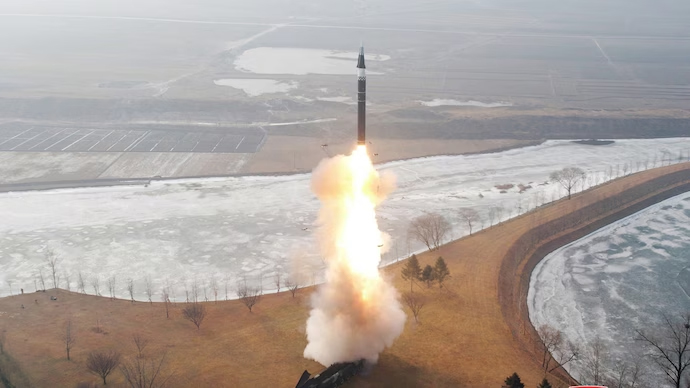
A missile flies during what state media KCNA says is a test of a new intermediate-range hypersonic ballistic missile at an undisclosed location on Monday. (Photo: Reuters)
SEOUL —
North Korea said on Tuesday that it has successfully test-fired a new
intermediate-range ballistic missile (IRBM) tipped with a hypersonic warhead,
claiming that the weapons system will reliably deter any rivals in the Pacific
region.
But the South Korean military said the North's claimed
success of a hypersonic missile launch could be "deception," raising
questions about its flight distance and other specifications.
North Korea said the missile flew some 1,500 kilometres at
12 times the speed of sound the previous day during the testing overseen by
leader Kim Jong-un via a monitoring system, Yonhap news agency reported quoting
the Korean Central News Agency (KCNA).
The South's Joint Chiefs of Staff (JCS) said on Monday that
the North's suspected hypersonic missile, fired from the Pyongyang area, flew
about 1,100 km before falling into the East Sea.
The North Korean leader said the development of such a
missile was aimed at bolstering the country's nuclear war deterrent by
"making the weapon system to which no one can respond the linchpin of
strategic deterrence."
"The hypersonic missile system will reliably contain
any rivals in the Pacific region that can affect the security of our
state," Kim was quoted as saying by the KCNA.
"The system can deal a serious military strike to a
rival while effectively breaking any dense defensive barrier," he added.
The North's latest missile launch, the first provocation in
about two months, came about two weeks before US President-elect Donald Trump
assumes office on January 20.
It also came amid political turmoil in South Korea sparked
by President Yoon Suk Yeol's botched martial law imposition last month and his
subsequent impeachment by the National Assembly.
"North Korea probably intended to flex its muscle
against the United States. As it said the latest launch was a test-firing, the
weapons system does not appear to be completed, pointing to demand (to further
develop) in terms of military technology," an official at South Korea's
unification ministry told reporters.
A hypersonic missile is usually hard to intercept with
existing missile defence shields. It travels at a speed of at least Mach 5 --
five times the speed of sound -- and is designed to be manoeuvrable on
unpredictable flight paths and fly at low altitudes.
The KCNA said the hypersonic glide vehicle atop the new IRBM
reached its first peak at a height of 99.8 km and the second at 42.5 km while
making a 1,500-km-long flight as scheduled before hitting a designated target
point at sea.
But the South Korean military dismissed the North's claim as
a "deception," saying there was no second peak.
"The flight range analysed by South Korea, the US and
Japan was around 1,100 km and (the missile) did not reach a second peak,"
JCS spokesperson Col. Lee Sung-un told a regular press briefing, noting the
North has a track record of "exaggerating."
North Korea also claimed a new compound of carbon fibre was
used in manufacturing the engine body of the hypersonic missile, and an
unspecified "comprehensive and effective" method was introduced for
the flight and guidance control system.
Experts said the North appeared to fire the upgraded version
this week of a hypersonic missile that it launched in April last year.
Pyongyang then claimed the IRBM loaded with a hypersonic glide vehicle flew
1,000 km.
The South's JCS then said the missile flew 600 km, calling
the North's claims partially "exaggerated," although it said
Pyongyang appears to have made some technological progress in its hypersonic
weapons program.
"As the North has claimed it has acquired technology
that is 'by no means easy,' there could be a technical improvement of its own.
But it is also hard to exclude the possibility of technical cooperation from
Russia," Hong Min, a senior research fellow at the Korea Institute for
National Unification, said.
North Korea and Russia have been deepening military
cooperation under a mutual defence treaty signed in June, with the North
accused of sending more than 11,000 troops to Russia to support its war against
Ukraine.
Hypersonic missiles, nuclear-powered submarines, spy
satellites, and solid-fuel intercontinental ballistic missiles are among the
sophisticated weapons Kim vowed to develop during a key party congress in 2021.
At a year-end party meeting, the North's leader said his
country would carry out the "toughest" counteraction strategy toward
the US and claimed that military cooperation among South Korea, the US and
Japan has expanded into a "military bloc for aggression."