


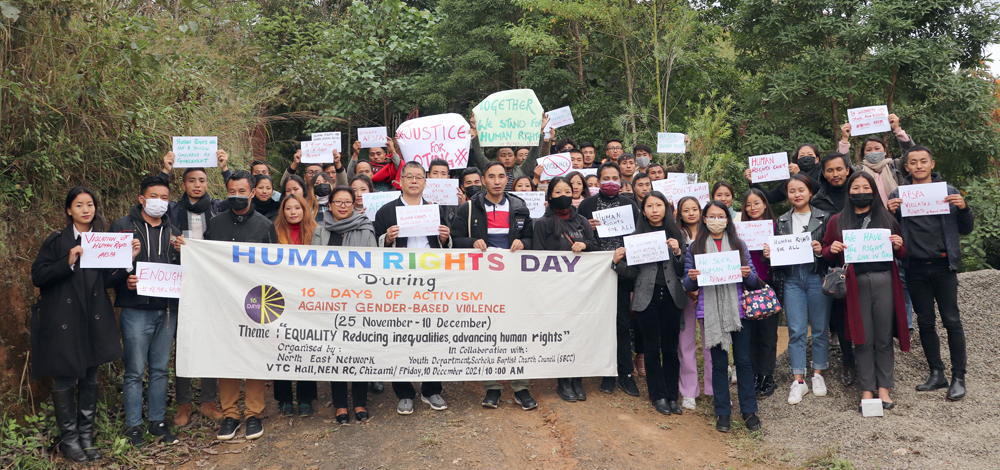
Dimapur, Dec. 11 (EMN): North East Network (NEN), in collaboration with youth department of Secheku Baptist Church Council (SBCC), observed ‘Human Rights Day’ on December 10 at its resource centre in Chizami under Phek district on the theme “Equality – Reducing inequalities, advancing human rights.”
An update from NEN informed that the event focused on youth leadership for social justice and sustainable economic development in realising human rights.
Regional consultant for Theological Education in East and South Asia of American Baptist Churches, Rev. Dr. Wati Longchar, was the guest speaker.
Speaking on the topic “Youth leadership for social justice,” Rev. Dr. Wati highlighted the colonial mindset instilled in the minds of Nagas resulting in hindered progress among the youth saying, “Everyone is a leader and youth are today’s leaders,” thereby disapproving the old saying that youth are tomorrow’s leaders.
Referring to the recent massacre of 14 innocent civilians in Oting village, the speaker emphasised on the importance of organised, collective and consistent protest and movements to attain social justice by having a concrete vision.
“Change never come from the top, change always come from the oppressed”, remarked Wati, underlining the significance of grassroots movements while criticising the result gap, created by the competent authorities who are reluctant to solve problems.
Longchar further iterated on dignity of labour by stressing on the need to change attitudes and also highlighted the wrong vocabulary and definition used for “school drop-outs” which according to him should be “new opportunities to start something”.
It stated that a moment of silence was observed in solidarity to pay respect for the victims of Oting village.
Seno Tsuhah, NEN honourary member, asserted that human rights is at the heart of Sustainable Development Goals (SDG), adding that without dignity, respect, peace, justice, we have no future. She emphasised to repeal AFSPA, an act that violates human rights.
“All the young people need to wake up and reaffirm our commitment towards upholding the values and principles of human rights”, said Seno while stressing that human rights could be realised only if people have equality and non-discrimination in their own lives and homes.
The second technical session witnessed screening of film “The story of human rights” by United Nations.
Issues deliberated in the discussion hour included tapping of natural resources for creating livelihood opportunities through sustainable harvesting, economic justice in the Biblical context, importance of understanding holistic salvation and not only spiritual etc.
Dr. Khrotsolou from Baptist Christian College (BTC), Pfutsero, emphasised on the importance of influencing Chakhesang Baptist Church Council (CBCC) to observe human rights Sunday so that village churches could follow suit in supporting the cause and also collect offerings to support victims of such human rights violations.
Report stated that the members pledged to say no to single-use plastics, grow one’s own food in kitchen gardens and depend less on market food, adopt zero-plastic decorations during Christmas season, influence church-run schools to impart life skills education to students, and choose the right leader in the next election.
A total of 59 participants from Zhavame, Porba, Razeba, Sumi, Chizami Town, Chizami village, Pholami, Gedemi, Enhulumi, Zelome and Baptist Theological College (BTC) Pfutsero attended the event.
Also commemorating the day, North East Institute of Social Sciences and Research (NEISSR), Dimapur, organised ‘WeKnit-2021’ on Dec. 10 on the theme “Child domestic work in the context of child labour” with Tsali Sangtam, advocate of Gauhati High Court, Kohima Bench, and NK Keny, proprietor of Love Care Home, as the resource persons.
In a keynote address, NEISSR principal Dr. Fr. CP Anto stated that Nagaland has a unique practice of child labour in a different form called “gifting the child.”
Pointing out that a child is meant to learn, not to earn, he stated that a child below the age of 14 years should enjoy life and not work. He, therefore, said that children should be allowed to enjoy, grow emotionally, physically and mentally or else they would become a nuisance to the society.
He encouraged the social workers to inform NGO, child helpline and government agencies if they see a child employed in the workshops, factories etc.
Tsali Sangtam spoke on “Child domestic work and child rights,” while NK Keny spoke on “Partnership of government and NGO in strengthening child protection system and services.”
Basing on the deliberation, the members developed an action plan to create awareness in the community on child domestic workers; strengthen systems to counter child domestic worker and continuously monitor and intervene on the issue; and conduct research on child domestic worker and propose for policy formulation at the state-level.