


Manipur Deputy CM Losii Dikho said he has “no doubt” that a Kuki militant group headed by fellow Deputy Chief Minister Nemcha Kipgen’s husband was involved in the killings of Naga community men earlier this year
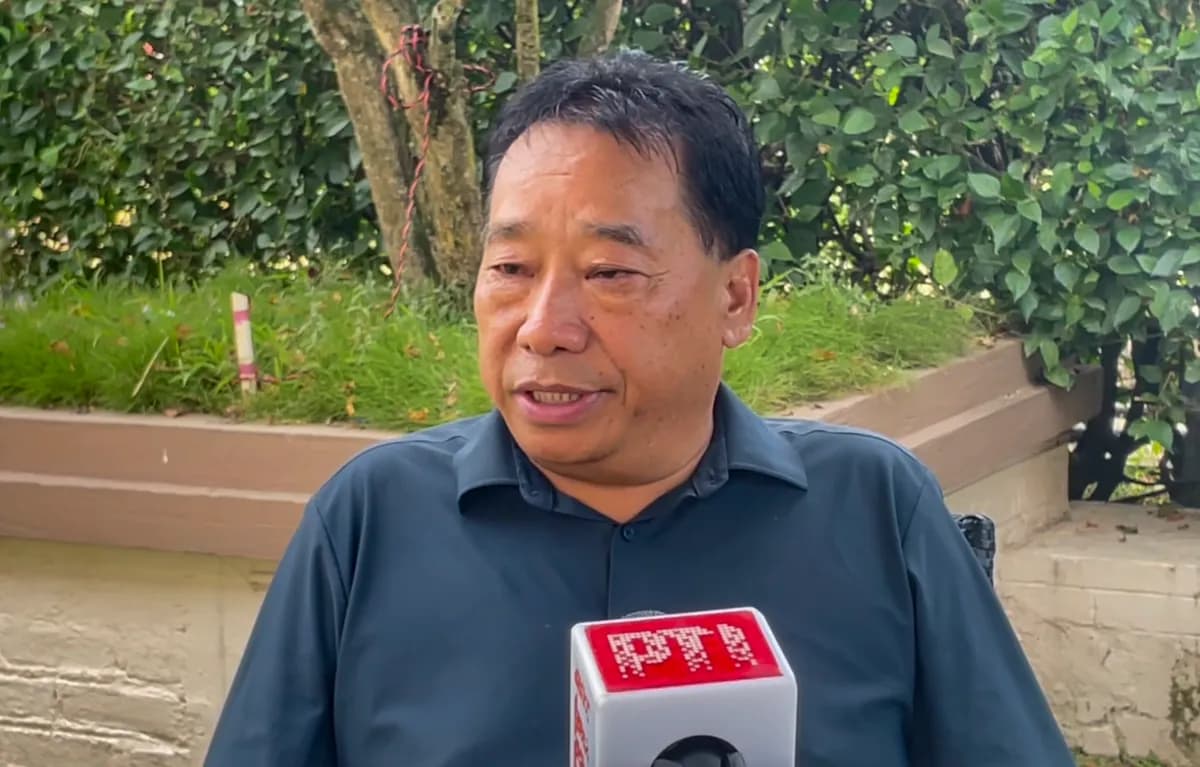
IMPHAL — Manipur Deputy Chief Minister Losii Dikho on Wednesday said he has “no doubt” that a Kuki militant group headed by fellow Deputy Chief Minister Nemcha Kipgen’s husband was involved in the killings of Naga community men earlier this year and she should either step down or use her influence to stop the violence.
Dikho, who cited conversations with people released from captivity as the basis for his allegation, also told PTI in an exclusive interview that the Centre’s representatives and “political agencies” are reaching out to the state’s Naga legislators to “bring about a understanding” over their demand for action against Nemcha Kipgen.
Her husband Thangboi Kipgen heads the Kuki National Front (President), or KNF(P), which is among the outfits covered by the tripartite Suspension of Operations (SoO) agreement involving the Centre, the Manipur government and Kuki armed groups.
The abduction and killing of six Naga men during a hostage crisis involving the Nagas and Kukis in May-June this year in Kangpokpi and Senapati, which sharply escalated tensions between the communities, is under investigation by the National Investigation Agency. Nemcha Kipgen has previously denied allegations of collusion with militants.
While Senapati is predominantly Naga, Kangpokpi is Kuki-Zo dominated with several pockets of Naga concentration. The divide is sharp, the on-ground tension rippling inevitably across to the highest levels of state governance.
Holding the KNF(P) responsible for violence in Kangpokpi district, Dikho told PTI, “She (Nemcha Kipgen) should say, ‘I am the deputy chief minister of the state. Why should my husband’s organisation be fighting and killing people’?”
“She should step down. If she does not want to leave her position, she should immediately tell her husband’s organisation to stop fighting and killing Nagas," Dikho, a three-term Naga People’s Front MLA from Mao in Senapati district, added.
Dikho’s allegations have exposed the public rift between the two deputy chief ministers appointed when the BJP-led government headed by Chief Minister Yumnam Khemchand Singh took office in February. Dikho is a Naga, Kipgen a Kuki and Khemchand a Meitei, appointments that reflected the desire to strike an ethnic balance in the strife-torn northeastern state.
His Naga People’s Front is a partner in the BJP-led Manipur government, leads the government with the BJP as an ally in Nagaland and is an NDA constituent.
Dikho and Manipur's seven other Naga MLAs out of nine wrote to Union Home Minister Amit Shah in late August seeking action against Nemcha Kipgen, the arrest of Kuki militant leaders allegedly involved in attacks on Nagas, and abrogation of the SoO agreement.
The SoO pact, renegotiated in September 2025, expired in September this year without renewal. Though there is no fresh agreement, officials said both sides -- Union government and Kuki outfits -- are respecting the terms of the agreement.
According to Dikho, there was “some movement” towards addressing the concerns of Naga MLAs who have warned that their continued support for the BJP-led government would become difficult if attacks on their community persisted.
Asked what evidence linked the KNF(P) to the killings, Dikho alleged, “The people who were subsequently released from abduction also spoke to me. They spoke about the exchange of those who had been abducted and how the releases were arranged. It was very clear to us who was involved. There is no doubt about it."
He said it was for the Central leadership to decide whether Kipgen should continue as deputy chief minister.
“Why is she remaining silent? She has never openly said that she wants to stop this fighting. She has never said that,” he said.
Dikho claimed that attempts to contact her while the six Naga men were still missing had failed.
“When those six Naga brothers were abducted, before they were killed, we tried to communicate with her, but we failed. That is why we are so unhappy with her,” he said.
Asked why the legislators remained in government nearly two months after warning about their continued support, Dikho said, “There are some people trying to establish contact with us and bring about an understanding on this issue. I do not want to disclose who is approaching us at this stage. But there is some movement.”
Asked to elaborate, he said there are some efforts to negotiate but he doesn’t want to disclose the details immediately.
“We have to respect the people who are approaching us for negotiations and trying to understand our position.”
Is he suggesting that the Central government was working towards a resolution? Dikho replied, “Yes. Some representatives and political agencies are coming.”
He did not identify those approaching the legislators or disclose any proposals under discussion.
Asked whether Namche Kipgen’s removal was non-negotiable, he said, “That depends on the party leadership.”
He maintained that the Central leadership had determined her appointment and that Khemchand consequently had little say in the matter. “I believe our home minister, prime minister and leaders in Delhi are listening,” he said. “But we understand that it takes time for them to act.”
The renewed Naga-Kuki confrontation has added another front to Manipur’s ethnic violence, which began between Meiteis and Kuki-Zo communities in May 2023.
On whether conditions were conducive to assembly elections, due early next year, Dikho said, “If the present situation continues, it will be very difficult. I have said this earlier, and I still feel the same way.”
He nevertheless argued that most people wanted elections and that announcing polls could help reduce tensions.
“The atmosphere could change because people want to participate in elections,” he said.
Dikho suggested that the delay in expanding Khemchand’s cabinet might be connected to the Central leadership’s thinking on elections, while acknowledging that he did not know the reason.
“Perhaps they want to wait. Perhaps they are thinking about the next elections,” he said.
On reconciliation efforts, Dikho said the government was engaging with community and church leaders. Some Kuki groups had responded positively, although discussions had not yet produced concrete outcomes.
He supported the security operation at the SoO-designated Sinai camp in Kangpokpi, where security forces found only one of 159 registered cadres present before taking control of the premises. Officials have announced an audit of all 14 designated camps.
Asked about Kuki organisations’ allegations of NSCN(IM) involvement in the violence, Dikho said he had not seen official or large-scale participation by the organisation but did not rule out individual members supporting village volunteers.
“There could be NSCN members among those supporting their own villagers. We cannot deny that possibility completely,” he said.