


Nagaland Speaker Sharingain Longkumer calls for stronger indigenous institutions, safeguards and preservation of culture amid rapid development and generational change.
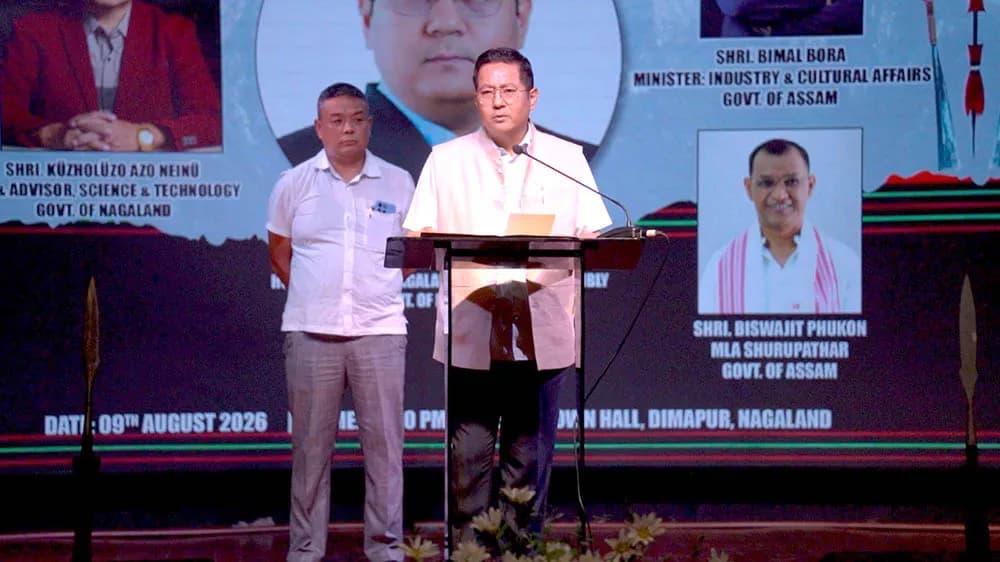
DIMAPUR — Nagaland Legislative Assembly (NLA) Speaker Sharingain Longkumer has called for stronger traditional institutions and constitutional safeguards to protect indigenous identity amid rapid development and generational change, saying the state must pursue development without losing its cultural roots.
Addressing the International Day of the World's Indigenous Peoples programme at Town Hall, Dimapur, as special guest, Longkumer said indigenous communities themselves must take responsibility for protecting their identity, culture, land, traditions and institutions while participating in the national aspiration of a developed India by 2047.
He also informed the gathering that efforts would be made to constitute a committee in the NLA to address issues concerning the indigenous rights of tribal people.
Longkumer said recognition accorded to indigenous peoples by the United Nations was significant, but recognition alone was not enough to protect indigenous communities and their way of life. He stressed the need for indigenous institutions to remain relevant and capable of responding to changing social and technological conditions.
"The indigeneity, the basis of being indigenous, depends on how they strengthen their existing institutions," he said.
He questioned whether traditional institutions would continue to remain relevant to younger generations amid rapid social and technological transformation, particularly with the region moving towards the 2040-47 development goals.
Longkumer linked the question of indigenous identity to the broader aspiration of Viksit Bharat 2047, saying development should respect the cultures, sensitivities and institutions of indigenous communities.
He said that the Northeast was home to around 220 ethno-linguistically diverse indigenous communities, each with its own language, traditions, customary laws, festivals and worldview. Such diversity, he added, should not be viewed as a weakness but as a strength and a reflection of India's pluralistic heritage.
He also spoke about the importance of land to indigenous communities, describing it as more than an economic resource. According to him, land forms the foundation of culture, spirituality, identity and collective existence.
Drawing from his experiences at international conferences in Australia and New Zealand, Longkumer said developed countries often formally acknowledge their indigenous peoples, but indigenous cultural practices can have limited presence in everyday life.
He questioned whether the Northeast could face a similar situation as it develops and urged communities to reflect on how traditional institutions and cultural practices could be preserved for future generations.
Focusing on the programme's theme, "Honouring Midwives: Safeguard Life and Well-being", Longkumer paid tribute to traditional midwives, saying their contribution represented more than a profession passed down through generations.
Advisor to Science and Technology Khuzoluzo Neinu said the coming together of indigenous communities of the Northeast under one platform was significant for safeguarding their rights and future.
He stressed that the observance of International Day of the World's Indigenous Peoples should serve not only as a celebration of indigenous heritage but also as a reminder of continuing struggles to protect land, culture, rights and traditional ways of life.
On the theme of indigenous midwives, Neinu described traditional midwives in Naga communities as "quiet guardians" of generations and custodians of indigenous knowledge.
He pointed out that long before modern healthcare facilities, roads and ambulances reached remote villages, traditional midwives assisted women during childbirth under difficult circumstances, often without recognition or financial reward.
While acknowledging the contribution of modern medicine and scientific advancement in saving lives, Neinu cautioned against allowing development to result in the disappearance of indigenous knowledge.
He called for practical measures to preserve indigenous midwifery practices, including strengthening rural healthcare networks and documenting traditional health practices before such knowledge disappears with ageing generations.
The programme was organised with participation from indigenous representatives from across the Northeast.