


Niki Sumi stresses Naga sovereignty and calls for an inclusive settlement involving all sections of Naga society.
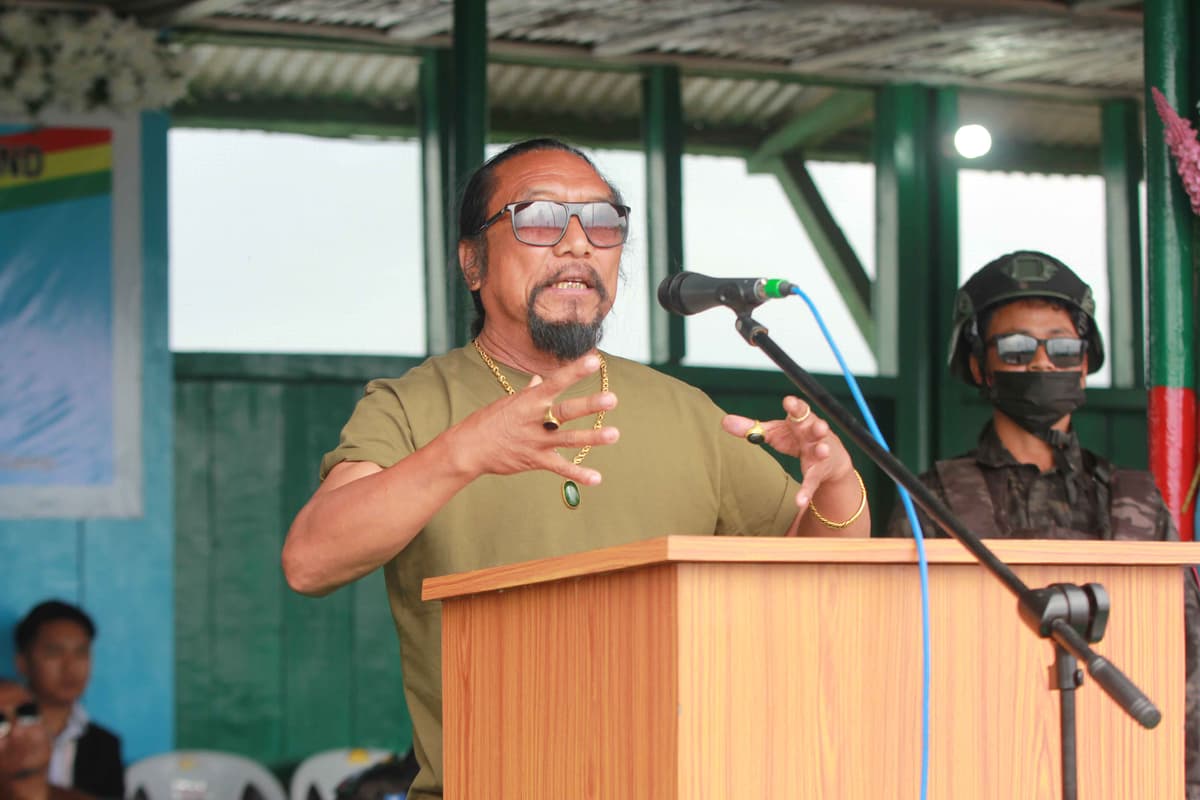
SURUHUTO — General (Retd.) Niki Sumi, president of the NSCN (K), Nikki group, has reiterated his group’s uncompromising stand on Naga sovereignty while calling for a truly inclusive political settlement that goes far beyond existing accords and involves every section of Naga society.
Interacting with reporters at the group’s Suruhuto Designated Camp in Zunheboto district on March 21, Sumi made it clear that the NSCN (K) remains outside both the “Agreed Position” backed by 18 Naga factions and the NSCN (IM)’s Framework Agreement, which he said operate within the Indian Constitution.
“Our position is crystal clear; we seek an inclusive settlement that is not limited to Naga political groups alone. It must encompass the entire Naga people, including all tribal hohos and civil society organisations,” he declared.
He said that he had conveyed this message directly to Indian government representatives and Naga intellectuals during earlier interactions.
Also read: NSCN (K) reiterates sovereignty stand, flags divisions among Naga political groups
Sumi described both the Framework Agreement and the Agreed Position as failures because they failed to align the interests of civil society with the political process.
“When the aspirations of civil society are not taken into account, any agreement is bound to collapse,” he added.
He prioritised NSCN K's “unity first” as its core stance; unity not only among the various Naga political groups but also with frontal civil society organisations.
Only after such unity is achieved, he said, should political dialogue proceed in accordance with the collective wishes of the Naga people.
On the sincerity of the Government of India, Sumi was blunt. He revealed that New Delhi has repeatedly pressured the NSCN (K) to join the NNPG (Naga National Political Groups), but the outfit refused.
“Instead of addressing our core demands, they are now trying to create friction between the Naga public and the underground groups,” he alleged.
“They are instigating the people to turn against the political groups and abandon the Naga political aspiration,” he added.
He urged the public to remain vigilant and protect Naga identity and political rights against such “malicious attempts.”
Sumi expressed his long-standing desire: “If the people so decide, I would like to transform the Naga movement into a genuine people’s movement,” but noted that the Government of India fears such a shift because it would become “unpredictable and difficult to control."
The NSCN (K) president disclosed that the Centre had even offered to make only the core workers signatories to any future settlement before formal dialogue could begin, an offer he rejected outright.
“I want every tribal representative to be a signatory to the final settlement. That is why I insist on taking the opinion of the people first,” he explained.
Sumi reaffirmed that the NSCN (K) would never compromise on the demand for sovereignty. “I will continue the fight for independence,” he assured.
He appealed to the people of Nagaland not to “sell the rights of the Naga nation,” expressing confidence that sovereignty would eventually be achieved “if not today, then tomorrow,” citing the Naga’s historic claim.
On the Forum for Naga Reconciliation (FNR), Sumi expressed appreciation for its sustained efforts in promoting peace and unity among Naga political groups. He particularly lauded the FNR’s role in significantly reducing fratricidal violence.
The NSCN (K) has never boycotted any FNR-called meeting, he clarified, though it has participated only as an “observer.”
However, Sumi criticised the FNR for being “toothless” in enforcing its resolutions or influencing political outcomes, describing its role as purely facilitative.
To make reconciliation effective, he suggested that future initiatives should be placed under the umbrella of tribal hohos so that decisions carry accountability and violators can be held responsible.