


Our Reporter
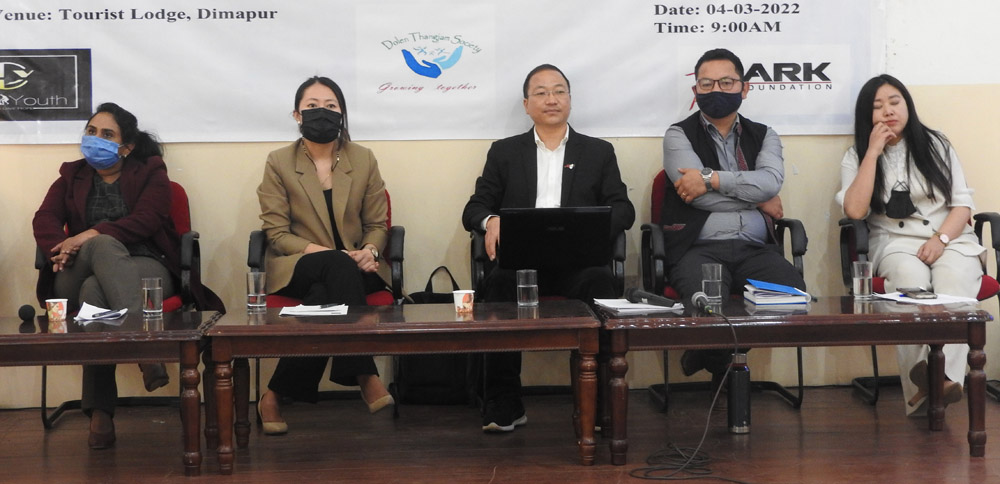
Dimapur, March 4 (EMN): Under the project ‘Leave no one behind,’ National Foundation for India (NFI), in collaboration with Can Youth, ARK foundation and Dolen Thangjam Society, organised a one-day state-level multi-stakeholders consultation programme at Tourist Lodge, Dimapur, on March 4.
While sharing his point of view on the topic ‘Peace building to achieve sustainable development goals in Nagaland,’ general secretary of Nagaland Christian Joint Forum (NCJF), Fr. GL Khing, stated that peace is a ‘positive inner urge and must be concretised through action-oriented goals.’ Stating that numerous initiatives to bring about development could not be materialised due to the absence of peace, he urged upon the young generation to change the system for the good of the whole community.
Khing also maintained that identifying cultural relations and differences was important for peaceful co-existence in the society. He has advocated identifying cultural relations and differences for an inclusive development.
Advocate and state coordinator of the Human rights Law Network, Neiteo Koza said that in terms of education male children were preferred sending to school against the girl child due to financial constraints. He, however, added that the practice has been eradicated with the introduction of central schemes related to girl education.
Some of the factors contributing towards woman inequalities, according to Koza, is the prevalence of stereotype gender laws. He added that inequalities towards women accounted for gender inequalities, economic imbalance and job security in the long run.
Consultant of International Development, Limabenla Jamir, while speaking on ‘Inclusive, effective and accountable institution in Nagaland,’ has sought peace, security, protection of rule of law and strong community institutions to achieve all other goals.
Associate editor of Morung Express, Dr. Moalemba Jamir, while speaking on ‘Education and economic development in Nagaland,’ asserted that the citizens of Nagaland are no stranger to visions- be it political, religious, socio-economic, cultural etc.
Jamir stated that Nagaland was among the first states in India to come out with State Human Development Report (SHDR) way back in 2004.
Jamir opined that Nagaland would have been way ahead of others in developmental parameters as well as a “developed state” by now if those visions came into reality.
Nayantara Sasikumar, nodal officer of SDG, spoke on “Challenges and opportunities; Nagaland state SDG vision 2030.”