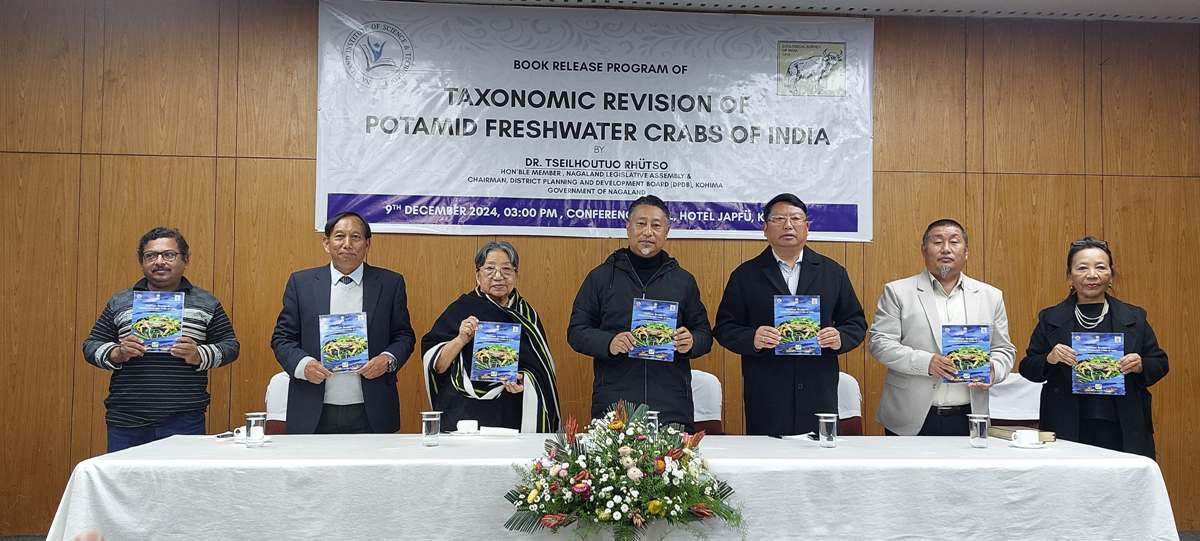
KOHIMA — A book, ‘Taxonomic Revision of Potamid
Freshwater Crabs of India,’ authored by Dr. Vinotsole Khamo and Santanu Mitra,
was released on Monday by Dr. Tseilhoutuo Rhutso, MLA and chairman of the District
Planning and Development Board (DPDB) Kohima.
The book launch ceremony, organised by the Nagaland
Institute of Science and Technology, Kohima, was held at Hotel Japfü. It was
published by the Zoological Survey of India and the Ministry of Environment, Forest
and Climate Change.
Speaking at the launch event, co-author Dr. Vinotsole Khamo
stated that, although she comes from a medical background, she became the
co-author of the book on crabs. She explained that this journey began when she
conducted research and a survey on a disease called paragonimiasis, which is
transmitted through the consumption of raw and undercooked crabs.
She explained that crabs are consumed both as a delicacy and
for medicinal purposes in Northeast India. Citing the World Health Organisation's
(WHO) findings, she highlighted that paragonimiasis has been identified as one
of the most neglected tropical diseases, including in India and the state.
This, she noted, led her to establish a research lab on
paragonimiasis, which was funded by the Department of Science and Technology,
Government of India.
Dr. Khamo explained that they were studying the distribution
of the disease in host species. During the process, they collected a number of
crabs from various places in Nagaland and Northeast India. She further noted
that they aimed to investigate which species served as hosts for the parasite.
However, as they could not identify the exact species of the crabs, they sought
the help of Santanu Mitra from the Zoological Survey of India, Kolkata.
She mentioned that this is how the book came into existence,
adding that Santanu Mitra is a keen researcher who, despite the pandemic,
visited to examine the crabs when invited.
Further, Dr Khamo informed that the research lab developed
an indigenous ELISA test kit for paragonimiasis, which was launched by the then
Principal Secretary of Health and Family Welfare, Himato Zhimomi, on April 27,
2018.
In his speech, co-author Santanu Mitra stated that
freshwater crabs are easily available in Northeast India and serve as a
low-cost food resource. He informed that there are two families of freshwater
crabs in India: Potamidae and Gecarcinucidae.
He pointed out that, in total, 650 species belonging to 100
genera of Potamidae are found around the world, while in India, only 40 species
had been reported before the research work began.
Mitra explained that, under the leadership of Dr. Khamo and
the Zoological Survey of India, they explored the diversity of freshwater crabs
along the northeastern and western Himalayas as well as the sub-Himalayan
region from 2019 to 2022. This research resulted in the identification of a
total of 62 species across 19 genera from India, of which 22 species and eight
genera were new to science.
He highlighted that Nagaland, located in the Indo-Burma
global biodiversity hotspot, is the most diverse northeastern state, with eight
new species and two new genera. He also mentioned that seven new species were
discovered in Arunachal Pradesh. He added that their study confirms the need
for more surveys and exploration in the states of Northeast India.
Mitra stated that taxonomy is the primary research for any
biological organism, as further research on any species requires a scientific
name. He emphasised the need for further research on freshwater crabs to
address economic and environmental issues, as well as the necessity to analyse
the food value of freshwater crabs, including their protein and lipid content,
on a species-by-species basis.
The co-author also pointed out the need to investigate the
cultural perspective of marketable species of freshwater crabs, as wild
collection may be a cause of their population decline.
Mitra also stressed the need to survey the population status
of each species to assess their abundance in their habitat. He emphasised the
importance of investigating the molecular-level identification of each species
in the near future to understand their phylogeny and evolutionary significance.
Dr. Rhutso prioritises research over buildings
In his address, the special guest, Dr. Rhutso, observed that
"research" is a term many Nagas may not be keen to hear or engage
with. While commending the authors' work, he expressed hope that the book would
assist many medical practitioners and support more researchers in the near
future.
Pointing out that many people like snails, crabs, and their
combination with pork, he maintained that this is also the right combination
for infection if not cooked properly. He explained that parasites reside in
crabs but initially infect snails, which then pass the infection on to crabs
and some crayfish. From crabs and crayfish, the infection can then spread to
humans.
However, he asserted that although the parasites can be
concerning when these foods are not properly prepared, he stated that they are
preventable if snails and crabs are cooked properly. He also explained the
combination with pork, noting that the meat contains a parasite called Tinea
solium, which appears as white cysts, typically in the muscle tissue and not in
the fat. He advised that all these products should be properly cooked.
The legislator encouraged the youngsters to draw inspiration
from Dr. Khamo and Santanu Mitra to pursue research not only in parasitic diseases
but also in other fields. He also assured that he would highlight the need for
increased funding for research and studies to the Nagaland Legislative Assembly
and fellow legislators, emphasising the importance of investing in research
over the construction of large buildings.
The Principal Secretary of Environment, Forest and Climate
Change, PHE, and Chairman of the Nagaland State Biodiversity Board (NSBB), E
Mhonbemo Patton, also addressed the event and commended the work of the authors
of the book.