


NEISSR launches ‘Rising Beyond Conflict’ highlighting pathways to peace, justice, and development in the Northeast.
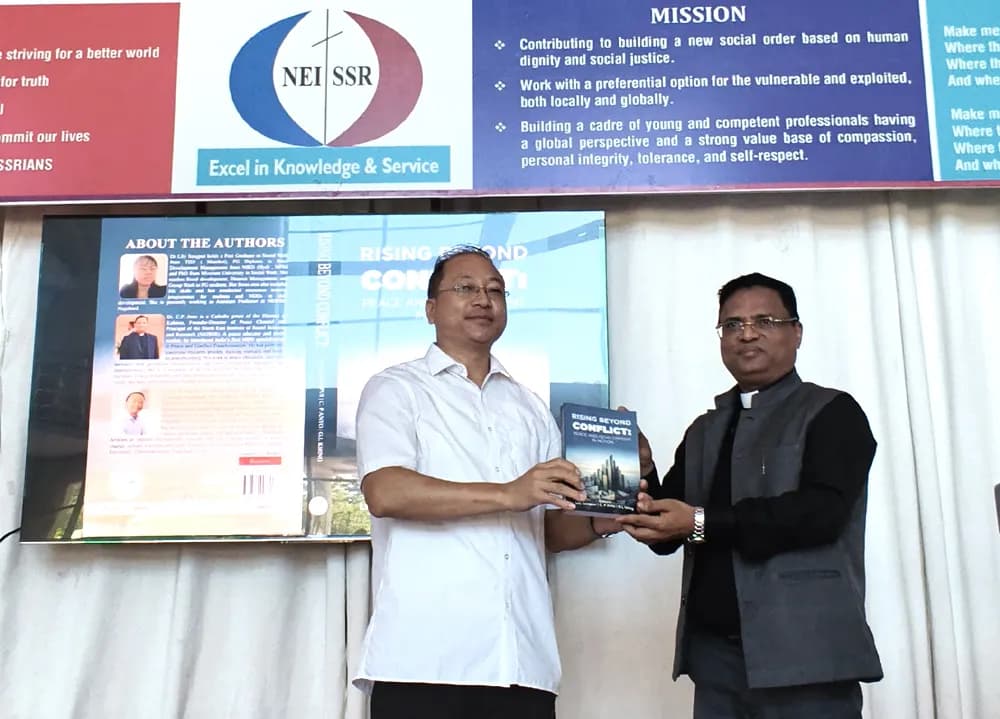
DIMAPUR — The North East Institute of Social Sciences and Research (NEISSR), Chümoukedima launched ‘Rising Beyond Conflict: Peace and Development in Action’ on September 28.
According to an update, the publication brings together perspectives that underscore the vital interrelationship between peace, reconciliation, social justice, and sustainable development, reflecting the institute’s commitment to scholarship, social responsibility, peacebuilding, and community transformation.
Presenting the publication, Dr. Fr. CP Anto, Principal of NEISSR, described the volume as a timely and meaningful contribution that reflects the academic vision, social commitment, and peacebuilding mission of the institute.
He stressed that for an academic institution, publication is not merely an academic exercise but an important expression of scholarship, intellectual responsibility, and institutional identity.
Dr. Anto highlighted the vital role of academic publications in creating and sustaining knowledge. While teaching transmits knowledge and research generates new knowledge, publication enables knowledge to reach the wider academic and social community.
Also read: Peace Channel launches mental health campaign in Chümoukedima
He observed that scholarly publications preserve experience, stimulate critical thinking, contribute to public discourse, and create an enduring intellectual legacy for future generations.
Speaking in the context of the Northeastern region of India, Dr. Anto noted the significance of engaging with questions of peace, reconciliation, social justice, and development. He stated that the region, while endowed with extraordinary cultural diversity, indigenous traditions, and rich community life, has also experienced complex social realities and histories of conflict. Consequently, discussions on peace and development extend beyond academic discourse and remain closely connected with the lived realities of communities.
Reflecting on the title of the publication, Dr. Anto underlined its message of hope and transformation. He stated that although conflict may constitute part of social reality, it need not determine the future of communities and societies. The journey beyond conflict, he said, requires resilience, reconciliation, and transformation.
Dr. Anto observed that sustainable development cannot flourish where communities experience exclusion, injustice, and persistent conflict. At the same time, sustainable peace requires opportunities, participation, education, social justice, and inclusive development. The integration of these dimensions makes the publication relevant to social workers, educators, researchers, community leaders, and peace practitioners.
Dr. Anto extended his congratulations to the editors and to all the contributors for their academic contributions.