TEHRAN — Iran's
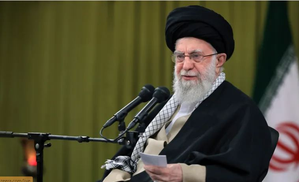
Supreme Leader Ali Khamenei said Friday that negotiating with the United States
will not solve Iran's problems, describing such negotiations as "neither
wise nor honourable," according to the official news agency IRNA.
Iran's past experience in negotiations with the United
States had shown that it led to no meaningful results, Khamenei said during a
meeting with senior Iranian military commanders.
"Even when we made concessions, we did not achieve the
desired outcomes. They tore up the agreement and failed to honor their
commitments," he said.
Regarding US threats to Iran's security, Khamenei stressed
that Iran would respond firmly to any of such threats. "If they violate
our national security, we will retaliate without hesitation," he stated,
Xinhua news agency reported.
On Wednesday, Iranian Foreign Minister Seyed Abbas Araghchi
said it is not difficult to ensure that Iran will not pursue nuclear weapons,
provided that "objective guarantees" are given to end hostile actions
against Tehran, including economic sanctions.
He made the comments on social media platform X, responding
to remarks by U.S. President Donald Trump who reaffirmed his stance of
preventing Iran from acquiring nuclear weapons and announced the restoration of
the "maximum pressure" campaign against Iran.
Ahead of his meeting with Israeli Prime Minister Benjamin
Netanyahu at the White House, Trump signed a national security memorandum
restoring maximum pressure on Iran, "denying Iran all paths to a nuclear
weapon, and countering Iran's malign influence abroad."
Araghchi criticised the "maximum pressure" as a
failed approach, reiterating that its continuation would only result in
"maximum resistance" from Iran.
The Iranian Foreign Minister emphasised that "wise
leaders should opt for maximum diplomacy instead," adding that Iran, as a
full member of the Nuclear Non-Proliferation Treaty and other global
nonproliferation agreements, has already made it clear that under no
circumstances will it seek, develop or acquire nuclear weapons.
Iran signed a nuclear deal, formally known as the Joint
Comprehensive Plan of Action (JCPOA), with six world powers in July 2015,
accepting restrictions on its nuclear program in exchange for lifting
sanctions.
However, during Trump's first term of office, the United
States withdrew from the agreement in May 2018 and reinstated sanctions,
prompting Iran to scale back some of its nuclear commitments.
Efforts to revive the JCPOA have not achieved substantial
progress.