[caption id="attachment_261851" align="aligncenter" width="500"]
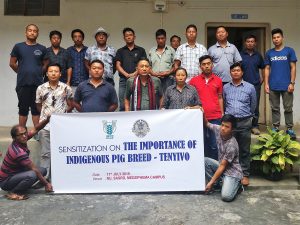 The participants of the one-day programme on "Sensitisation on the importance of indigenous pig breed – Tenyivo” posing for a photograph.
[/caption]
Dimapur, July 22 (EMN): A programme highlighting the importance of the indigenous pig of Nagaland was organised at NU-SASRD, Medziphema Campus, in Dimapur on July 17.
The one-day programme on "Sensitisation on the importance of indigenous pig breed – Tenyivo” was organised by ICAR-All India Coordinated Research Project on pig, Nagaland Centre, NU-SASRD Medziphema, a press release informed. A total of 29 participants representing four districts attended the event.
Dr. M Catherine Rutsa, assistant professor and in-charge of the ICAR-AICRP on pig, "stressed the importance of conservation and propagation of ‘Tenyivo’ which is decreasing rapidly in numbers," the statement read. She further stated that Tenyivo is now a recognised breed of Indian pig with unique morphological characters, adaptability, excellent mothering ability and meat quality.
Rutsa further pointed out that "low cost housing using locally available materials are the strength and plus points for pig farmers of Nagaland."
Dr. Gwazenlo Tep, VAS Zunheboto, while addressing the gathering emphasised on the "importance of rearing pig in a healthy system". He stated that it was important to use worm medicine and vaccinate them against swine fever in order for them to reach the desired weight, the statement read.
This registered Indian pig breed -- Tenyivo -- will be known the world over, so we need to give our best afford to rear, breed and safeguard it, the only first state domestic animal recognised by the Indian Government, Tep said.
Dr. Rüüsalie Nakhro, Nagaland State Technical Executive in-charge for Godrej Agrovet, made a presentation on the "advantages of feeding Godrej pellet for pigs which is economical, less wastage and users friendly," it informed.
Prof. T Lanusosang, Pro-Vice Chancellor, NU-SASRD, Medziphema campus, also spoke during the programme, and in his address "acknowledged the farmers for sharing their field experiences, adopting suitable management system, supporting the time bound funded project all to reduce poverty and hunger prevailing in the world around us."
A discussion on the "need of a demarcated enclosure for in situ propagation for Tenyivo pig" was also held during the programme where the farmers shared the need for the availability of "pure breed male and female Tenyivo pig" for "production and propagation.” The participants were also introduced to the various services provided by the "Animal Husbandry and Veterinary Services department for prevention and control of classical swine fever and farmer welfare schemes.”
A club for the farmers called Tenyivo Farmers’ Club was proposed to be formed in order to create awareness "on preservation, multiplication and promotion of Tenyivo".
T Lanusosang also released a booklet entitled “Tenyivo – An Indigenous germ plasm of Nagaland” authored by M Catherine Rutsa and V Rutsa during the programme.
Pure breed Tenyivo for breeding were made available at a subsidised rate to the participants. Godrej Agrovet also gave away free concentrate pig feed samples to the participants.


