National seminar on geology at Meriema
[caption id="attachment_82810" align="aligncenter" width="500"]
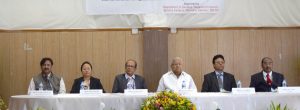 PB Acharya and resource persons seen here during the three-day national seminar at the NIELIT at Meriema, in Kohima district, on November 9.
[/caption]
KOHIMA, NOVEMBER 9: Calling the north-east India a goldmine, the governor of Nagaland PB Acharya has lamented that in spite of the wealth of natural resources, the sufferings of the people of the region do not seem to end.
The governor was of the opinion that the north east region had for long been portrayed negatively due to political instability, insurgency, and other problems.
The governor has challenged the educated people of the country to visit the region and explore its potential. “Unless the north east develops,
India as a nation cannot progress,” he said during an academic event on Wednesday.
Acharya was addressing the inaugural session of a three-day national seminar on geology, geochemistry, tectonics, energy and mineral resources of said region.
The event was conducted in the conference hall of the National Institute of Electronics and Information Technology (NIEIT), at Meriema, under Kohima district, on Wednesday.
The seminar-annual general meeting of the Indian Society of Applied Geochemists (ISAG) was organised by department of Geology,
Nagaland University.
With a population of 20 lakh and five universities in the state of Nagaland, Acharya said that the universities should not only be the centres of knowledge. The institutions need to ‘be applicable socially for the development of the society,’ he said.
Further, while pointing out that getting a degree was not the end goal for learners, the governor asserted that ‘applicability and
accountability of knowledge’ were what matters in today’s fast-changing world. Therefore, he said, one should not limit their selves to knowledge alone but should open up to ‘developmental activities with the acquired knowledge.’
Challenging Nagaland University, Acharya said it should work toward being a university ‘for developmental activities in the state by teaching the students about what is required in the society, so that the knowledge is translated into action.’
Empowered knowledge, Acharya explained, is one of the key factors for development. Research should be applicable to the growth of the society and if not, it should be stopped, he said.
Delivering the welcome address during the event, Prof. BV Rao called the northeast region a place where it is possible for researchers to
‘analyse both short and long-term events of the earth’s history, shaping not only some of the major features of the earth but also providing
enough natural resources for civilisation.’
Prof Rao said that the sedimentary basins of the region were endowed with ‘potential sites’ of coal and petroleum resources. However, he said, the progress of investigation so far has been slowed owing to the region’s hilly terrains.
Therefore, the professor said, the seminar was aimed at providing an opportunity for geoscientists for interaction and fruitful discussion about the recent advances made in the field of geological, mineral, and energy resources about the Naga hills and its contiguous regions.
Prof Rao hoped that the seminar would serve as a guide to exploring energy and mineral resources of the state and initiating collaborations form new projects with various interest-organisations.
The dean School of Humanities and Education, Prof Buno Liegise, also addressed the event. She said that the study of geology was paramount not only to prevent and prepare for disasters. It is also important to boosting trade and commerce of a country in a sustainable way, she said.
Further, she that although the science of geology was the bedrock of all societies and civilizations, she lamented that it had not been given its due place in the academic field, or at least in the state of Nagaland.
Nonetheless, she hoped that the seminar would encourage the value and relevance of science; that geology would received a highlight and its
scope would be comprehensively explored and widely understood, more so in the context of the Act East Policy of the Government of India.
During the event, Prof. GT Thong gave a brief profile of the department of Geology of Nagaland University. He informed that the faculty members have completed eight major research projects funded by the DST and the ISRO, three minor and five more major research projects are underway.
The department has also helped in formulating Nagaland’s State Disaster Management Plan and State Action Plan on Climate Change, he said.
Stating that the focus of the department was on generating skilled manpower to meet societal needs, Prof. Thong said plans were afoot to
introducing post graduate diploma and certificate courses in GIS and remote sensing, disaster management, watershed management, exploration geology and gemmology.
Also, giving a brief profile of the Indian Society of Applied Geochemists (ISAG), the group’s president Dr KK Dwivedy urged the state to be members of the organisation. The group was formed primarily to further the thrust and popularise geochemist in the country, he said.


