[caption id="attachment_124477" align="alignleft" width="550"]
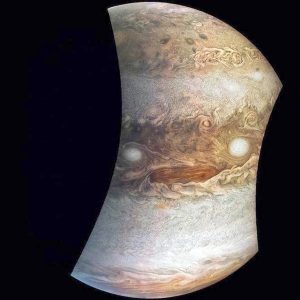 An image of Jupiter acquired by JunoCam on NASA’s Juno spacecraft on May 19, 2017 at 11:20 am PT (2:20 p.m. ET) from an altitude of 12,075 miles (19,433 kilometers). Photo Credit: NASA IMAGES
[/caption]
Washington, July 4 (IANS): NASA has said its Juno spacecraft will pass directly over Jupiter’s Great Red Spot, the gas giant’s iconic, 16,000-km wide storm, on July 10.
This will be humanity’s first up-close and personal view of the gigantic feature -- a storm monitored since 1830 and possibly existing for more than 350 years.
“Jupiter’s mysterious Great Red Spot is probably the best-known feature of Jupiter,” said Scott Bolton, principal investigator of Juno from the Southwest Research Institute in San Antonio, Texas.
“This monumental storm has raged on the solar system’s biggest planet for centuries. Now, Juno and her cloud-penetrating science instruments will dive in to see how deep the roots of this storm go, and help us understand how this giant storm works and what makes it so special,” Bolton added.
The data collection of the Great Red Spot is part of Juno’s sixth science flyby over Jupiter’s mysterious cloud tops.
Perijove (the point at which an orbit comes closest to Jupiter’s centre) will be on July 10 at 9:55 p.m. EDT, NASA said.
At the time of perijove, Juno will be about 3,500 km above the planet’s cloud tops.
Eleven minutes and 33 seconds later, Juno will have covered another 39,771 km and will be directly above the coiling crimson cloud tops of Jupiter’s Great Red Spot, the US space agency said in a statement on Saturday.
The spacecraft will pass about 9,000 km above the Giant Red Spot clouds.
All eight of the spacecraft’s instruments as well as its imager, JunoCam, will be on during the flyby, NASA said.
Gemini telescope aids Juno’s mission through Jupiter
San Francisco: Researchers are using very detailed Gemini Observatory images to help guide the Juno spacecraft’s exploration of Jupiter, a media eport said.
The high-resolution imaging by the Gemini North telescope on Maunakea in Hawaii was informing the Juno mission of compelling events in Jupiter’s atmosphere, Xinhua news agency reported.
“These observations trace vertical flows that cannot be measured any other way, illuminating the weather, climate and general circulation in Jupiter’s atmosphere,” Michael Wong of the University of California, Berkeley, said.
The scientists were using a longer-wavelength filter on the telescope to look at cloud opacity on the giant planet.
Being supported by Earth-based observations, according to a news release from UC Berkeley on Saturday, the Juno spacecraft, of the US National Aeronautics and Space Administration (NASA), was currently looping around Jupiter.
Using adaptive optics that removes atmospheric blur, astronomers at the Gemini North telescope were revealing “a treasure-trove of fascinating events in Jupiter’s atmosphere,” said Glenn Orton, the principal investigator for this Gemini adaptive optics investigation and coordinator for Earth-based observations supporting the Juno project at Caltech’s Jet Propulsion Laboratory.
The observations have produced a composite colour infrared image of Jupiter showing haze particles over a range of altitudes.
“Events like this show that there’s still much to learn about Jupiter’s atmosphere,” Orton was quoted as saying. “The combination of Earth-based and spacecraft observations is a powerful one-two punch in exploring Jupiter.”


