NASA mission touches down on Moon aboard Firefly Aerospace lander
According to a NASA statement, throughout Blue Ghost’s mission, the agency’s scientific instruments aim to test and demonstrate lunar subsurface drilling technology, regolith sample collection capabilities, global navigation satellite system abilities, radiation tolerant computing, and lunar dust mitigation methods.
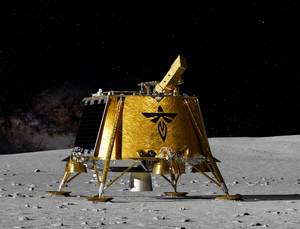
- WASHINGTON — Carrying a suite of NASA science and
technology payloads to the Moon, Firefly Aerospace’s Blue Ghost Mission 1 on
Sunday touched down on the lunar surface.
-
- According to a NASA statement, throughout Blue Ghost’s
mission, the agency’s scientific instruments aim to test and demonstrate lunar
subsurface drilling technology, regolith sample collection capabilities, global
navigation satellite system abilities, radiation tolerant computing, and lunar
dust mitigation methods.
-
- The data captured could also benefit humans on Earth by
providing insights into how space weather and other cosmic forces impact Earth.
-
- Blue Ghost will perform surface commissioning with health
checks on each subsystem.
-
- Once completed, the lander will be ready to perform its
payload operations and science demonstrations.
-
- Over the next 24 hours, Blue Ghost will deploy its surface
access arm with the Electrodynamic Dust Shield and Lunar PlanetVac, calibrate
the top deck gimbal to support the Lunar Environment Heliospheric X-ray Imager,
and enable operations for Radiation Tolerant Computer, Stereo Cameras for Lunar
Plume Surface Studies and the Lunar GNSS Receiver Experiment, according to the
US space agency.
-
- Previously, during this 9-minute braking burn, Firefly’s
Blue Ghost lunar lander positioned itself above the target landing site and
pitched over from a horizontal to a vertical orientation.
-
- This critical burn with all engines reduced Blue Ghost’s
orbital velocity from about 5,500 feet per second to 130 feet per second.
-
- After this braking maneuver, Blue Ghost’s main engine shut
off with under two minutes to touchdown. The lander’s Reaction Control System
thrusters then performed the final descent, pulsing as needed to reduce orbital
velocity to about 3 feet per second before touchdown.
-
- Simultaneously, Blue Ghost’s vision navigation system
tracked craters, slopes, and rocks to select a hazard free spot within the
landing zone.


