


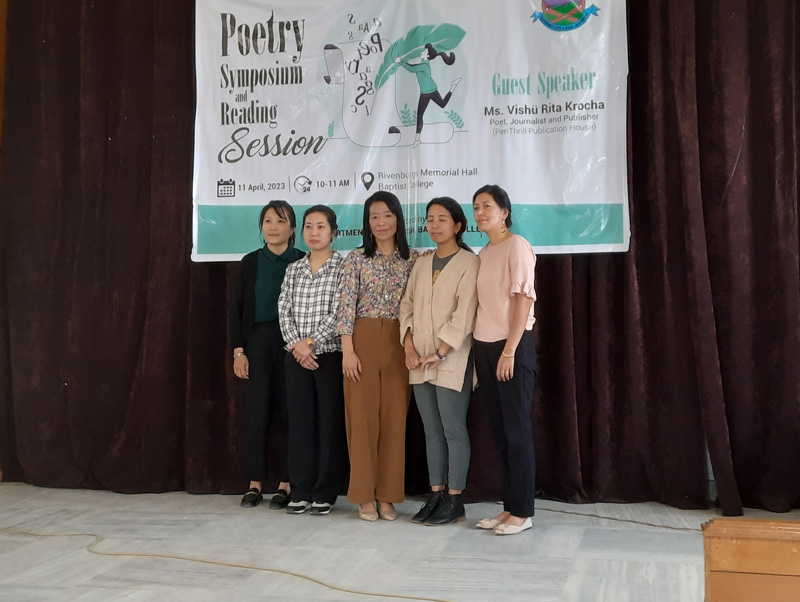
KOHIMA — For Vishü Rita Krocha, Nagas have the legacy of storytelling where many of its folktales, folksongs and stories of the rich culture and tradition have been passed on from generations and strongly felt that those attributes should be preserved by the posterity.
Vishü Rita Krocha, a poet, journalist and publisher, made this remarks during the poetry symposium and reading session organised by the English department of Baptist College in Kohima on Tuesday.
[bsa_pro_ad_space id=1]"I always think that the way our forefathers expressed themselves is so lyrical and this, I think is also deeply enrooted in the Naga culture that we continue to create music just like our forefathers sang while working in the fields, in groups or alone, when they sowed paddy on terrace fields; when they harvested them or carried them home; when they celebrated our numerous traditional festivals or even when they mourned the death of a loved one", Krocha said.
This is where she thought that some have inherited the gift of writing poetry. At the same time, she stated that a lot of people don't like poetry.
But for Krocha, who grew up listening to her grandparents narrating folktales to her, there was no escape as she personally loves poetry.
Recounting her initial venture into the PenThrill Publication House back in 2013, she said that her love for poetry was quite obvious because the first imprint was also a poetry collection. Krocha said that she knew right from the start they won't quite make money out of it, but she also knew the fact that it was important for people to express themselves whether it is through poetry, music, art, dance or any other form of art. It is through those expressions the stories could be preserved.
She found it interesting that many continued to write poems despite the fact that it does not sell too well.
"I think most of us do it for the love of it," she observed.
“Today, out of the 71 book titles the PenThrill have published so far, at least 50% of them are poetry collections and it continues to receive poetry manuscripts. This showed how most writers have chosen poetry to express themselves,” she shared.
"As an art form, I truly believe, poetry puts us back in touch with our humanity and helps see yourself in someone else's struggle. Then, you also begin to understand and appreciate their strength even more. For many of us, writing poetry is a therapeutic way to express our inner thoughts and feelings and what I like best about it is the raw emotion that it evokes. I think it's safe to say that so long as there are emotions, there will be poetry", Krocha said.
Krocha found great comfort in writing poetry. It helped her celebrate the beauty of each passing season and enabled her to deal with life's adversities especially in times of grief and sadness.
"And I think when we pass this on by way of sharing our poems with another fellow human being, we are also able to reach out to somebody who might be in a similar situation and in a way, tell them that they are not alone," she added.
When she first started writing poetry, she did not realised that it would become an integral part of her life. Now, she exclusively authored three poetry books and had co-authored a poetry book with her sister.
The head of English department at Baptist College, Dr. Sentinaro, said the symposium was organised keeping in mind the holistic development besides the academics. She added that the platform was for those who are interested in poetry to come together, exchange ideas and concepts.
On the occasion, the English honours students of the college presented original poems in poetry readings and also presented poetry in song.