[caption id="attachment_170396" align="alignnone" width="550"]
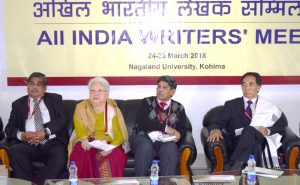 (From left to right) Prof. Ramesh C Gupta, pro vice-chancellor of NU; Dr. Temsula Ao; Madhav Kaushik, vice-president of Sahitya Akademi and Prof. D Kuolie seen at the All India Writers’ Meet at Kohima on March 24. (EM Images)
[/caption]
Kohima Bureau
Kohima, March 24 (EMN): The promise of literature in Nagaland – still to carve a distinct image of its own from fusing together its rich oral literature with a nascent writing tradition – has attracted interest from India’s national academy of letters, the Sahitya Akademi.
The Akademi has expressed hope of helping Naga writers ‘unearth the beautiful literature inherent in the traditions of Nagaland’ and sharing with the rest of the country. This was stated by K Sreenivasarao, the secretary of Sahitya Akademi.
To help ‘develop and enrich’ Naga languages and literature, the first ever All India Writers’ Meet has been organised jointly by the Akademi and Nagaland University, Kohima. The two-day event got underway on Saturday at Meriema.
With writers representing various cultural and literary traditions of the country keen to know the literary and cultural traditions of Nagaland, the organisers hope that writers and poets of Nagaland can interact with writers from other parts of India and get to know more about various practices, techniques and nuances connected with literary traditions of other regions and languages.
Speaking at the inaugural session, Sreenivasarao said the hope was to ‘inspire aspiring writers in the state to take up literature in a serious way and help Sahitya Akademi in unearthing the beautiful literature inherent in the traditions of Nagaland’.
Describing Northeast as a ‘linguistic treasure trove’, he maintained that the time was ripe to ‘unearth all these oral traditions and gems of native traditions and disseminate them to a vast audience.’
Towards this, he said the Akademi was committed to preserve and promote literature of the Northeast. It has already established the North East Centre for Oral Literature in Imphal, he informed.
Sreenivasarao asserted that there should be a concerted effort to preserve these languages and literature. “For death of a language is not merely a loss of one’s tool for communication. Loss of a language is equal to, or even more than a loss of one's culture, traditions, one's root and history,” he said while reminding that literature is the direct expression of languages.
He expressed desire to organise more programmes in Nagaland with the support of local writers and institutions.
Noted Naga writer, Dr. Temsula Ao observed that though Nagas have rich oral traditions, ‘which in itself is a form of literature’, most of it has been lost and what little remains is also on the verge of extinction as ‘Nagas do not have many knowledgeable story-tellers and folk-singers today.’
“Our oral tradition has most definitely been one of the greatest casualties of 'progress' and 'development' in our society,” she said.
While asserting that the ‘pristine past’ cannot be restored to its original status ‘nor should it be attempted to’, she was nevertheless encouraged that youngsters today are ‘creating a new tradition where the soul of our oral tradition is resonating with new vigour’.
Reminding that the literature the youngsters are writing is not a one-to-one transference of old stories, she said they must be encouraged to nurture their talents with freshness of the present with the wisdom of the past.
She also pointed out that the written literature from Nagaland is still nascent and not substantial in terms of quantity. However, Ao said she was encouraged to see visible energy among younger people who have taken to writing about the realities of today where ‘glimpses of the past are incorporated in subtle ways to create a new kind of fusion.’
“In such a symbiotic process, recollection of the past, inclusion, inversion and re-interpretation of orality into a written text has enabled quite a few writers to engage in a literary activity which may one day be acknowledged as the genesis of a New Literature from Nagaland,” she said.
The session was followed by poetry reading in various languages; and a session and discussion on ‘Writing: Passion or Profession.’


