Police immunization to begin on June 8
[caption id="attachment_41098" align="aligncenter" width="400"]
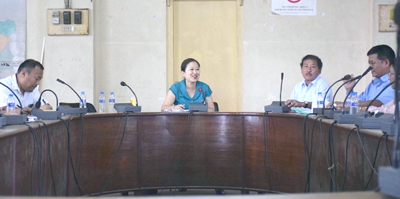
Elizabeth Ngully, center, seen here with members of the task force for Dimapur district’s Mission Indradhanush, an immunization program, during the group’s meeting on June 5 in Dimapur town.[/caption]
EMN
Dimapur, June 6
The percentage of child immunization in Nagaland is below the national average. This information was one of the key points of discussions during a recent meeting of government machineries that met to review the activities of an immunization program for Dimapur district.
The task force of the healthcare scheme, Mission Indradhanush, for Dimapur district met on June 5 to discuss the third round of the healthcare campaign. The health drive will start on June 8. The task force, consisting of administrative and healthcare officials of Dimapur district was conducted in the deputy commissioner’s office.
Presiding over the meeting, Additional Deputy Commissioner of Dimapur district Elizabeth Ngully said more information should be spread to the public to make them aware of the health campaign. Ngully is also the officiating deputy commissioner of the district.She said that ‘proper coordination’ was required between the administration and the implementing agencies including the stakeholders to make the health mission a success.
During the meeting, the officials noted that the percentage of child immunization in the state was below the national average. The mission will focus its efforts on high risk areas such as the urban areas, urban slums, brick kiln areas, construction sites, ‘nomadic sites’, and other areas where routine immunization coverage is weak.
Dr. Lanuakum gave an overview of the first and second round of Mission Indradhanush campaign that was carried out in the district. He sought continued involvement and support of accredited social health activists and Anganwadi workers, and school teachers for mobilizing targeted populations and their participation.
The medical doctor suggested that Indradhanush Mission would have better coverage if it was carried out starting in the month of January or February instead April to June. The latter period is the monsoon season during which ‘migrant worker goes back’, he said. He told the members of the task force that the migrant populations were reluctant to take immunization ‘due to lack of awareness and education’.
Citizens’ Factfile: Key facts about Mission Indradhanush
• It will focus on systematic immunization drives through a catch-up campaign mode aiming to cover all the children who have been left out or missed out for immunization.
• Under this scheme government will conduct 4 special vaccination campaigns between January and June 2015 with intensive planning and monitoring.
• These campaigns will be planned and implemented according to the learning’s of the successful implementation of the polio program.
• It will be implemented in 2 phases in 2015. First phase will cover 201 districts. While, second phase will cover 297 districts.
• For the first phase government has identified 201. These are high-focus districts in the country which have nearly 50 per cent of all unvaccinated or partially vaccinated children. Under this mission, these districts will be targeted intensively in order to improve the routine immunization coverage.
• Among the 201 districts, 82 districts are in the ‘BHIMARU’ states i.e., Bihar, Madhya Pradesh, Rajasthan, and Uttar Pradesh. In these 82 districts nearly 25 per cent children are unvaccinated or partially vaccinated children.
• WHO, UNICEF, Rotary International and others will be donor partners for Mission Indradhanush. While the mass media, interpersonal communication will play crucial role to monitor and evaluate the sturdy mechanisms for implementing this mission.



 Elizabeth Ngully, center, seen here with members of the task force for Dimapur district’s Mission Indradhanush, an immunization program, during the group’s meeting on June 5 in Dimapur town.[/caption]
EMN
Dimapur, June 6
The percentage of child immunization in Nagaland is below the national average. This information was one of the key points of discussions during a recent meeting of government machineries that met to review the activities of an immunization program for Dimapur district.
The task force of the healthcare scheme, Mission Indradhanush, for Dimapur district met on June 5 to discuss the third round of the healthcare campaign. The health drive will start on June 8. The task force, consisting of administrative and healthcare officials of Dimapur district was conducted in the deputy commissioner’s office.
Presiding over the meeting, Additional Deputy Commissioner of Dimapur district Elizabeth Ngully said more information should be spread to the public to make them aware of the health campaign. Ngully is also the officiating deputy commissioner of the district.She said that ‘proper coordination’ was required between the administration and the implementing agencies including the stakeholders to make the health mission a success.
During the meeting, the officials noted that the percentage of child immunization in the state was below the national average. The mission will focus its efforts on high risk areas such as the urban areas, urban slums, brick kiln areas, construction sites, ‘nomadic sites’, and other areas where routine immunization coverage is weak.
Dr. Lanuakum gave an overview of the first and second round of Mission Indradhanush campaign that was carried out in the district. He sought continued involvement and support of accredited social health activists and Anganwadi workers, and school teachers for mobilizing targeted populations and their participation.
The medical doctor suggested that Indradhanush Mission would have better coverage if it was carried out starting in the month of January or February instead April to June. The latter period is the monsoon season during which ‘migrant worker goes back’, he said. He told the members of the task force that the migrant populations were reluctant to take immunization ‘due to lack of awareness and education’.
Citizens’ Factfile: Key facts about Mission Indradhanush
• It will focus on systematic immunization drives through a catch-up campaign mode aiming to cover all the children who have been left out or missed out for immunization.
• Under this scheme government will conduct 4 special vaccination campaigns between January and June 2015 with intensive planning and monitoring.
• These campaigns will be planned and implemented according to the learning’s of the successful implementation of the polio program.
• It will be implemented in 2 phases in 2015. First phase will cover 201 districts. While, second phase will cover 297 districts.
• For the first phase government has identified 201. These are high-focus districts in the country which have nearly 50 per cent of all unvaccinated or partially vaccinated children. Under this mission, these districts will be targeted intensively in order to improve the routine immunization coverage.
• Among the 201 districts, 82 districts are in the ‘BHIMARU’ states i.e., Bihar, Madhya Pradesh, Rajasthan, and Uttar Pradesh. In these 82 districts nearly 25 per cent children are unvaccinated or partially vaccinated children.
• WHO, UNICEF, Rotary International and others will be donor partners for Mission Indradhanush. While the mass media, interpersonal communication will play crucial role to monitor and evaluate the sturdy mechanisms for implementing this mission.
Elizabeth Ngully, center, seen here with members of the task force for Dimapur district’s Mission Indradhanush, an immunization program, during the group’s meeting on June 5 in Dimapur town.[/caption]
EMN
Dimapur, June 6
The percentage of child immunization in Nagaland is below the national average. This information was one of the key points of discussions during a recent meeting of government machineries that met to review the activities of an immunization program for Dimapur district.
The task force of the healthcare scheme, Mission Indradhanush, for Dimapur district met on June 5 to discuss the third round of the healthcare campaign. The health drive will start on June 8. The task force, consisting of administrative and healthcare officials of Dimapur district was conducted in the deputy commissioner’s office.
Presiding over the meeting, Additional Deputy Commissioner of Dimapur district Elizabeth Ngully said more information should be spread to the public to make them aware of the health campaign. Ngully is also the officiating deputy commissioner of the district.She said that ‘proper coordination’ was required between the administration and the implementing agencies including the stakeholders to make the health mission a success.
During the meeting, the officials noted that the percentage of child immunization in the state was below the national average. The mission will focus its efforts on high risk areas such as the urban areas, urban slums, brick kiln areas, construction sites, ‘nomadic sites’, and other areas where routine immunization coverage is weak.
Dr. Lanuakum gave an overview of the first and second round of Mission Indradhanush campaign that was carried out in the district. He sought continued involvement and support of accredited social health activists and Anganwadi workers, and school teachers for mobilizing targeted populations and their participation.
The medical doctor suggested that Indradhanush Mission would have better coverage if it was carried out starting in the month of January or February instead April to June. The latter period is the monsoon season during which ‘migrant worker goes back’, he said. He told the members of the task force that the migrant populations were reluctant to take immunization ‘due to lack of awareness and education’.
Citizens’ Factfile: Key facts about Mission Indradhanush
• It will focus on systematic immunization drives through a catch-up campaign mode aiming to cover all the children who have been left out or missed out for immunization.
• Under this scheme government will conduct 4 special vaccination campaigns between January and June 2015 with intensive planning and monitoring.
• These campaigns will be planned and implemented according to the learning’s of the successful implementation of the polio program.
• It will be implemented in 2 phases in 2015. First phase will cover 201 districts. While, second phase will cover 297 districts.
• For the first phase government has identified 201. These are high-focus districts in the country which have nearly 50 per cent of all unvaccinated or partially vaccinated children. Under this mission, these districts will be targeted intensively in order to improve the routine immunization coverage.
• Among the 201 districts, 82 districts are in the ‘BHIMARU’ states i.e., Bihar, Madhya Pradesh, Rajasthan, and Uttar Pradesh. In these 82 districts nearly 25 per cent children are unvaccinated or partially vaccinated children.
• WHO, UNICEF, Rotary International and others will be donor partners for Mission Indradhanush. While the mass media, interpersonal communication will play crucial role to monitor and evaluate the sturdy mechanisms for implementing this mission.