


Nagaland University’s School of Agricultural Sciences organised a lecture series on ethical AI, e-resources, ONOS and researcher profiles for students and research scholars.
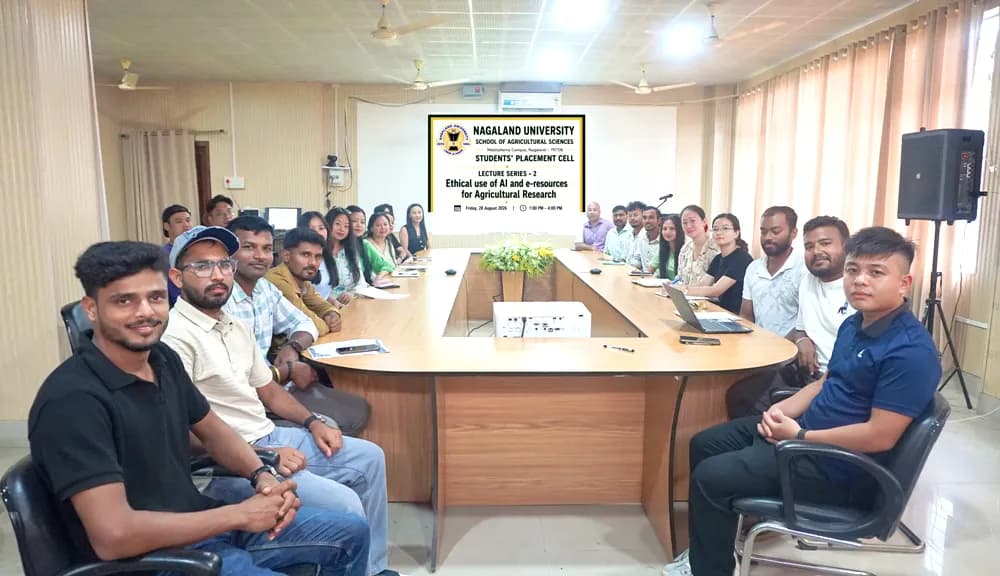
DIMAPUR — Nagaland University, through the Students’ Placement Cell of the School of Agricultural Sciences (SAS), Medziphema Campus, organised a lecture series on “Ethical Use of AI and E-Resources for Agricultural Research” on August 28, focusing on the responsible use of Artificial Intelligence (AI), digital library resources and researcher identification platforms in academic and research activities.
In a press release, the university stated that the programme was aimed at creating awareness among postgraduate students and research scholars about emerging digital tools and resources and their appropriate application in academic and research work.
Prof. Dipak Sinha, Pro Vice-Chancellor, School of Agricultural Sciences, Nagaland University (SAS NU), highlighted the growing relevance of AI in contemporary higher education and research.
He also emphasised the importance of establishing a strong digital research identity and encouraged Ph.D. scholars to create and maintain researcher profiles and identifiers, including ORCID, Google Scholar, Scopus and Web of Science Researcher Profiles.
Prof. Sinha said such profiles were important for enhancing the visibility and discoverability of researchers and ensuring proper attribution of their scholarly contributions.
The technical sessions were conducted by Dr. Chanlang Ki Bareh, Assistant Librarian, Nagaland University.
The first session, titled “Ethical and Responsible Use of Artificial Intelligence in Academic and Research Activities,” focused on the responsible application of AI tools, with emphasis on ethical practices, academic integrity, originality and the need for researchers to exercise appropriate judgement while using AI-assisted technologies.
The second session, “E-Resources Available through the University Library with emphasis on One Nation One Subscription (ONOS),” familiarised participants with scholarly electronic resources and digital services available through the University Library.
Particular emphasis was placed on ONOS and its role in facilitating access to scholarly literature and research resources.
The third session, “Research ID: Creation and Maintenance of a Researcher’s Profile,” focused on the importance of developing and maintaining a strong digital research identity.
Participants were sensitised to the role of researcher identifiers and academic profiles in improving the visibility, discoverability and proper attribution of scholarly work.
The technical sessions were followed by an interactive question-and-answer session, during which students and research scholars sought clarification on various aspects of AI, e-resources, ONOS and researcher profiles.
Participants also shared their views on the relevance of the sessions to their academic and research activities.
The programme commenced with a welcome address by Dr. Sabbithi Pavan, Assistant Placement Officer, SAS, Nagaland University.
The programme concluded with a closing remark by Dr. Mary N Odyuo, Placement Officer, SAS, Nagaland University, who expressed gratitude to the university authorities, pro vice-chancellor, resource person, library team, faculty members, research scholars, students and others who contributed to the successful conduct of the programme.
The programme witnessed active participation from students and research scholars of the School of Agricultural Sciences, underscoring the growing importance of ethical AI use, access to quality scholarly resources and the development of strong research identities in contemporary academic research.