


Nagaland University develops a pilot-tested tool to evaluate trainee teachers on inclusive education
DIMAPUR — Researchers from Nagaland University have developed and pilot-tested a 50-item achievement test to measure how well teachers-in-training understand inclusive education.
The tool is designed to help identify gaps in teacher preparation and improve teaching practices for children with learning needs.
According to a press release, the study is situated in the context of the National Education Policy (NEP) 2020, which calls for teachers to be ready to build classrooms where all children, regardless of ability, can learn together.
As per the researchers, a gap exists in how teacher education is assessed. Most tools currently focus on teachers' attitudes or confidence when dealing with classrooms, while few measure what future teachers know about inclusive education, including its concepts, practices, and policies. The new test aims to address that gap and assist teacher education institutions in identifying areas where trainee teachers struggle.
The findings were published in the International Journal of Research and Innovation in Social Science, a peer-reviewed open-access journal covering education, social sciences, economics, and management. The paper was co-authored by Research Scholar Aseto Iralu Meyase and Gyanendra Nath Tiwari from Nagaland University.
Also read: Nagaland University researchers study stock market reactions to banking frauds
The test was built around B.Ed. Course-10 at Nagaland University titled "Creating an Inclusive School". It covers five areas: special needs and education policies and provisions, inclusive classroom practices, building support networks, and related concepts. The questions assess various levels of thinking, ranging from recall to applying knowledge, analysing situations, and evaluating possible solutions.
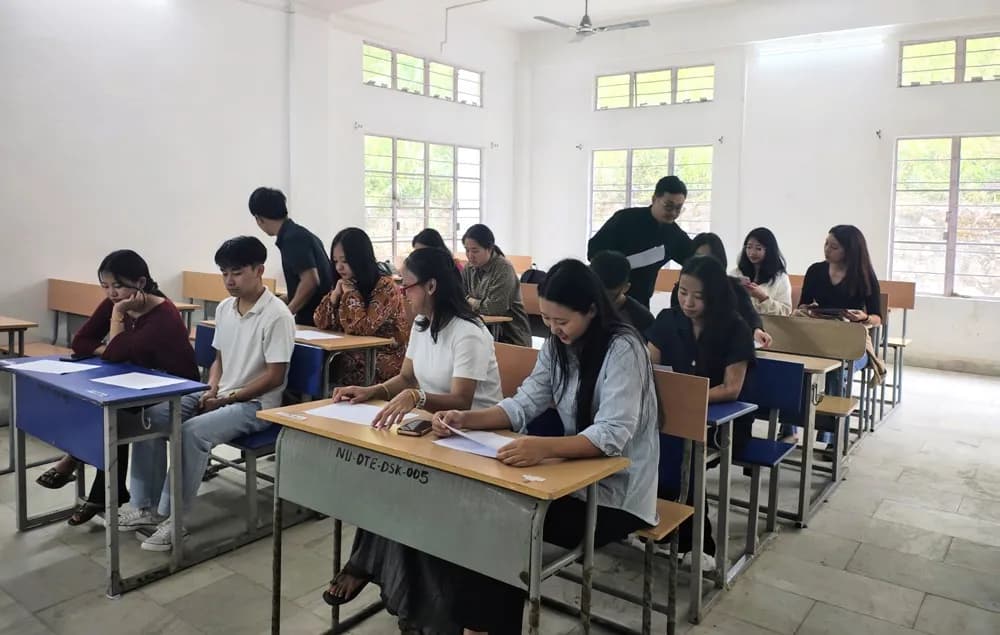
Elaborating on the research, Gyanendra Nath Tiwari from the Department of Teacher Education, Nagaland University, said, "We started with 60 questions. We reviewed them before being used with 42 M.Ed. Students at the Kohima Campus. We looked at how difficult each question was, how well it could tell strong and weak performers and how consistent the test was overall."
Aseto Iralu Meyase added, "Based on our analysis we removed 10 questions that did not work well. This left us with a 50-item test. The internal consistency of the test, measured by Cronbach’s alpha went up from 0.641 to 0.727. This means the test is more reliable now. More testing is needed to confirm its stability across larger and more varied groups of trainee teachers."
The results showed that questions requiring students to apply or analyse knowledge performed better, suggesting that testing how well future teachers use knowledge is more effective than testing recall alone.
The researchers noted that this is a pilot study, and the test serves as an assessment tool. Next steps include testing it with trainee teachers across different colleges in Nagaland to verify consistency across groups and observe whether scores align with classroom practices. The method could also be adapted for other northeastern states based on local curricula.