


Nagaland University hosts international seminar exploring environmental humanities, indigenous knowledge and ecological awareness
DIMAPUR — Nagaland University (NU), Kohima Campus, Meriema, hosted a two-day international seminar on environmental humanities, bringing together 20 eminent resource persons from institutions across India, Europe, North America and Asia.
Titled “Where Trees Become Texts in Environmental Humanities: Art, Music, Literature & Pedagogy,” the seminar was held on November 12 and the 13th in hybrid mode at the conference hall of the Department of Commerce, NU, Kohima Campus, the university stated in a press release.
The seminar was jointly organised by the Department of English and the Department of Teacher Education, in collaboration with Amity University, Kolkata; Budge Budge College, West Bengal; Government College Seppa, Arunachal Pradesh; Kohima Science College, Jotsoma; and PURE Foundation, Kolkata.
The inaugural programme was attended virtually by Prof. Jagadish Kumar Patnaik, Vice-Chancellor of Nagaland University and chief patron of the seminar.
Prof. Lungsang Zeliang, Dean, School of Humanities and Education and co-patron, was also present, along with Prof. MAJ Khan, Head of the Department of English, and Prof. Nigamananda Das, Senior Professor, Department of English and Advisor to the seminar.
In his inaugural address, Prof. Patnaik underscored the growing importance of interdisciplinary academic engagement in addressing contemporary environmental concerns.
He emphasised that environmental challenges should not be viewed merely as scientific or technological problems but also as ethical, cultural and educational issues requiring collective intellectual engagement.
Prof. Zeliang highlighted the transformative role of the humanities and education in fostering environmental consciousness.
He stressed the importance of understanding the natural world as an integral part of human culture, collective memory, indigenous identity and literary imagination.
Presenting the concept note, Dr. Subhashis Banerjee, Assistant Professor, Department of English, NU, outlined the theoretical foundations of the seminar, highlighting environmental humanities as an interdisciplinary field connecting literature, philosophy, cultural studies, art, music, ecological criticism and pedagogy.
He also emphasised the significance of indigenous ecological knowledge systems, particularly in Northeast India, where forests, rivers, mountains and plant life remain deeply embedded in oral traditions, community identities and cultural practices.
Dr. Banerjee acknowledged the scholarly contributions of Prof. John Charles Ryan to plant humanities and ecological literary studies, which provided intellectual encouragement for conceptualising the seminar.
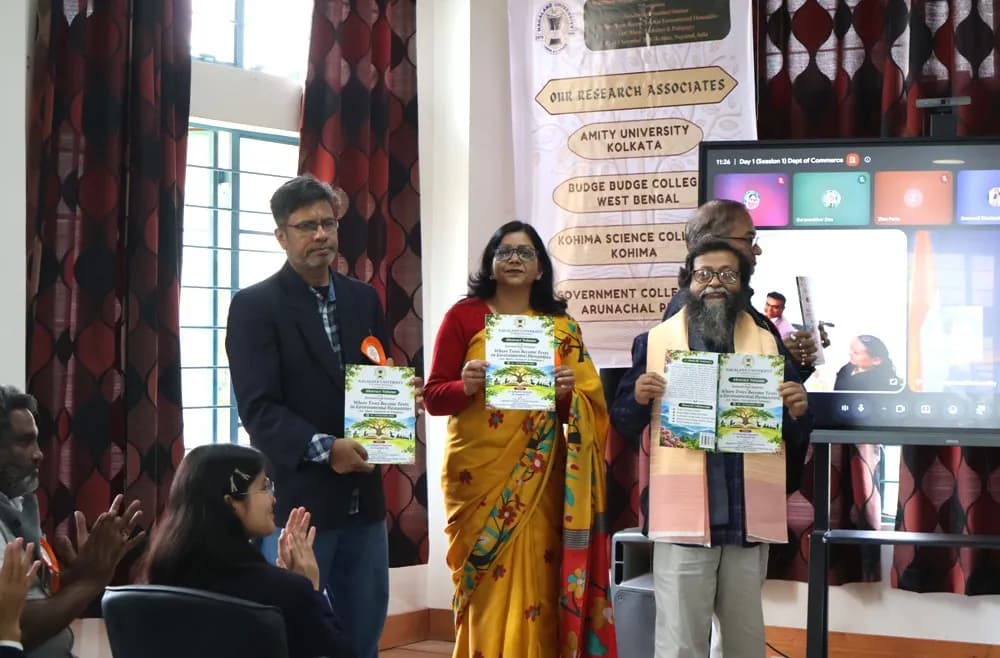
The abstract volume of the seminar edited by Dr. Banerjee and Dr. Pal, was released during the programme.
The publication features research abstracts exploring various aspects of environmental humanities, including literature, ecological philosophy, indigenous knowledge, plant studies, music, artistic expression and pedagogy.
Delivering the valedictory address, Prof. Anju Verma, Head of the Department of Teacher Education, NU, highlighted the importance of environmental awareness in contemporary education and called for greater integration of ecological sensitivity into teaching and learning.
She also emphasised the responsibility of educational institutions in nurturing environmentally conscious citizens and promoting sustainable relationships between humanity and the natural world.
The seminar concluded by reaffirming Nagaland University's commitment to interdisciplinary research, international academic collaboration and environmentally responsible education.