


Nagaland University’s MDRC hosts a national conference on revitalising Indian Knowledge System, highlighting indigenous knowledge, multidisciplinary education and systematic research.
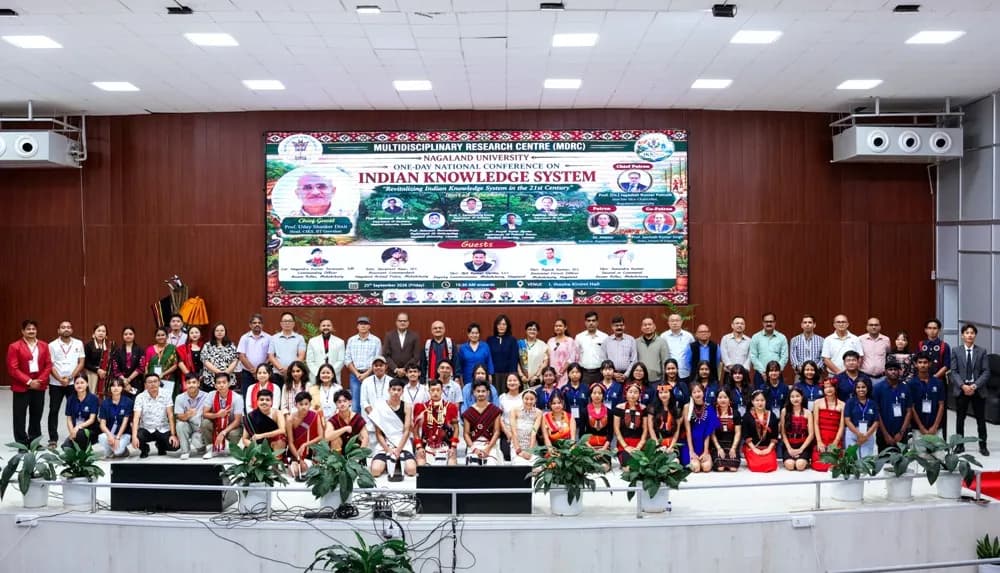
DIMAPUR — The Multidisciplinary Research Centre (MDRC), Nagaland University, organised a one-day national conference on “Revitalising Indian Knowledge System in 21st Century” at the I Ihoshe Kinimi Hall, Headquarters Lumami, Zunheboto district, on September 25.
The conference brought together university administrators, faculty members, researchers, scholars and students to examine the relevance, preservation and revitalisation of Indian Knowledge System (IKS) in the contemporary context.
In a press release, the university stated that the conference highlighted the need to connect traditional knowledge with modern education, research and sustainable development, while emphasising the importance of documenting and validating indigenous knowledge through systematic research.
Nagaland University Vice-Chancellor and chief patron, Prof. Jagadish Kumar Patnaik, said traditional knowledge should be connected with modern knowledge systems.
Reflecting on the impact of colonial education, he stressed the value of ancient Indian pedagogical traditions, particularly experiential and learner-centred approaches.
He also pointed to traditional water-harvesting practices in Nagaland as examples of indigenous knowledge that could offer lessons for sustainable development.
The chief guest, Prof. Uday Shanker Dixit, Head of Indian Knowledge System at IIT Guwahati and former Officiating Director of CIT Kokrajhar, underscored the importance of multidisciplinary education under NEP 2020.
He said students should develop knowledge and skills across disciplines while recognising the continuing relevance of traditional Indian knowledge in contemporary education and research.
Prof. Dixit delivered the keynote address on “Relevance of Indian Knowledge Systems in Modern Age” during the first technical session.
He discussed the potential contribution of traditional Indian knowledge to contemporary challenges, with particular reference to knowledge contained in ancient texts such as the Vedas and Puranas and its relevance to science, technology, education and research.
The conference featured two technical sessions, poster presentations and a valedictory session.
Technical Session-II brought together presentations from scholars in Chemistry, Economics, Anthropology, Law and Political Science.
The presentations examined IKS from diverse perspectives, including the impact of colonial education and the revitalisation of indigenous knowledge through NEP 2020; the relationship between indigenous knowledge and economy, culture, food, medicine and ecology; preservation of traditional knowledge; Indian legal jurisprudence based on concepts of dharma, duties and justice; and the global relevance of ancient Indian wisdom.
The conference also provided a platform for students to showcase their research through poster presentations.
A total of 72 abstracts were received from different departments of Nagaland University, representing undergraduate, postgraduate and Ph.D. scholars.
Posters were evaluated by a jury comprising faculty members and invited experts, with prizes awarded in the UG, PG and Ph.D. categories.
During the valedictory session, Divisional Forest Officer, Mokokchung, Rajesh Kumar, stressed the importance of acquiring, preserving and appropriately sharing knowledge, while referring to traditional knowledge practices and examples from Indian philosophical and literary traditions.
Assistant Commandant, Mokokchung, Gurpreet Kaur, emphasised the need for proper examination, documentation and validation of knowledge through research methodology.
Referring to the Rigvedic idea of receiving knowledge from different directions, she highlighted disciplined thinking and action as important elements in nation-building.
Deputy Commissioner, Mokokchung, Ajit Kumar Verma, who was the chief guest at the valedictory session, called for preserving knowledge embedded in India’s cultural traditions, texts, philosophies and historical practices.
He stressed the need for systematic documentation and revival of IKS, referring to the six Indian philosophical systems and the four Purusharthas—Dharma, Artha, Kama and Moksha.
The conference opened with a welcome address by MDRC convenor and coordinator Prof. Ambrish Singh, while organising secretary Dr. Alka Nanda Amethia provided an introductory presentation on IKS and the thematic context of the conference. NU Registrar Dr. Abemo also addressed the gathering, emphasising the growing significance of multidisciplinary education for the future generation.
The inaugural session also featured the release of the conference abstract book and a Swachhata Pledge led by Dr. Likhase Sangtam.