


Nagaland University and the Institute of Chinese Studies open the 19th All India Conference of Chinese Studies in Lumami
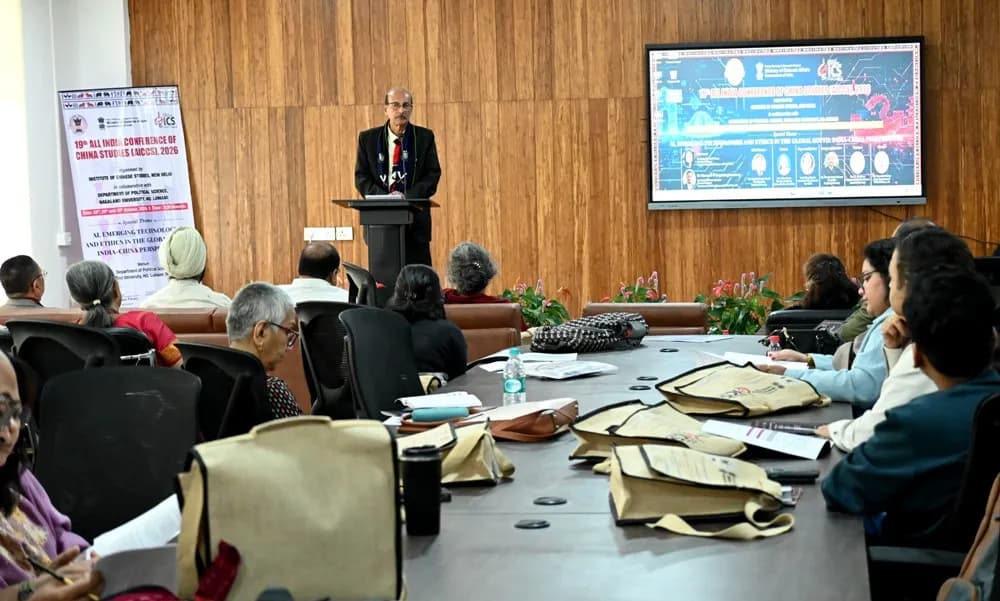
DIMAPUR — The 19th All India Conference of Chinese Studies (AICCS) commenced at Nagaland University, Lumami, on October 28.
Jointly organised by the Institute of Chinese Studies (ICS), New Delhi, and the Department of Political Science, Nagaland University, the three-day conference from October 28 to October 30 brings together scholars, researchers, and practitioners to examine contemporary China, India-China relations, and the future of China Studies in India.
According to an update, speaking on the occasion, Director of ICS Alka Acharya highlighted the significance of the partnership in expanding research on China and East Asia across Northeastern India. Lt. Col. Amardeep Singh Multani, representing the Ministry of External Affairs, observed that diplomacy must continue even amid strategic competition.
Nagaland University Chancellor Dr. Samudra Gupta Kashyap underscored the need to integrate China Studies into local academic discourse, given the region's shared boundary and strategic location.
Delivering the keynote address, "Cartographies of the Cloud: New Maps, Old Dilemmas for the Global South", Nimmi Kurian argued that artificial intelligence (AI) has a material foundation in resource extraction, water use, land, and physical labour.
Read more local news: 35 Nagaland PM SHRI schools contest in state-level choir competition in Kohima
During Special Panel I, titled "Current Discourses in Chinese Studies", Nishit Kumar, Assistant Professor at Chanakya University, Bengaluru, traced the evolution of China Studies in India from an early focus on civilisation, language, and Buddhism (1928-1962), through security-centred research after 1962, to economic engagement after 1991 and the post-2017 focus on technology, security, and supply chains. He recommended a national consortium of universities and research bodies, dedicated faculty positions, improved archival access, and the use of AI for translation support, while stressing that human expertise remains irreplaceable.
Prashant Kaushik of Central University of Gujarat examined Chinese language education through the lens of the National Education Policy 2020. Using oral history, archival research, and interviews, he argued that the field requires stronger institutional integration, systematic research methods, and deeper archival investigation rather than merely new institutions.
Shanky Chandra of Doon University highlighted the absence of a clear national policy for Chinese language teaching and warned that uneven implementation of NEP 2020 could widen inequalities between metropolitan and regional institutions. He recommended a coherent national policy, standardised quality control, and sustained institutional support.
Snehal Ajit Ulman of Sikkim University focused on Northeast India, noting the acute shortage of Chinese language programmes and qualified faculty despite the region's strategic location. In the closing discussion, Mitra stressed that, despite AI's growing influence, soft skills and human scholarship cannot be replaced.
During Thematic Panel I, "China's Political Economy: Environment, Energy and Regional Development", Prachi Aggarwal of the University of Delhi analysed China's energy strategy under Xi Jinping, describing a gradual rather than immediate transition away from fossil fuels. She noted that coal remains central because of local government and industrial dependence, while electric vehicles, batteries, and solar panels are emerging as key sectors in China's cleaner-energy strategy.
Saumya Soni of Jawaharlal Nehru University presented research on Zhejiang Province's shift from the market-driven "Wenzhou Model" to technology-led digital governance, exemplified by Hangzhou's "City Brain" initiative. She argued that AI and big data improve public services but do not replace local institutions, community networks, and human verification.
Mallika Bora of the University of Delhi critiqued the political economy of ethnic textile and handicraft industries in Yunnan. Applying Samir Amin's framework of unequal development, she argued that tourism, poverty-alleviation programmes, and global market expansion can commodify ethnic culture while reinforcing class, ethnic, and gender hierarchies. She cautioned that market visibility should not be mistaken for structural emancipation.
Ana Sinha of FORE School of Management examined water stress, carbon-transition risk, and governance gaps in India-China semiconductor and AI infrastructure investment. Identifying Dholera and Jewar in India, and Tianjin, Xi'an, and the Yangtze Delta in China as high-risk zones, she argued that technological sovereignty is impossible without environmental sustainability, responsible water management, and stronger impact assessment.
During Thematic Panel II, "State, Society and Governance in Contemporary China", Prabir Kumar Talukdar of the University of Delhi presented on Tang Ping ("lying flat"), arguing that the withdrawal of many Chinese youth from intense competition reflects declining trust in fairness and upward mobility rather than laziness. He noted that educational pressure, precarious employment, and inequality have weakened the belief that individual effort guarantees advancement, while the state has responded through censorship and moral framing.
Bidisha Seth of Visva-Bharati University analysed the contradictions between China's official state feminism and its restrictions on autonomous feminist activism. Referring to the 2025 Global Leaders' Meeting on Women, she argued that genuine gender equality requires independent agency, decision-making authority, and the freedom to organise, not official declarations alone.
Rityusha Mani Tiwary and Saima Iqbal of Shaheed Bhagat Singh College presented a comparative gendered political economy of women's movements in China and India. They contrasted China's state-led feminism within limited autonomous space with India's more open but fragmented democratic and market environment.
The panel concluded that development models must be re-evaluated to centre young people's lived realities and foster independent feminist spaces.