


Department of School Education will close down more government schools and continue the amalgamation exercise across Nagaland, revealed Dr. Kekhrielhoulie Yhome
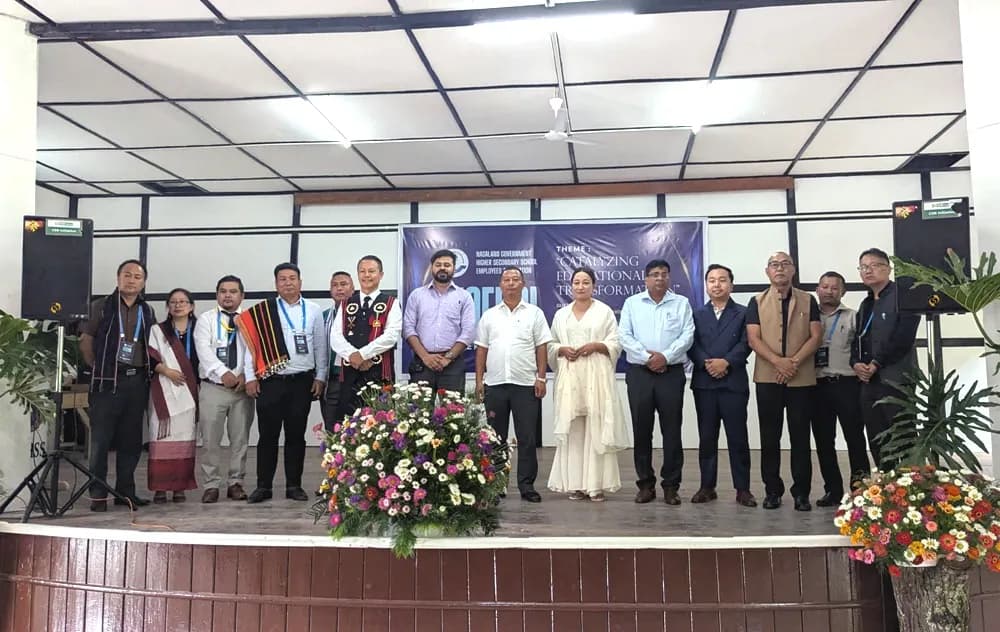
KOHIMA — Department of School Education will close down more government schools and continue the amalgamation exercise across Nagaland, revealed Dr. Kekhrielhoulie Yhome, Advisor of School Education, on Saturday.
He said this while addressing the general conference of the Nagaland Government Higher Secondary School Employees Association (NGHSSEA), held at Rüzhükhrie Government Higher Secondary School, Kohima, under the theme ‘Catalyzing Educational Transformation’.
Besides plans to close down and amalgamate several schools this year, he said the department will convert higher secondary schools into composite schools because composite schools ‘automatically begin to grow’. Out of 57 government higher secondary schools, 21 are composite, an exercise which began only recently.
The advisor informed that the overall enrolment in the three streams stood at 6,475 in 2025, but it fell short by 81 students this year.
Highlighting the issue of stagnation in the postgraduate teachers (PGTs) and other cadres, he said the department is unable to appoint District Education Officers (DEOs) in six districts due to instructions from the Personnel and Administrative Reforms (P&AR) department.
Also read: Nagaland to shut 34 government schools, merge 17 others in statewide education overhaul
Citing a recent office memorandum issued by P&AR, he said it would be difficult for the secondary and elementary groups to have directors in the future. Nobody will reach director’s position and currently 46 administrative posts are lying vacant, he added.
‘Expect drastic decisions’
Also highlighting the issue of officers being absent from their workplaces two to three months before retirement, he said motivation tends to decline with seniority, describing it as “human nature”. Especially, seniors from the secondary cadre who are posted at the Directorate find the sits and offices of the directors and immediate officers vacant as they often leave a few months before retirement.
WATCH MORE:
With the Samagra Shiksha scheme set to transition to its 2.0 phase, it will no longer remain a dedicated division of the Directorate, he said, adding that owing to this, the department would have to take “drastic decisions” to strengthen the Directorate and urged teachers not to view such decisions negatively.
The department is also working to fast-track language development and address the shortage of language teachers, he said, adding that the Nagaland curriculum framework is almost ready. He noted that artificial intelligence (AI) could help accelerate the writing of books and the collection of stories.
Yhome said the department is working on three pillars--infrastructure, curriculum and governance--to rebuild Nagaland's school ecosystem.
Infrastructure depends on funding, while curriculum reboots the education system, and governance depends on understanding service matters, human resource management, transfer and posting. He said this move could clash with some of the existing service rules.
Read more: 117 government schools in Kohima record attendance below 80%; DEO issues show-cause notices
‘If we look at the state, we realise the mistakes of our elders. This generation, unless we come from our own end with a sense of sacrifice and agree to do something, it will be difficult for our children to rectify all these,’ he said.
On teacher shortage and upcoming projects
The advisor further informed that 70 PGTs will join the cadre once the NPSC conducts the oral examination, while another 30 candidates are in the pipeline.
The department is not appointing teachers due to financial constraints, he said, adding that there are surplus teachers except in key subjects such as Mathematics, Science and PGTs. To address the imbalance, the department is reconverting existing resources to fill PGT positions, he said.
The advisor also highlighted several ongoing and upcoming projects, including those involving partnerships with various organisations through corporate social responsibility (CSR) initiatives. One such projects is learning centres in Kiphire and Dimapur that are engaging with Dream a Dream, which is collaborating with a US-based firm to develop curriculum. Another initiative involves Saturday art classes in schools across the state.
He went on to say that an MoU worth INR 1 million with Google is expected soon to improve the school ecosystem in terms of artificial application interventions. Yamaha International has started implementing pilot project in Kohima and Dimapur involving the introduction of the recorder to develop a music curriculum for children.
Also speaking at the event, NGHSSEA President Yekavi Swu noted that the National Education Policy (NEP) 2020 has brought a drastic change to the education system, administration and teaching profession.
Stating that a teacher is now expected to not only to serve as a role model for students but also as educators and facilitators, he urged teachers to ensure that students’ academic interests and the holistic development of children do not suffer in any manner.
He also pointed out the long-felt need of the department to review the higher secondary cadre and the School Education Service Rules, 2017, as well as the limited upgrading of higher secondary schools in recent years.
He expressed hope that the department would bring about positive changes, while urging the teachers to work hand in hand and serve as catalysts for change.
Earlier in the programme, Yhome released the association’s statistical report on ‘government higher secondary schools in Nagaland and academic performances in the HSSLC examinations’.