


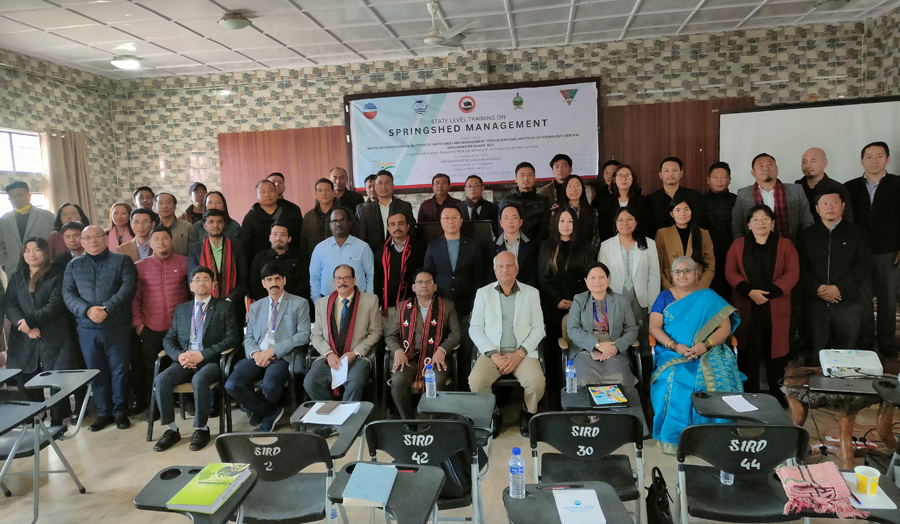
Dimapur, Dec. 16 (EMN): A three-day state-level training on springshed management, organised by North Eastern Institute of Water and Land Management (NERIWALM), Tezpur, in collaboration with Central Ground Water Board-NER (CGWB), Guwahati; National Institute of Hydrology (NIH), Roorkee; department of Water Resources, RD and GR, Ministry of Jal Shakti, government of India; and department of Land Resources, government of Nagaland, was held at the conference hall of SIRD from December 13 to the 15th.
Delivering the welcome speech at the inaugural programme, A Pangjung Jamir, director of Land Resources, expressed hope that the training would help in the implementation of water related programmes in the state. He also highlighted the springshed development programmes being taken up by the department of Land Resources in the state.
Short speeches were delivered by T Rajababu, senior scientist of CGWB-NER, and Dr. SV Vijayakumar, head of NIH, NERC. Rajababu stated that springs are the primary source of water for the rural households in hilly areas. Informing that 80-90% of the total Himalayan region depended on springs, he stated that the government of India has taken up several initiatives in collaboration with different states to ensure water security.
Dr. Vijaya Kumar stressed on the interconnection of springs and impact of other developmental activities taking place in the springshed areas. He stressed on maintaining the national database of springs in a systematic way.
A short video clip on “Springshed management in Nagaland-a strategy for climate proofing” was also screened during the inaugural function.
Speaking on “Hydrological overview of country and water budgeting for effective water resources management” during the technical session, Dr. Vijaya Kumar explained about springs, types and classification of springs and their importance, quantifying and budgeting, field mapping of surface inter connection, water sample collection and chemical analysis, dye trace experiments, source water assessment area, spring yield, intervention measures and common mistakes in spring flow management.
Speaking in the second session on “Overview of springs: importance, problems, genesis and types,” Dr. SS Rawat state that many good works have been done in the state on springs and water related issues but there was a lack of documentation. Informing that springs are drying up due to anthropogenic activities as well as climate change and climate variability, he stated that the government of India has come up with a water policy to bridge the major gaps which has kept springs away from the policy/ mainstream research.
The third session on “Hydrology with special reference to springs in NE States,” Shashinlo Kent, scientist B of CGWB, spoke on the importance of spring studies which included regional and local geology, structure, topography and the aquifer system and their characteristics. He stated that at least a one-year study of the recharge pattern of the springs should be done before taking up any intervention measures.
The fourth session on “Mapping of geological features in context of genesis of springs,” Mophi Mili, scientist B of CGWB, explained about the importance of stratigraphy, lithology, lineaments, joints/ fractures and faults and slope in springshed studies. She also spoke on using mobile Apps for geological mapping.
The last session on “Data requirement for spring inventorisation and application of open source tool for field data collection,” Dr. Deepak Singh Bisht, scientist B of NIH, spoke about the limitations and problems of paper-based data collection and the importance of using electronic data collection.
The second day of the training started with a technical session on “Water chemistry and geo-chemical analysis of spring water” by Dr. Keisham Radhapyari, scientist at CGWB, NER, Guwahati.
The participants also undertook a field visit to Thizama village springhed area for hands-on training on field data collection by using Kobo Collect app and water quality testing of spring waters.
The third day started with a technical session on “Estimation of spring aquifer and dynamic storage of springs” by Dr. Dipjyoti Khound, scientist C at CGWB. He spoke on spring discharge hydrograph, elements of water budget in a spring drainage area, different ground water resource estimation, recharge estimation of springs through water balance method and GEC 2015 methodology for spring resource, spring discharge estimation, spring discharge hydrograph, equation of recession discharge and aquifer resource in recession period.
It was followed with a session on “Water conservation efforts for sustainability of springs” by Dr. M Panner, scientist at CGWB-NER, Guwahati, and on “Technique for springshed mapping” by Dr. SS Rawat, scientist E at NIH, and concluded with a session on “Management and visualisation of field data on QGIS” by Dr. Deepak Singh Bisht, scientist B at NIH.