


The Nagaland State Legal Services Authority organises a lecture on the art of examination and cross-examination in Kohima.
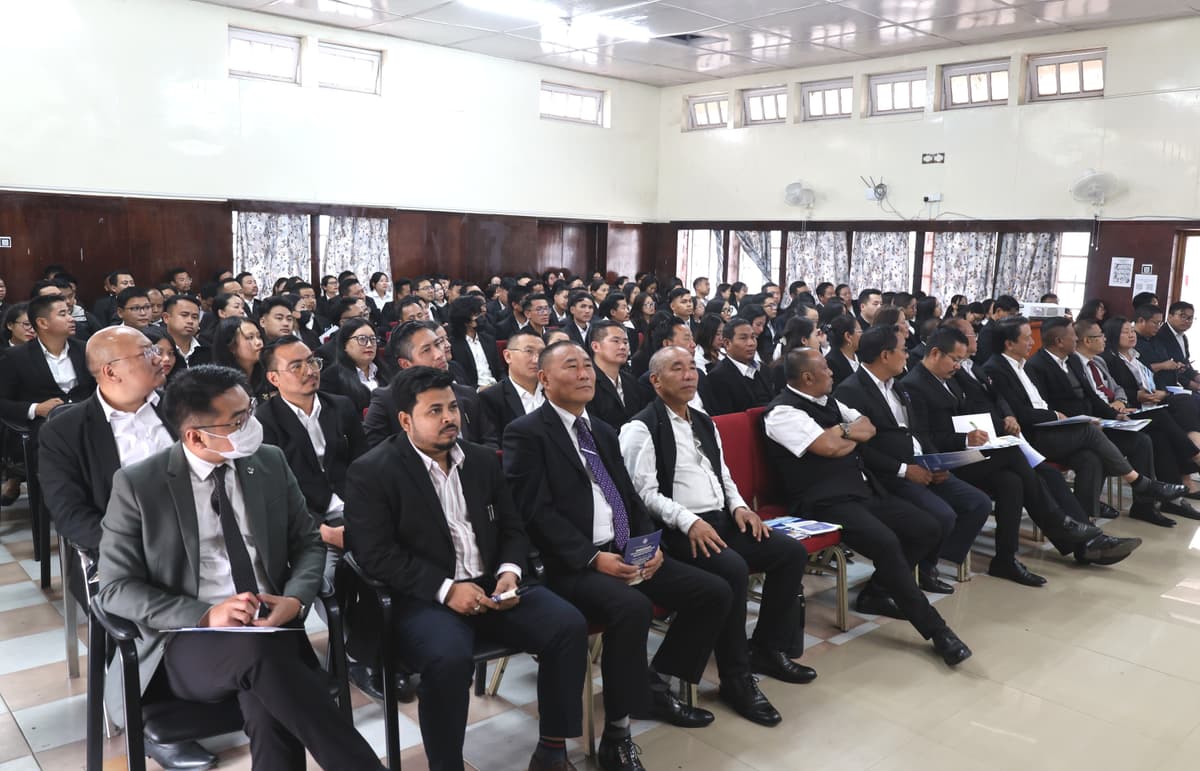
DIMAPUR — A one-day lecture on the art of examination and cross-examination in civil and criminal matters was organised by the Nagaland State Legal Services Authority (NSLSA) in collaboration with the High Court Bar Association, Kohima, and the Kohima Bar Association at the Bar room, Gauhati High Court, Kohima Bench, on Wednesday.
According to an update, Justice Kalyan Rai Surana, Judge of Gauhati High Court and Executive Chairman of NSLSA, delivered a presentation and observed that examination and cross-examination in both criminal and civil matters are some of the most difficult and complex skills for an advocate.
He added that the talent to cross-examine is a rare commodity which can only be mastered through years of practice and thorough reading, among others.
Apart from keeping a fair idea of the provisions of law, especially Chapter X of the Evidence Act or Chapter X of the Bharatiya Sakshya Adhiniyam 2023, Justice Surana stated it is important to be attentive in court proceedings.
The judge spoke on the aims and objectives of cross-examination, noting that these processes and procedures in legal matters are undertaken to dispute the validity and accuracy of the testimony, challenge the credibility of the witness, and use witnesses to strengthen claims made by one of the witnesses.
It also helps to impeach the credibility of the other side's witnesses, introduce one's narrative to the court, change the opinion to reduce its effect, or establish the credibility of an expert.
Also read: Kohima reviews monsoon readiness; vulnerable road stretches flagged
The speaker added that while the scope of cross-examination is very wide, it should be limited only to the core controversy involved in a case, and some questions in relation to the credibility of the witness are also permissible.
Justice Surana highlighted that cross-examination may either be constructive or destructive, and sometimes there are scenarios wherein one may have to adopt both approaches, but called for extreme care in such a situation.
Giving tips for cross-examinations, he pointed out that extracting the truth from an unwilling witness is a great art and that itself requires introspection. He advised that cross-examination should not be conducted with fixed expectations, as it cannot be ascertained what path it will follow.
"Similarly, it would not be a good idea to anticipate the persuasiveness of the cross-examination on the judges or tribunals. However, if the cross is prepared thoroughly and if there is a clear purpose behind every question, then the results may be fruitful," Justice Surana said.
The judge stated that each case is unique and cannot follow a fixed straight-jacket formula, and what works will depend on various factors and approaches. He advised lawyers to invest double the time one thinks will be needed for the preparation of cross-examination.
"One must always bear in mind that irrespective of what approach is to be adopted, simplicity, politeness, clarity and confidence will enhance the impact of cross-examination. At times, the effectiveness of good cross-examination may get reduced if the judge or tribunal gets an impression that the witness is being bullied or receiving impolite treatment," he further added.
Justice Surana also gave tips to exercise and keep in mind during cross-examination.
A question-and-answer session was held in the presence of Justice Sanjeev Kumar Sharma, Judge of Gauhati High Court.
CT Jamir, Senior Advocate and President of the High Court Bar Association, delivered the introductory note, and Neiko Akami, Member Secretary of NSLSA, gave the welcome address. Nagali Shohe, Assistant Secretary of the Kohima Bar Association, chaired the sessions, and A Zho, Senior Advocate, pronounced the invocation.